
That glossy moisturiser bottle sitting on your shelf might look innocent—cute curves, luxe finish, the whole nine yards. But behind the scenes? It could be slow‑cooking your cream. I’ve seen brands pour heart and budget into a dreamy formula, only to watch it turn yellow, smell “off,” or separate like a bad breakup. Turns out, the villain wasn’t the lab. It was the bottle.
A pump that lets air sneak back in is like leaving milk out on the counter—tick‑tock, bacteria clock. Clear plastic under store lights? That’s sunscreen for your profits, because oxidation doesn’t play nice. According to Grand View Research’s 2024 packaging report, product stability is now a top purchasing driver for U.S. beauty brands. As one Topfeel packaging engineer put it in 2025, “If the barrier fails, the formula fails.” Short and sharp.
Here’s the kicker: customers don’t blame packaging. They blame you. And that tiny detail could be quietly draining trust, reviews, and repeat sales.
Why Your Moisturiser Bottle Might Be Contaminating Creams?
Your moisturiser bottle looks clean on the shelf, right? Still, the bottle for moisturiser can quietly mess with your cream. From hidden chemical migration to sneaky air leaks, even a fancy lotion bottle or cream container can affect texture and scent. Let’s break down how your moisturiser bottle may be changing what’s inside.
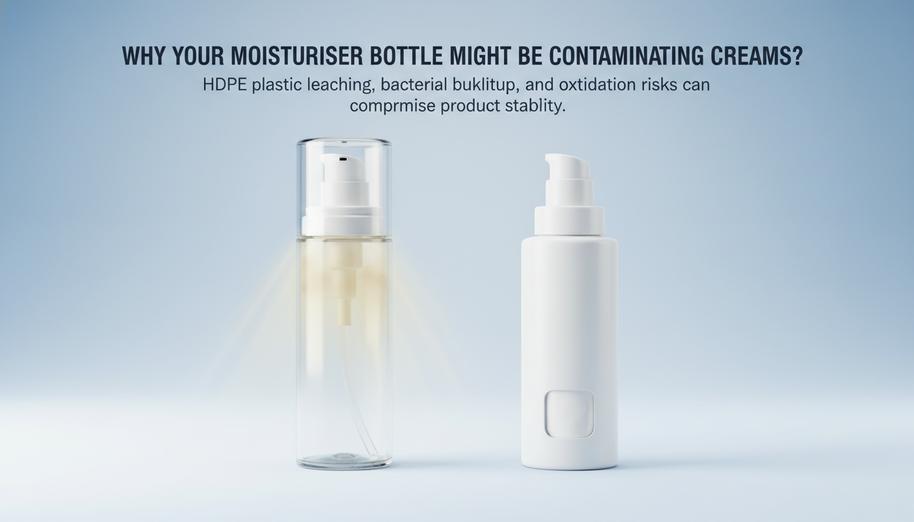
How HDPE plastic leaches trace additives into your formula
When a moisturiser bottle is made from HDPE plastic, the risk isn’t dramatic, but it’s real.
- Material Interaction
- HDPE plastic contains minor trace additives like stabilizers and slip agents.
- In oil-rich creams, leaching may occur over time.
- Heat speeds up chemical migration into the formula.
- Trigger Conditions
- High storage temperature (above 40°C)
- Long shelf time in 200ml–500ml packs
- Direct sunlight on the lotion bottle
- Observable Impact
- Slight fragrance shift
- Texture thinning
- Reduced stability of actives
Here’s a simplified lab-style comparison:
| Storage Temp (°C) | Duration (Months) | Detected Plasticizers (ppm) | Fragrance Stability (%) |
|---|---|---|---|
| 25 | 3 | 0.2 | 98 |
| 40 | 3 | 0.8 | 94 |
| 45 | 6 | 1.5 | 88 |
| 50 | 6 | 2.1 | 81 |
Manufacturers like Topfeel address this by controlling resin grades and minimizing residual stabilizers, helping the moisturiser bottle stay neutral toward the cream formula. For brands prioritizing safety, choosing the right plastic spray bottles or lotion containers requires strict material vetting.
Bacterial buildup in pump dispensers vs airless pumps
A moisturiser bottle with a classic pump feels handy. Press, apply, done. But here’s the catch.
- Traditional pump dispensers
- Allow slight air backflow
- Increase contamination risk
- Encourage hidden microbial growth
- Air enters after each press.
- Moisture lingers in the dip tube.
- Bacterial buildup forms over weeks.
An airless pump changes the game:
- No backflow
- Reduced oxygen contact
- Better overall hygiene
For sensitive creams with low preservatives, that difference matters. A well-designed moisturiser bottle using airless tech keeps the cream container cleaner, longer. Topfeel integrates sealed systems that cut down internal exposure, helping brands protect product stability without overloading preservatives. Many professional lines are transitioning to pump bottles specifically to solve this hygiene issue.
Oxidation risks through transparent bottle walls
Light looks harmless. It’s not.
- Exposure Factors
- Clear PET or glass transparent bottle walls
- Strong indoor retail lighting
- Daily bathroom UV spillover
- Chemical Response
- Increased light exposure
- Accelerated oxidation risks
- Faster ingredient degradation
- Long-Term Effects
- Color darkening
- Active loss
- Weakened product stability
★ Opaque or frosted finishes block part of UV radiation.
★ Reduced air exposure slows oxidative change.
“Packaging that limits light and oxygen ingress can extend cosmetic shelf life by up to 30%,” notes Smithers in its 2025 global packaging sustainability outlook.
A smart moisturiser bottle isn’t just about style. It’s about protection. Choosing the right bottle for moisturiser formulas keeps your cream performing the way it should—fresh, stable, and safe from the quiet risks hiding in plain sight. This is why airless pump cosmetic bottles have become the gold standard for high-end formulations.
4 Signs Your Current Bottle Harms Formulation
A good moisturiser bottle should protect your cream, not mess it up. Yet small packaging flaws can quietly damage your formula. From color shifts to weird smells, your moisturiser bottle, lotion bottle, or cream container might be the real troublemaker. Let’s break down what’s going wrong and how to fix it smartly.
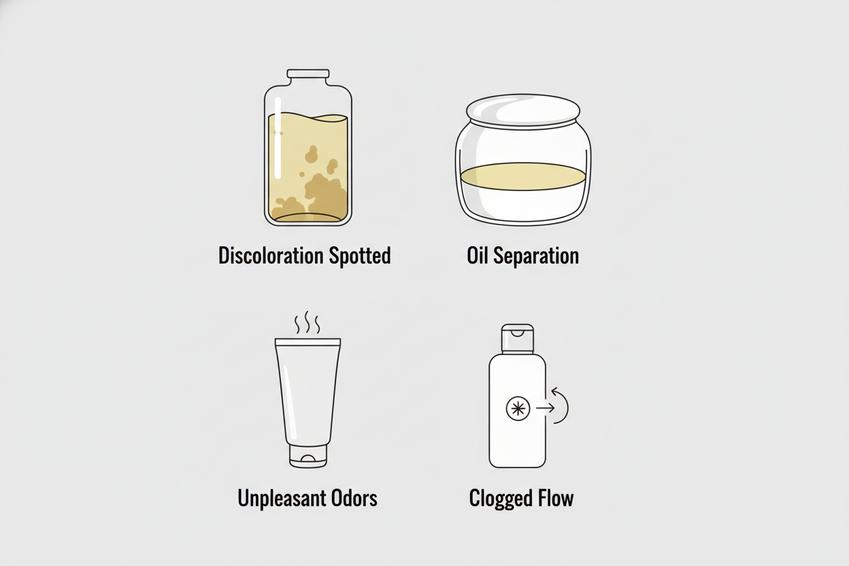
Discoloration spotted in a 200ml transparent bottle
When discoloration shows up inside a transparent bottle, it’s rarely random. In a 200ml clear moisturiser bottle, the problem often builds in layers:
- Light Exposure
- UV passes through the clear wall.
- Sensitive actives in the moisturiser formulation react.
- Oxidation speeds up, leading to visible degradation.
- Material Interaction
- Additives migrate from plastic into bulk.
- The formulation shifts in pH or tone.
- Yellowing becomes obvious against a clear background.
- Storage Habits
- Shelf lighting in retail.
- Warm bathrooms at home.
- Long display cycles.
Mintel’s 2025 Global Beauty Packaging Review notes that consumers increasingly link visible color change in a moisturiser bottle to reduced product safety, even when efficacy remains stable.
If your moisturiser bottle sits under strong light daily, switching to UV-blocking material or tinted packaging—like options developed by Topfeel—can slow oxidation and protect the cream bottle’s contents. If the pump itself seems stuck, learning how to open pump bottles can help, but discoloration usually means the barrier has already failed.
Oil separation inside a glossy-finish jar
Oil separation inside a glossy finish jar usually points to emulsion stress. The issue often unfolds like this:
- Barrier Limits
- Standard PP jars allow slight air exchange.
- Oxygen exposure impacts stability.
- Active ingredients begin to drift apart.
- User Behavior
- Frequent opening.
- Finger dipping.
- Repeated contamination.
- Environmental Factors
- Temperature swings.
- Transit vibration.
- Long warehouse cycles.
Within weeks, oil pooling appears on top. In a moisturiser bottle with an airless pump, that same formula may stay visually uniform much longer. Jar packaging looks luxe, sure. But if your cream container can’t protect the emulsion, the texture tells on you fast. To solve this, many luxury brands use a round airless pump bottle to maintain the look without the risks.
Unpleasant odors from screw cap tubes
A sharp smell from your tube isn’t just annoying. It signals internal stress.
Here’s what often happens inside a screw cap design:
- Residual cream builds up around threads.
- Micro air pockets form.
- Bacterial growth increases if preservatives are weak.
Then comes spoilage. The odor creeps in slowly, especially in aluminum or plastic lotion tube formats stored in warm spaces.
Check three things:
- Seal integrity
- Thread cleanliness
- Preservative compatibility with packaging material
A well-designed moisturiser bottle or upgraded tube cap reduces trapped residue. Even small tweaks in cap geometry can cut down air exposure and stop unpleasant odors before customers notice. For complex formulas, a dual chamber bottle can keep ingredients separated until the very last second.
Clogged flow in disc top cap squeeze bottles
Thick cream. Narrow orifice. Trouble.
A disc top cap on a squeeze bottle sounds convenient, but high viscosity and dense product texture can block the opening. The formula dries at the tip. Next use, the clogged flow forces users to squeeze harder.
Too much pressure.
Too much product.
Messy dispensing.
Over time, that stress can even crack the moisturiser bottle wall. Switching to a wider valve or controlled pump keeps texture smooth and dosing steady. Brands working with Topfeel often test flow rate against cream thickness early on, so the moisturiser bottle matches real-life usage instead of looking good only on paper. This precision is essential when sourcing cosmetic packaging in China.
Materials Matter: Glass vs. Plasti Bottles
Choosing the right moisturiser bottle is not just about looks. The material shapes product safety, shelf life, and how customers feel when holding that bottle of moisturiser. From lab stability to daily bathroom drops, every moisturiser bottle decision counts.
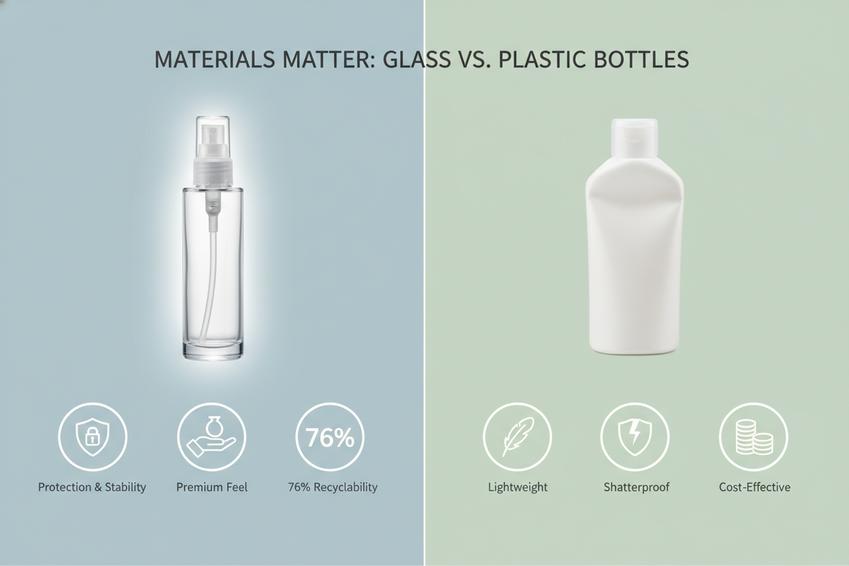
Glass container
When a moisturiser bottle is made of glass, performance often centers on three core strengths:
- Protection & Stability1.1 Inertness keeps formulas stable, especially vitamin C or retinol blends.
1.2 Strong chemical resistance reduces interaction between cream and container.
1.3 An airtight seal limits oxidation inside the moisturiser bottle.
- Product Experience2.1 Noticeable durability under normal storage.
2.2 Better light protection with tinted glass.
2.3 A clear premium feel that upgrades any bottle for moisturiser line.
- Sustainability Profile3.1 High recyclability in many regions.
3.2 Lower risk of long-term contamination.
| Property | Glass Value Range | Impact on Moisturiser |
|---|---|---|
| Oxygen Transmission | ~0 cc/m²/day | Extends shelf life |
| Chemical Interaction | Extremely Low | Preserves actives |
| Weight (50ml pack) | 120–180g | Higher transport load |
| Recycling Rate (EU) | ~76% (2024 est.) | Strong recovery loop |
Brands like Topfeel often recommend glass when formula integrity matters most in a moisturiser bottle. Understanding the advantages of glass is key for brands positioning themselves as premium.
Plastic bottle
A plastic moisturiser bottle plays a different game. It’s practical, easy to carry, and less stressful if dropped.
• Lightweight build cuts shipping costs.
• Shatterproof design suits travel-size lotion bottle formats.
• Strong cost-effectiveness for mass retail.
In daily use, flexibility matters. A squeezable bottle for moisturiser makes dispensing simple. PET and HDPE offer good flexibility, though some grades show slight UV permeability, which may affect sensitive creams. There’s also ongoing discussion around potential for leaching, so resin choice and testing are key.
Here’s how smart brands handle it:
- Select food-grade resin.
- Add UV blockers if needed.
- Increase recycled content without losing barrier strength.
Topfeel balances these factors so each moisturiser bottle matches formula needs, price goals, and real-life use. For many brands, the right plastic bottle keeps the moisturiser fresh while staying friendly to budgets and everyday routines. Using PET and PETG correctly can ensure both clarity and chemical resistance.
Too Much Waste? Refillable Moisturiser Bottle Solutions
The beauty aisle is packed, yet the trash bin fills even faster. A single moisturiser bottle, finished in weeks, can stick around for years. Smarter packaging—refill systems, cleaner materials, recycled tubes—helps brands cut waste without cutting style or performance.
Airless pump paired with a refillable design
A smart moisturiser bottle does more than look cute on a shelf. It protects the formula and trims waste at the same time.
- Airless pump keeps out oxygen.
- Refillable design swaps inner cartridges, not the whole bottle.
- Less contact means better product preservation and reduced air exposure.
Here’s how it works in real life:
- Outer shell stays on your vanity.
- Inner pod clicks out once empty.
- New refill slides in. Done.
Under the hood:
- Protection system
- Sealed chamber → supports hygienic application
- Vacuum push plate → consistent dosing
- Sustainability angle
- Reuse outer moisturiser bottle
- Lower material use per refill cycle
Topfeel applies this concept to lotion bottle and cream bottle formats, turning one durable moisturiser bottle into a long-term piece of sustainable packaging. A high-quality refillable airless pump bottle offers the ultimate balance of luxury and responsibility.
Mono-material packaging for seamless recycling
Recycling gets messy when materials mix. A mono-material moisturiser bottle keeps things simple.
- Design logic
- Bottle body: single PP
- Cap: matching PP
- Label: compatible film
- Impact on recycling process
- Easier material separation
- Fewer sorting errors
- Higher acceptance in municipal streams
Within a circular economy, this means:
- Cleaner input waste.
- Faster reprocessing.
- Real waste reduction and easy disposal for consumers.
“Designing packaging for recyclability at the material level is now a baseline expectation, not a bonus,” notes McKinsey’s 2024 sustainable packaging outlook.
Topfeel develops each moisturiser bottle with recycling codes and resin consistency aligned, helping brands move closer to closed-loop goals. Choosing refillable airless pump bottles made of mono-material is a major step forward.
Post-consumer recycled content tubes for less waste
Squeeze formats still matter. A tube-style moisturiser bottle made with recycled content tackles waste upstream.
- Source stream
- Collected post-consumer waste
- Cleaned and reprocessed resin
- Production stage
- Blended PCR with virgin resin
- Performance testing for pressure and seal strength
- Environmental gains
- Lower virgin plastic demand
- Better resource conservation
- Reduced environmental impact and reduced landfill
For travel-size lotion bottle or daily-use cream bottle lines, PCR tube packaging keeps the familiar feel while shrinking the footprint. Topfeel integrates verified recycled materials into each moisturiser bottle format, proving that smart design can look good—and do good—at the same time. Many are now using PCR-PP to meet their ESG goals.
FAQs about Moisturiser Bottle
Why is an airless moisturiser bottle preferred for active-rich creams?
An airless pump in a cylindrical bottle protects delicate formulas in ways a standard pump dispenser cannot.
- No air backflow → less oxidation inside a 50ml bottle or 100ml bottle.
- Reduced finger contact → lower contamination risk than a jar.
- Stable texture → peptides and botanical extracts stay effective longer.
Common pairings:
- PP plastic or Glass container for compatibility
- Opaque or frosted finish to reduce light exposure
- Silk screen printing or hot stamping for a premium look
For sensitive skin users, freshness is reassurance.
How does HDPE plastic impact cream stability and scent?
HDPE plastic works well for squeeze bottle or tube formats, yet storage conditions matter.
Under high heat:
- Oil-rich creams may absorb slight odors from the container.
- Fragrance notes can soften over long shelf periods.
- Texture may feel marginally thinner in a 200ml bottle or larger.
Best practice includes:
- Opaque HDPE plastic to reduce UV exposure
- Tight-sealing flip-top cap or screw cap
- Lightweight design for easier transport without stress cracks
Customers notice scent shifts quickly—consistency builds trust.
Which closure suits thick moisturiser in tubes or jars?
Closure choice shapes daily user experience more than expected.
- Disc top cap (Tube, PP plastic): quick access, but prone to clogging.
- Screw cap (Jar or Aluminum tube): stronger seal, needs cleaning around threads.
- Flip-top cap (Squeeze bottle): balanced hygiene and speed.
- Airless pump (Square bottle or Oval bottle): ideal for dense creams needing measured doses.
For 100ml bottle to 250ml bottle formats, controlled dispensing prevents waste and keeps edges clean—small details customers appreciate every morning.
How can a moisturiser bottle stay sustainable without losing luxury appeal?
A refined look and eco-responsibility can share the same shelf.
Short description: Durable outer packaging with smarter material choices reduces waste while preserving elegance.
| Element | Sustainable Option | Visual Impact |
|---|---|---|
| Material | Recycled content plastic, Bioplastic, Glass container | Matte finish or frosted finish |
| Structure | Refillable design, Mono-material packaging | Clean silhouette in cylindrical bottle or square bottle |
| Production | Reduced plastic usage, Recyclable packaging | Compatible with labeling, shrink sleeve, or offset printing |
A 50ml bottle or 200ml bottle built this way feels thoughtful in hand—lighter, responsible, yet still gift-worthy.
References
- Cosmetic Packaging Market Size & Share Analysis – 2024 Report – Grand View Research
- Global Packaging Sustainability Outlook 2025 – Smithers
- The Future of Beauty Packaging: Trends and Innovations – Mintel
- Chemical Leaching in Plastic Personal Care Containers – Chemosphere / ScienceDirect
- Microbial Contamination in Open Jar vs. Pump Dispensers – DermNet
- UV Degradation of Skincare Actives in Transparent Packaging – Cosmetics & Toiletries
- Designing for Circularity: Recyclability in Beauty – Ellen MacArthur Foundation
- Refillable Packaging Models for Beauty Brands – McKinsey & Company
- HDPE vs PETG: Material Compatibility in Cosmetics – British Plastics Federation
- BPA and Phthalate Safety in Cosmetic Plastics – FDA
- Impact of Light Exposure on Vitamin C Stability – MDPI Cosmetics Journal
- Polypropylene Mono-material Recycling Challenges – Association of Plastic Recyclers
- Ergonomic Dispensing Systems for Viscous Liquids – Packaging Digest
Post time: Mar-18-2026
