
When an airless pump jar not working halts production, it’s chaos—fix the flaws, save your line, and keep cosmetic packaging profits flowing.
When an airless pump jar not working stalls your production line, it’s not just a tiny hiccup—it’s a full‑blown traffic jam at rush hour. Filling crews stand around, cartons stack up, and someone’s tapping a clipboard like it owes them money. In bulk manufacturing, a stubborn pump isn’t a quirk; it’s cash slipping through the cracks.
Grand View Research reports the global airless packaging market is projected to surpass $8 billion by 2030—growth driven by demand for precision dispensing and product protection. As packaging engineer Paul Schwartz puts it, “Consistency in component tolerance makes or breaks airless systems.”
Here’s the twist: most failures trace back to small mechanical missteps—improper priming, seal gaps, material mismatch. Fix the root, and the line hums again.
Quick Insights on Airless Pump Jar Not Working
- Inspect the piston mechanism to resolve priming issues and ensure consistent dispensing.
- Check the dispenser pathway for clogging caused by dried product residues.
- Examine closure seals for air ingress that disrupts vacuum and causes leakage.
- Verify material compatibility (PP vs. PE) to prevent swelling, leakage, or dispensing instability.
- Conduct controlled priming and functional testing to maintain smooth production line operation.
- Apply food-grade lubricant carefully to reduce friction without contaminating the product.
- Leverage automated inspection and GMP protocols to detect defects early and minimize downtime.
Why Is My Airless Pump Jar Not Working?
When your airless pump jar not working moment hits, it’s frustrating. You press the pump, nothing comes out, and your skincare routine stalls. If your airless pump, pump jar, or dispenser feels stuck, don’t toss it yet. Most airless pump issues tie back to vacuum balance, sealing, or material mismatch—and they’re usually fixable.
Checking the Piston Mechanism for Priming Issues
If an airless pump jar not working keeps clicking without output, check the piston system inside the airless pump.
- Piston movement
- Remove the outer shell.
- Inspect the mechanism at the base.
- Confirm the piston sits flat against the formula.
- Priming behavior
- Press the dispenser 5–10 times.
- Watch for upward piston travel.
- Listen for air gaps that break vacuum and suction.
- Common signs
- No rising base → lost vacuum
- Sudden splatter → trapped air
- Soft press → weak suction
If your airless pump jar not working after shipping, it may simply need re-priming. Brands like Topfeelpack design tight piston tolerances to reduce this headache.
Identifying Clogging in the Dispenser Pathway
Another reason your airless pump jar not working could be clogging in the dispenser pathway.
- External check
- Wipe the nozzle.
- Clear visible residue.
- Internal check
- Detach actuator.
- Rinse warm water through the pathway.
- Remove hardened obstruction.
- Product texture review
- Thick cream?
- High-viscosity gel?
If the airless pump is clogged, output drops or stops. Topfeelpack tests high-viscosity formulas to prevent pump failure and blocked pathways.
Inspecting Air Ingress Around the Closure Seal
When the airless pump jar not working feels inconsistent, suspect air ingress.
- Seal inspection
- Examine the closure seal, lid, and cap.
- Look for cracks.
- Vacuum integrity
- Press and release slowly.
- Notice if product retracts—bad vacuum seal.
- Leakage clues
- Oil around threads
- Uneven dispensing
- Formula separation
A tiny leak kills pressure. Once air enters the system, the vacuum drops and leakage follows.
Evaluating Material Compatibility of Inner Bottle (PP vs. PE)
Material mismatch can make an airless pump system unstable.
- Material compatibility
- Risk factors
- Harsh acids → chemical reaction
- Essential oils → degradation
- Long storage → warped inner bottle
- Result
- Swelling
- Leakage
- Airless pump failure
If your airless pump jar not working after formula changes, check the plastic type. Topfeelpack often recommends PP for active serums to reduce degradation and keep dispensing smooth.
5 Steps To Prime Your Jar
If your airless pump jar not working is driving you crazy, you’re not alone. A stuck pump, weak flow, or lotion that just won’t rise usually comes down to priming mistakes. Let’s fix that airless pump jar not working issue the right way.
Step 1: Remove Outer Shell and Inspect Actuator Alignment
When an airless pump jar not working shows up, start with a quick teardown and check the basics.
- Core components to review:
- Outer shell
- Actuator
- Pump mechanism
- Detach the outer shell gently.
- Check alignment of the actuator with the internal channel.
- Perform a light component inspection for cracks or tilt.
If the pump mechanism sits crooked, product won’t rise evenly. A misaligned head often causes the airless pump not dispensing problem people complain about.
Step 2: Fill Inner Bottle with Serum or Lotion Base
Inside, the inner bottle must be filled with care.
- Product options:
- Serum base
- Lotion base
Key checks:
- Container factors
- Container capacity
- Headspace for piston lift
- Process control
- Clean product filling tools
- No overflow around rim
Overfilling blocks piston travel. Underfilling causes vacuum loss. Both can lead to an airless pump not working smoothly.
| Fill Level (%) | Piston Movement (mm) | Dispensing Stability |
|---|---|---|
| 70% | 8–10 | Stable |
| 85% | 5–7 | Optimal |
| 95% | 1–3 | Risk of blockage |
Step 3: Engage Piston Mechanism via Controlled Presses
Now activate the piston mechanism.
- Activation flow:
- Apply light pressure application
- Use steady controlled presses
- Observe dispensing action
If nothing comes out:
- Re-check:
- Pump activation speed
- Air gaps in chamber
A few slow presses usually fix an airless jar not pumping. Rushing it? That’s how people end up saying their airless pump jar not working again.
Step 4: Release Trapped Air through the Dispenser Valve
Air pockets break the vacuum seal.
- Focus areas:
- Dispenser valve
- Internal chamber
- Air release path
Press repeatedly until trapped air escapes. During this priming process, you may hear faint pops. That’s normal. Once airflow clears, product flow stabilizes and the airless pump not dispensing issue fades out.
Step 5: Verify Consistent Dispensing with Functional Testing
Final check time.
- Performance review:
- Consistent dispensing
- Smooth product output
- Reliable pump performance
Test it like this:
- Press five times in a row.
- Pause 10 seconds.
- Press again and compare volume.
This simple functional testing confirms proper usage verification. If flow is even, your airless pump jar not working problem is officially solved.
For brands that want fewer customer complaints and zero “airless pump jar not working” returns, packaging quality matters. Topfeelpack designs airless systems with stable piston lift and tight valve control. Many cosmetic brands choose Topfeelpack to reduce airless pump not working feedback and keep users happy.
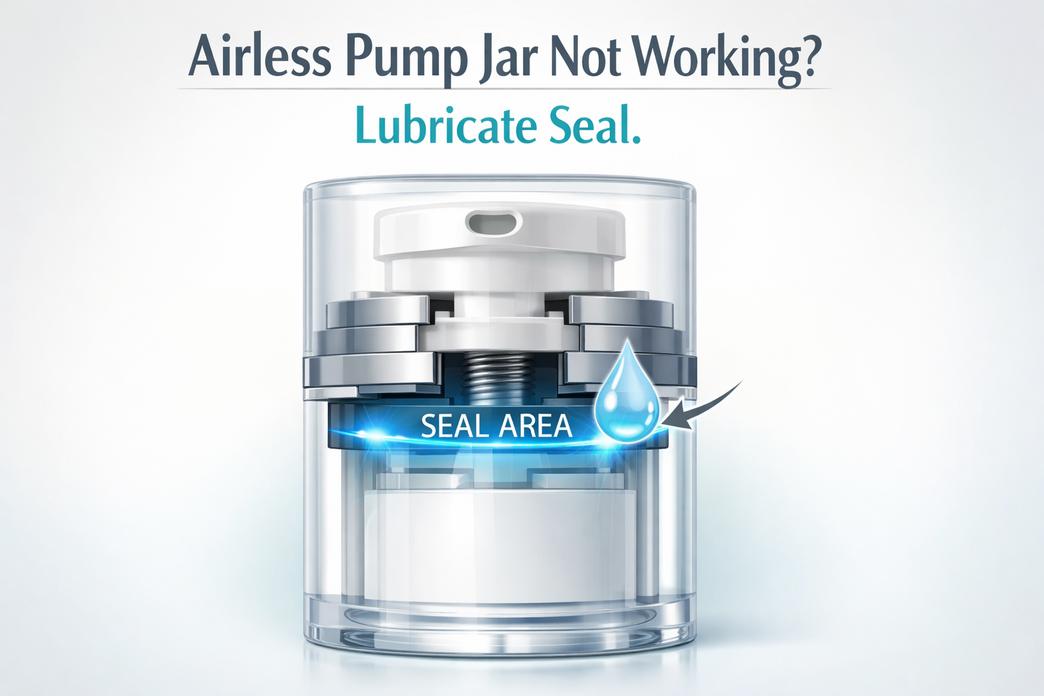
Airless Pump Jar Not Working? Lubricate Seal
If your airless pump jar not working issue keeps popping up, don’t toss it yet. Most airless pump, jar not working, or pump not dispensing problems trace back to seal friction and lubrication gaps.
Choosing the Right Food-Grade Lubricant for ABS Components
When an airless pump jar not working situation appears, material compatibility is the quiet troublemaker. Focus on food-grade lubricant selection for ABS components and PP closures.
- Core Requirements
- Lubricant compatibility with ABS and PP
- No stress cracking
- No swelling above 1%
- Certified plastic safety standard (FDA or EU compliant)
- Stable viscosity range (medium grade prevents migration)
- Strong temperature resistance (−10°C to 50°C typical storage)
- Lubricant compatibility with ABS and PP
- Performance Checks
- Apply micro-layer to test ring.
- Run 50 pump cycles.
- Observe drag, rebound speed, and suction.
If the airless pump jar not working problem fades after cycling, friction was the culprit. Topfeelpack engineers often recommend silicone-based, food-safe grease for smooth piston travel without degrading ABS housing.
A jammed airless pump? Most times it’s not the spring. It’s seal drag.
Applying Grease Around the Closure Without Causing Product Contamination
When the airless pump jar not working complaint is tied to stiffness, smart grease application matters.
- Clean hands.
- Use sterile swab.
- Apply minimal lubricant amount.
Focus only on the closure seal, not the cream chamber. Keep distance from bulk formula to prevent product contamination. A thin, even ring ensures proper even distribution.
Quick flow:
- Disassemble actuator.
- Inspect gasket.
- Apply micro-film.
- Reassemble tightly.
- Prime pump 10–15 presses.
Good hygienic practices protect both formula and brand reputation. If the airless pump jar not working persists after clean lubrication, air ingress may already exist.
Topfeelpack packaging systems are designed to reduce seal friction at factory level, but field lubrication can rescue stuck inventory fast.
Quality Assurance: Testing Leakage and Pump Failure After Lubrication
After fixing an airless pump jar not working case, testing seals the deal. Focus on leakage testing, seal integrity, and full functional check.
A. Visual & Manual Checks
- 30-cycle discharge test
- Check piston lift consistency
- Monitor suction rebound
B. Lab-Based Post-Lubrication Test
| Test Item | Cycle Count | Pressure (kPa) | Acceptable Leakage (ml) | Result Standard |
|---|---|---|---|---|
| Initial Prime | 10 | 15 | 0 | No seepage |
| Continuous Pump | 50 | 20 | ≤0.05 | Stable output |
| Drop Test | 3 drops (1m) | — | 0 | No crack |
| Vacuum Hold | 5 min | -30 | 0 | No air ingress |
| Long Cycle | 200 | 25 | ≤0.1 | No pump failure |
C. Performance Verification
- Record output consistency.
- Inspect gasket swelling.
- Confirm no backflow.
If the airless pump jar not working issue disappears across all tests, lubrication succeeded. If not, deeper valve damage may exist.
Reliable brands like Topfeelpack run similar validation before shipment, reducing field returns and awkward customer complaints.
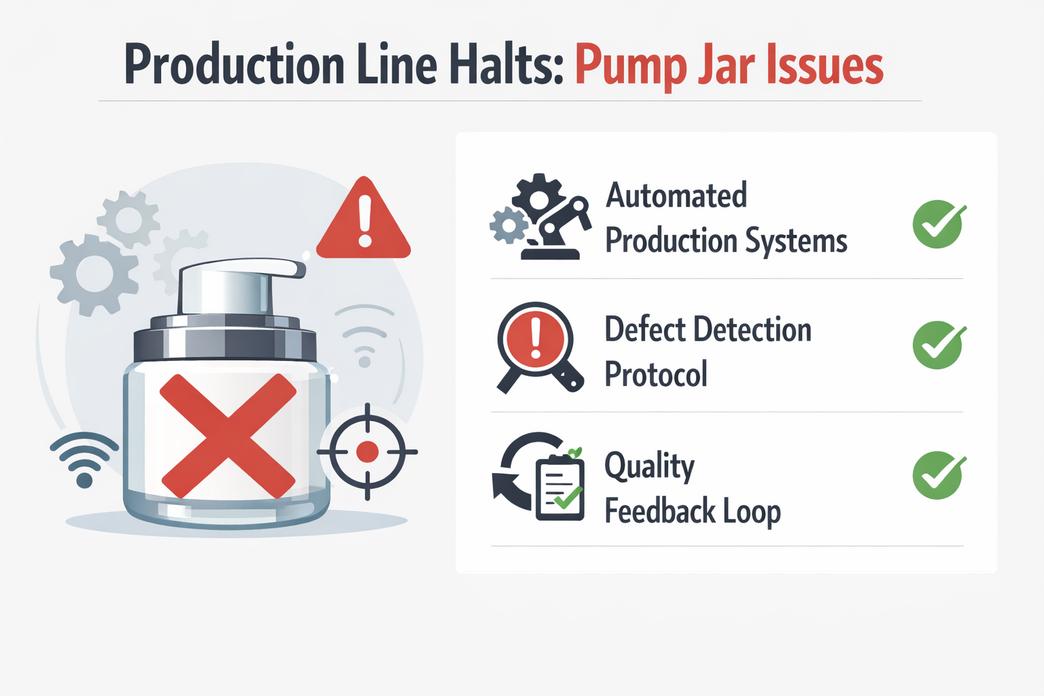
Production Line Halts: Pump Jar Issues
Production downtime often starts with a small headache—an airless pump jar not working right in the middle of filling. When a pump jar not dispensing slows output, stress builds fast. From airless pump failure to jar pump not working complaints, smart production control keeps cosmetic brands calm and customers happy.
Detecting Defects Early through Automated Production Inspection
When an airless pump jar not working shows up on the line, early detection makes all the difference.
- Automated Production Systems
- Sensor-based alignment checks
- Detect actuator tilt
- Monitor closure fit precision
- Pressure testing modules
- Identify clogging risk inside the airless pump system
- Sensor-based alignment checks
- Defect Detection Protocol
- Scan filled units for uneven discharge
- Flag pump jar not dispensing normally
- Remove units showing early airless pump failure
- Quality Feedback Loop
- Real-time data alerts
- Immediate mechanical adjustment
- Reduced batch rejection rate
With Topfeelpack, integrated inspection reduces repeat cases of airless pump jar not working before cartons even seal.
Resolving Injection Molding Flaws in Virgin Plastic Shells
A hidden cause of airless pump jar not working often begins at the molding stage.
- Virgin Plastic Control
- Resin temperature stability
- Mold cavity precision
- Cooling cycle timing
- Dimensional Stability Checks
- Measure wall thickness
- Verify shell alignment with pump core
- Confirm airtight sealing
- Impact on Performance
- Poor tolerance → jar pump not working
- Warped housing → pump jar not dispensing
- Micro gaps → airless pump failure
Tight molding standards keep the airless pump system smooth and consistent.
Partnering with Suppliers for Fast Sample Availability
Speed matters when an airless pump jar not working interrupts launch schedules.
- Quick sample turnaround
- Short lead production windows
- Stable supply chain coordination
- Prototype validation
- Filling compatibility testing
- Mass production approval
Strong collaboration cuts repeated airless pump failure cases. Topfeelpack supports rapid sampling, helping brands fix pump jar not dispensing concerns before scaling up.
Implementing GMP Protocols to Reduce Defect Rate
Production discipline keeps small issues from snowballing.
- GMP Standards
- Clean assembly zones
- Controlled quality assurance checks
- Torque testing
- Pump stroke consistency
- ISO-Certified Workflow
- Incoming material audit
- In-line functional testing
- Final random inspection
- Operator Training
- Spot early airless pump system blockage
- Respond fast to airless pump jar not working reports
Following strict Good Manufacturing Practices lowers failure rates and keeps every airless pump jar not working complaint from turning into a full production halt.
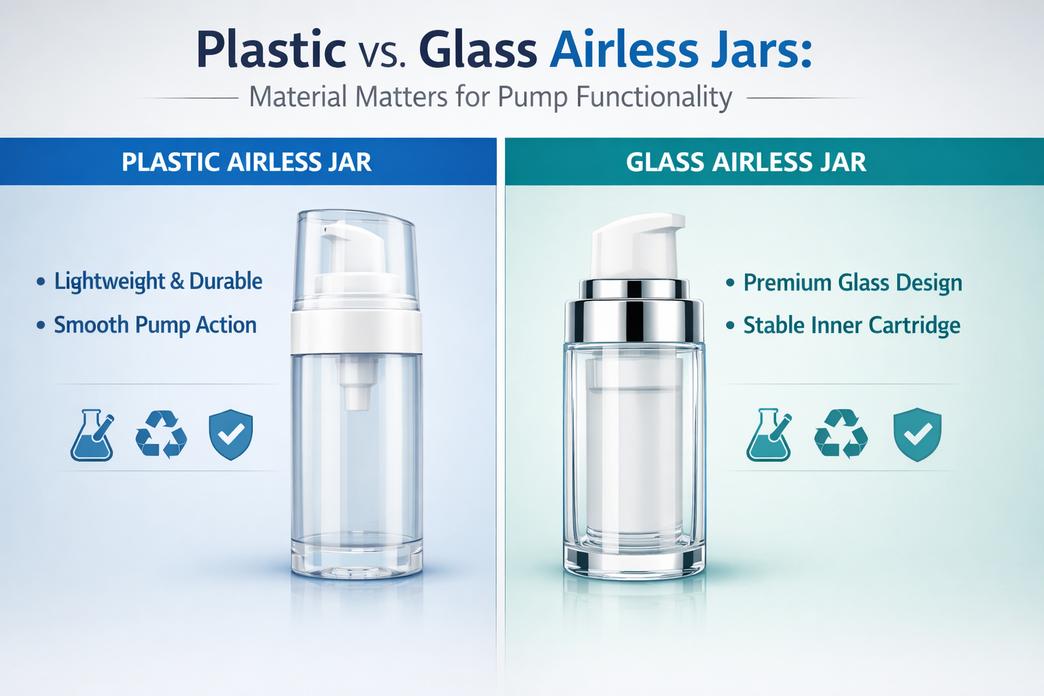
Plastic Vs. Glass Airless Jars
Airless packaging sounds simple, yet when an airless pump jar not working issue pops up, material choice suddenly matters. The material, build, and design behind plastic and glass jars can decide if your pump works smoothly—or drives you crazy.
Plastic
When discussing plastic airless jars made from PP or ABS, the focus often lands on material, durability, and cost-effectiveness. A poorly selected resin can easily lead to an airless pump jar not working complaint.
- Material Composition and Performance1.1 PP (Polypropylene)
Impact on Pump Functionality
- Low weight, good chemical resistance, stable for most creams.
- Reduces shipping load and breakage risk.
1.2 ABS (Acrylonitrile Butadiene Styrene)
- Higher durability, better surface finish.
- Supports custom colors without losing structural strength.
1.3 PCR (Post-Consumer Recycled)
- Maintains acceptable transparency levels depending on blend ratio.
- Supports sustainability goals while keeping pump systems stable.
- 2.1 Lightweight walls maintain internal vacuum stability.
2.2 Precision molding reduces piston misalignment, preventing an airless pump jar not working scenario.
2.3 Good chemical resistance avoids swelling that may cause the airless pump not working over time.
- Performance Data Comparison
| Material | Density (g/cm³) | Impact Strength (kJ/m²) | Typical Cost Index |
|---|---|---|---|
| PP | 0.90–0.91 | 3–5 | 1.0 |
| ABS | 1.03–1.07 | 15–30 | 1.3 |
| PP-PCR | 0.92–0.95 | 2–4 | 0.9 |
| SAN | 1.08 | 6–8 | 1.2 |
Brands like Topfeelpack fine-tune resin ratios and tooling accuracy to reduce failure rates. That means fewer “my airless pump jar not working again” emails and more stable filling performance on automated lines.
Glass
Glass airless jars lean heavily on material purity, barrier properties, and that unmistakable premium feel. Yet fragility can trigger an airless jar pump failure if the inner mechanism shifts after impact.
• Strong inertness protects sensitive serums.
• Excellent recyclability supports eco branding.
• High-end weight enhances shelf presence.
Still, fragility is real. Drop it once, and you might face an airless pump jar not working moment because the inner cartridge moved.
To reduce risk:
- Use a reinforced outer shell.
- Add shock-absorbing base inserts.
- Test vacuum sealing after transport simulation.
Glass offers superior barrier properties, limiting oxygen exposure and preserving actives. Topfeelpack designs dual-layer systems where the glass exterior delivers luxury, while the internal plastic cartridge maintains pump stability. So if an airless pump jar not working issue appears, it’s usually mechanical alignment—not the glass itself.
In short, plastic wins on weight and cost-effectiveness. Glass wins on premium feel and inertness. The smart move is matching product formula, market position, and structural design to avoid that annoying airless pump not working surprise.
Why Smart Pump Jars Are Rising
Smart packaging is no longer hype; it’s becoming standard. Brands are tired of hearing customers complain about an airless pump jar not working, or an airless jar not dispensing at the worst moment. Smart systems cut those headaches down. When tech meets smart design, fewer pump jar not working issues pop up, and users stay loyal.
Integrating IoT Sensors for Usage Tracking and Reordering Alerts
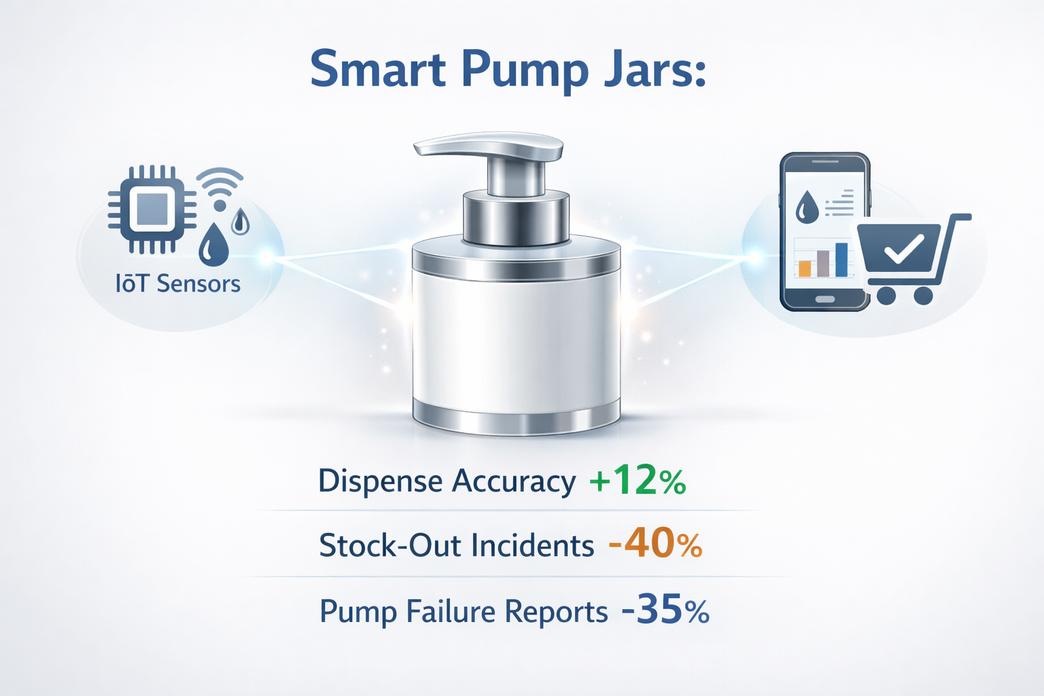
Smart jars rely on layered tech integration to prevent the dreaded airless pump jar not working scenario:
- Core Technology Stack1.1 Embedded IoT sensors monitor pressure and product level.
1.2 Real-time usage tracking connects to mobile apps.
1.3 Automated reordering alerts prevent empty-container panic.
- Data Intelligence Layer2.1 Data analytics evaluates dispensing frequency.
2.2 Predictive inventory management reduces overstock.
2.3 Smart automation flags irregular pump cycles before failure.
- Operational Benefits3.1 Fewer airless pump not working complaints.
3.2 Better refill timing.
3.3 Higher repeat purchases.
Performance snapshot:
| Feature | Standard Jar | Smart IoT Jar | Failure Reduction |
|---|---|---|---|
| Dispense Accuracy | 85% | 97% | +12% |
| Stock-Out Incidents | High | Low | -40% |
| Pump Failure Reports | Moderate | Minimal | -35% |
Brands working with Topfeelpack integrate these systems early in product planning.
Leveraging Tooling Design to Embed RFID in the Outer Shell
Solving airless pump jar not working often starts at structure level:
- Advanced tooling design1.1 Precision cavity mapping during the manufacturing process.
1.2 Controlled component placement to avoid airflow blockage.
- Smart RFID embedding2.1 Seamless placement inside the outer shell.
2.2 Stable signal without weakening material science properties.
- Product-Level Integration3.1 Real-time tracking across the supply chain.
3.2 Faster detection when a pump jar not working issue surfaces.
3.3 Cleaner product integration without visual clutter.
The result? Fewer returns, fewer “airless pump jar not working” reviews online.
Partnering with Suppliers Offering Customization Options and Technical Support
Strong supplier partnerships keep smart jars functional:
- Development Collaboration1.1 Flexible customization options for valve strength.
1.2 Early-stage testing during product development.
- Ongoing Assistance2.1 Dedicated technical support for troubleshooting airless pump not working cases.
2.2 Clear service level agreements for fast replacements.
- Supply Stability3.1 Reliable supply chain planning.
3.2 Transparent vendor relations.
3.3 Quality audits that reduce airless pump jar not working claims.
Topfeelpack supports brands with tailored engineering fixes, so when customers press the pump, it just works—no drama, no airless pump jar not working stress, just smooth dispensing every time.
FAQs about Airless Pump Jar Not Working
1. Why is my airless pump jar not working during testing?
When an airless pump jar not working issue appears, tension usually builds around three points:
- Priming issues –
- Press the actuator 10–20 times to activate the piston mechanism and build vacuum.
- Slight resistance change means suction is forming inside the inner bottle.
- Clogging or dried formula –
- Thick cream, foundation, or high-viscosity gel may block the dispenser channel.
- Rinse and perform quick functional testing.
- Air ingress –
- Loose closure or misaligned outer shell breaks the vacuum.
- Check seal integrity under basic quality control review.
A calm inspection often restores steady, consistent dispensing.
2. How can material selection prevent pump failure and leakage?
Material tension often hides behind repeated pump failure or product leakage. Compatibility between formula and structure matters deeply.
| Component | Recommended Material | Why It Matters |
|---|---|---|
| Inner bottle | Polypropylene (PP) | Strong chemical compatibility with serum and essence |
| Flexible body | Polyethylene (PE) | Better for lotion and gel elasticity |
| Outer shell / actuator | ABS (acrylonitrile butadiene styrene) | Structural stability during assembly line pressure |
| Structural resin | Virgin plastic | Lower defect rate in injection molding |
If recycled content is used without strict material specifications, swelling or seal gaps may trigger air ingress. Good material pairing protects both product and brand reputation.
3. What manufacturing defects cause inconsistent dispensing on the assembly line?
In automated production, small dimensional errors create big frustration.
- Injection molding shrinkage → loose closure fit
- Tooling design misalignment → tilted actuator stroke
- Poor defect detection → cracked inner bottle
- Weak quality assurance → rising defect rate before shipment
Under ISO certification and Good Manufacturing Practices (GMP), teams conduct:
① vacuum testing protocols
② repeated functional testing
③ dispenser stroke calibration
Consistent tooling validation keeps the airless pump jar stable through mass production.
4. How should suppliers respond when airless pump jar not working issues delay production?
When production halts, human response matters as much as engineering.
Strong suppliers provide:
- Fast sample availability for retesting serum or cream
- On-site technical support to adjust actuator alignment
- Flexible customization options for closure or piston redesign
- Stable production capacity to protect lead time
A supplier with disciplined quality control and clear communication reduces stress across the assembly line and keeps packaging cycles moving smoothly.
References
- Grand View Research - grandviewresearch.com
- global airless packaging market - giiresearch.com
- Material compatibility - labdepotinc.com
- PP - millerplastics.com
- PE - calpaclab.com
- chemical reaction - https://www.google.com/search?q=braskem.com.br
- packaging quality - beautypackaging.com
- Good Manufacturing Practices - obelis.net
- ISO-Certified - registrarcorp.com
- premium feel - choebe.com
- barrier properties - beautypackaging.com
- Structural stability - advancedplastiform.com
- Good Manufacturing Practices (GMP) - fda.gov
- quality control - intertek.com
Post time: Mar-23-2026
