
Refillable airless bottles can lower packaging impact, but only when customers actually refill them and the refill part uses less material than a new pack. If refills are rarely bought, or the refill carries nearly as much material as the full pack, the benefit shrinks or disappears. Sustainability depends on use and design, not on the word refillable.
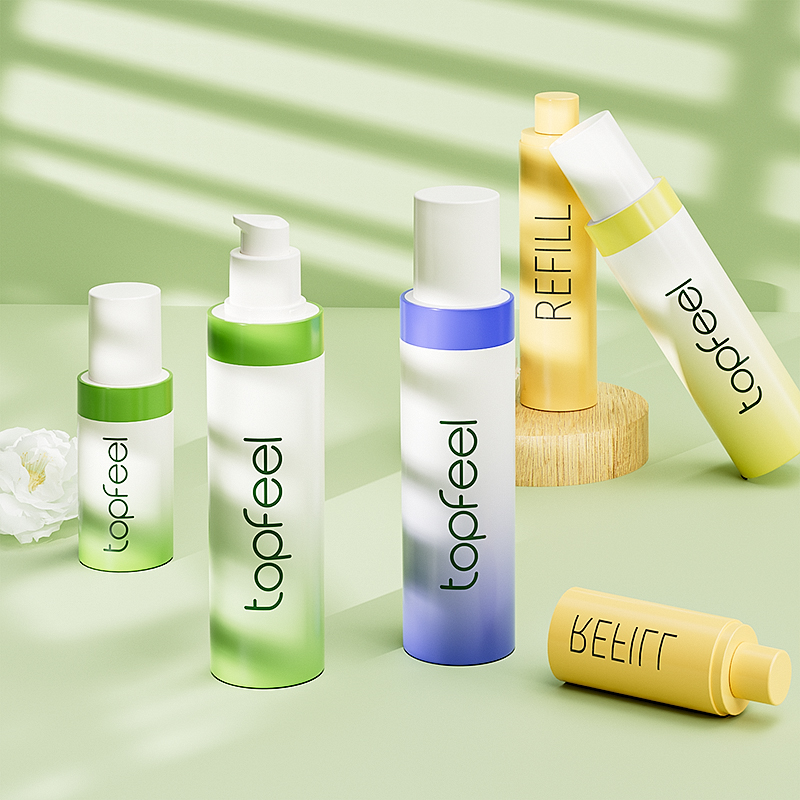
What Decides the Outcome
| Factor | Why it matters | What to ask |
|---|---|---|
| Refill rate | Savings appear only when refills replace new full packs | How many refills per shell does the program expect? |
| Refill part mass vs full pack | A heavy refill saves little | Component weights for both |
| Materials | Mixed materials complicate recycling of the shell and the refill part | Material breakdown for every component |
| Durability of reused parts | The shell and pump must survive repeated use | Tested cycle data for the model |
| Logistics | Refills still need to be shipped; returns add trips | Is there a return or collection route? |
| Claim wording | A refillable claim needs a real refill system behind it | Evidence that refills are offered and used |
A Simple Illustration
This is an illustrative calculation, not a Topfeelpack specification.
- Full pack: 40 g. Refill unit: 15 g.
- Three fills with full packs only: 3 x 40 g = 120 g.
- One full pack plus two refills: 40 g + 2 x 15 g = 70 g.
- Difference: 50 g, roughly 42% less packaging mass.
- If the customer never buys a refill, the saving is zero.
The point is the dependency: the benefit comes from refills being bought, not from the pack being refillable on paper.
Claims and Regulation
In the United States, the FTC Green Guides address refillable claims in 16 CFR 260.14. In summary, an unqualified refillable claim should be backed by a system for collecting and refilling the package, or for consumer refilling, and the package should in fact be refilled. Other markets apply their own rules. The EU Packaging and Packaging Waste Regulation (PPWR) also includes reuse and refill provisions, some of which phase in later, so confirm which apply to each format and market.
Making a Refill Program Work
- Keep the refill part as light and as simple in materials as the design allows.
- Document component weights and materials for the shell, pump, and refill unit.
- Make the refill easy to buy and easy to fit.
- Track the real refill rate, because it decides whether the claim holds.
A refillable format that nobody refills is only a more complex pack.

Topfeelpack Models to Evaluate
- PA139 PP-PCR Airless Bottle: listed in 50 ml and 100 ml as a refillable bottle. Confirm PCR content and calculation scope for your project.
- PA181 Refillable Airless Pump Bottle: listed with a snap-lock design.
- PA176 Eco-Friendly Refillable PET Airless Pump Bottle: a refillable PET format.
See also Topfeelpack's sustainability overview. A general sustainability statement does not replace a package-specific assessment.

Questions to Put to Your Packaging Supplier
Bring these to the first discussion so the sustainability case rests on documents rather than slogans.
- What is the weight of each component: shell, pump, inner container or refill unit, and cap?
- What material is each component made from, and which parts can be separated?
- Is there tested cycle data for the pump and seals of this model?
- How is any recycled content calculated, and which components does it cover?
- Which recycling guidance has the supplier checked the design against, and for which markets?
How to Describe the Pack Honestly
Describe what the design does and what the program offers, for example that the pack accepts a lighter refill unit. Avoid stating a saving unless the calculation and the refill rate behind it are documented. If the numbers are not available yet, say less, and revisit the wording when real refill-rate data arrives. Check the claim against the rules of each destination market before it reaches the pack or the website.
Where the Evidence Usually Falls Short
Sustainability statements about refills often fail on a few predictable points. Check each one before publishing.
- The refill rate is assumed, not measured. A saving that depends on repeat purchase needs real purchase data, or a clearly labeled estimate.
- Component weights are missing. Without them, nobody can check whether the refill part is meaningfully lighter than a full pack.
- The comparison baseline is unrealistic. Comparing against an unusually heavy pack makes any alternative look good.
- One model's data is applied to the whole range. Weights, materials, and durability differ by model.
Early in a program, label figures as estimates and update them as real refill data arrives.
FAQ
Is refillable better than recyclable?
They answer different questions. Refillable concerns reuse; recyclable concerns end of life. A pack can be one, both, or neither.
Does PCR content make a refillable bottle sustainable?
No. PCR describes material origin. It does not establish refill rate, durability, or recyclability.
What should a brand measure?
Refill rate, the weight of each component, and how long the reused parts last.
Request samples · Request a quote: contact Topfeelpack
Post time: Nov-18-2026
