
There is no universal reuse limit for a refillable cosmetic bottle. Service life is set by the first part to wear out, usually the pump, a seal, or the printed decoration rather than the outer shell. Ask the supplier for tested cycle data on the exact model, and set your own end-of-life criteria for dose, leakage, and appearance.
Which Parts Wear First
| Part | Typical wear mode | What it looks like to the user |
|---|---|---|
| Pump or actuator | Spring, valve, or piston wear | Dose drifts, pump feels weak or sticks |
| Gasket or seal | Compression set, contamination | Leakage, loss of airless performance |
| Thread or snap-lock | Loosening after repeated opening | Cap fits poorly, lock no longer holds |
| Decoration | Abrasion from handling and cleaning | Print or finish fades, scratches |
| Outer shell | Scratches, stress cracks | Cosmetic damage, rarely function loss |
| Inner container | Residue, staining | Visible build-up, odor |
The order depends on the model and on how customers use it.

What to Test Before Promising Reuse
- Pump cycle life: dose consistency across the number of actuations your program assumes.
- Leak resistance after repeated refills: test the pack after several swaps, not only when new.
- Cleaning compatibility: if parts are cleaned between refills, check that cleaning does not damage seals or decoration.
- Handling durability: drop and abrasion checks on the shell and decoration.
Use the real formula in these tests. A pack that performs on water may behave differently with a viscous cream or an oil-rich serum.
Setting End-of-Life Criteria
A brand should define when a reused part must be replaced, for example:
- Dose per actuation falls outside the agreed range.
- Any visible leakage at the pump, seal, or closure.
- Cracks, deformation, or a lock that no longer holds.
- Decoration worn beyond the agreed visual standard.
Put these criteria in the customer instructions so users know when to replace a part.
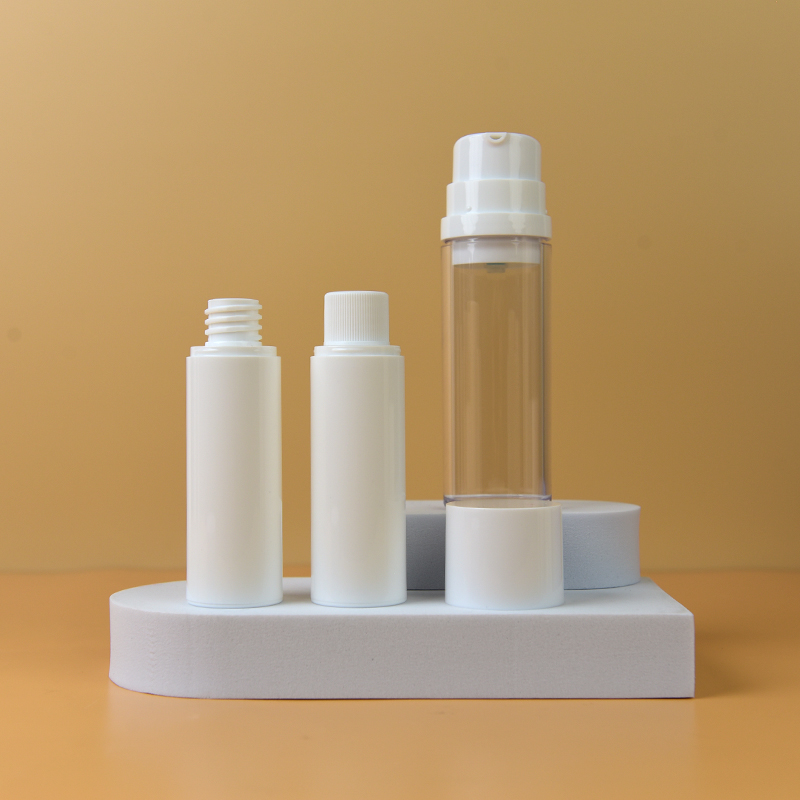
Reuse and Hygiene
Repeated use brings in-use contamination risk. A replaceable inner part restarts the product-contact path with each refill, which can help. Parts that stay in service still need clear care guidance. Packaging does not replace a preservation and safety program for the formula.
Topfeelpack Refillable Models to Discuss
- PA181 Refillable Airless Pump Bottle: listed with a snap-lock design.
- PA20A Refillable Screw-on Airless Pump Bottle: listed in 15 ml, 30 ml, and 50 ml.
- PA148 Fresh-Keeping Refillable Airless Pump Bottle: listed as a 30 ml refillable airless bottle.
Product pages do not publish a reuse limit. Ask Topfeelpack what testing exists for the selected model and which tests remain the brand’s responsibility.
A Simple Reuse Test Plan
Use this outline to turn the question into evidence for your own model and formula.
- Record a baseline. Measure dose per actuation, closure fit, and appearance on new packs filled with the real formula.
- Define the use cycle. Decide how many actuations per day and how many refills the program assumes, so the test matches real use.
- Run cycles. Cycle the pump and swap the refill part repeatedly, and re-measure dose at set intervals.
- Check leakage at each stage. Test with the pack upright, on its side, and after a temperature change.
- Inspect after the run. Look at the seal, the thread or lock, and the decoration for wear.
- Compare against the criteria. A part passes only if it stays inside the end-of-life criteria set earlier.

Reading the Results
Base any reuse statement on the weakest part. If the pump fails first, the program can be built around replacing the pump with each refill instead of promising a long shell life. If decoration wears first, discuss a more durable finish. Record the result with the formula, the temperature, and the cycle count, because a different formula or use pattern can change the outcome. Repeat the plan whenever the formula, the pump, or the decoration changes.
Share the findings with your supplier so any change in material or design is assessed against the same criteria.
Care Instructions That Extend Service Life
Good care guidance helps parts last, and it costs little to print.
- Wipe the outside with a soft, dry or slightly damp cloth. Confirm with the supplier which cleaning methods the decoration tolerates.
- Do not soak pumps or seals unless the instructions say it is allowed.
- Keep the pack away from solvents and strong heat, which can attack finishes and seals.
- Store the pack upright and closed.
- Replace any part that meets an end-of-life criterion, even if the rest of the pack looks fine.
Treat these as defaults to verify. The right guidance for a given model and formula comes from your own testing.
FAQ
Can a refillable pump be reused indefinitely?
No. Pumps and seals wear. How quickly depends on the design, the formula, and how often the pack is used.
Does a longer-lasting shell mean a longer-lasting bottle?
Not necessarily. The weakest part sets the service life, and that is often not the shell.
Should refills be limited by a stated number?
Only if testing supports the number for the specific model and formula.
Keep Reading
- Category: Refillable Bottle range
Request samples · Request a quote: contact Topfeelpack
Post time: Nov-23-2026
