
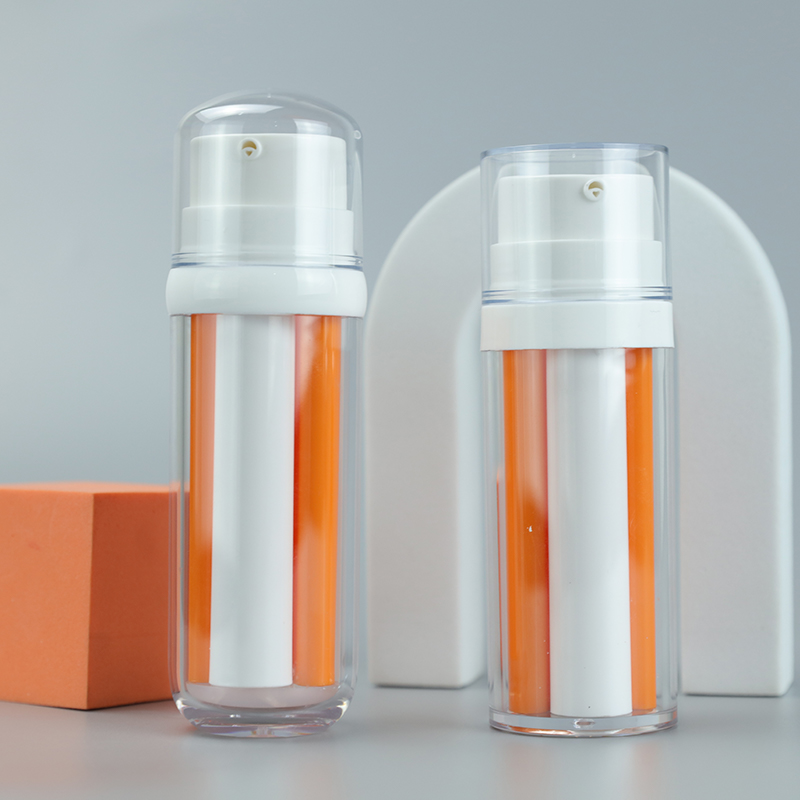
Dual chamber bottles hold two formulas in separate chambers within one package, dispensing them simultaneously through a single outlet or in a controlled sequence. They are used where two components must stay apart until use — an active and a stabiliser, two incompatible actives, or a tint and a base.
The format exists to solve a chemistry problem that no single-chamber pack can address: some ingredients degrade the moment they meet, but the consumer wants to apply them in one motion.
The core problem it solves
Three incompatibilities drive demand for this format.
- Actives that destabilise each other. Vitamin C and certain peptides interact; an acid and a retinol in the same phase will degrade each other and irritate the skin. Separate chambers keep both stable until application.
- Actives that need a low-pH or high-pH environment. Some ingredients are only stable within a narrow pH band, and two such ingredients cannot share one phase.
- Components that must remain sterile or anhydrous. A water-based phase and an anhydrous oil phase can be held separately and emulsified at the moment of dispensing.
In each case the packaging is not a convenience feature. It is what makes the product formulation possible at all.
The four dual-chamber architectures
Not every “dual-chamber” bottle works the same way, and the differences determine both the formula options and the user experience.
| Architecture | How it dispenses | Chambers | Best for |
|---|---|---|---|
| Single outlet, simultaneous | One button, both formulas through one orifice, mixed in the nozzle | Equal or unequal volumes | Serums applied together, essence + emulsion |
| Single outlet, unequal volumes | One button, small chamber doses into the larger flow | Typically 10 ml + 20–30 ml | Concentrate + carrier, booster systems |
| Rotary / sequential | Twist to switch between chambers | Independent, full-size | Day/night systems, two-step routines |
| Concentrate-in-cap | Activate by pressing the cap; concentrate drops into the main body | Small concentrate + large bulk | Fresh-activated actives, high-potency launches |
The most common consumer-facing format is the second row: a small chamber for an expensive active and a larger chamber for the carrier. It lets the brand market a high-concentration ingredient without putting it in the full volume, where it would be diluted and less stable.
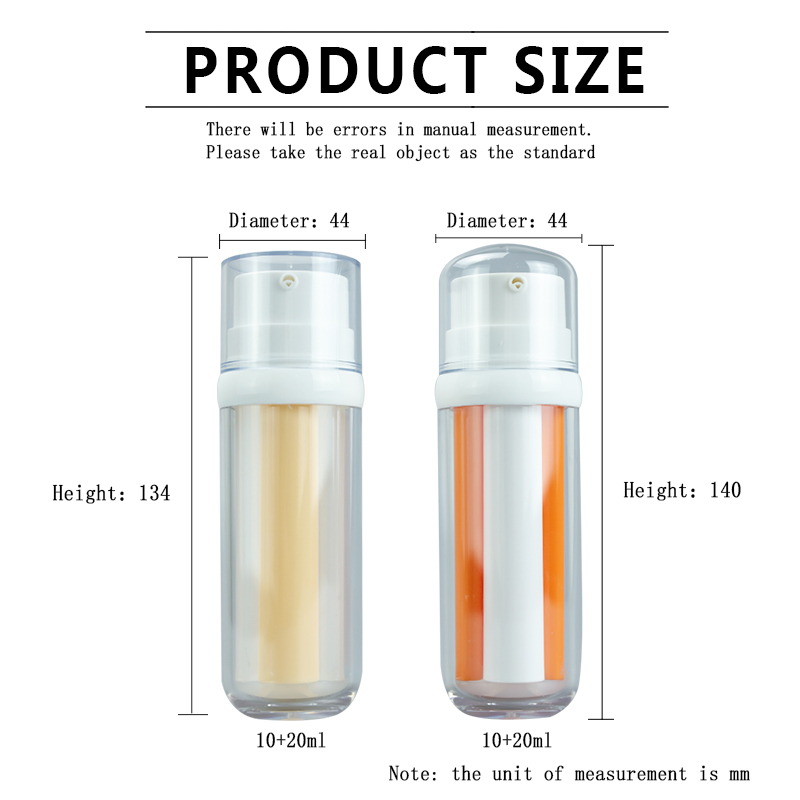
Topfeel’s PL41 two-in-one mixing launcher is a working example of this architecture: 10 ml + 20 ml or 10 ml + 30 ml, a single 0.2 ml pump output, PETG or AS outer bottle with PP and PETG inner tubes, and a 10 ml airless inner chamber with a built-in piston.
Dual-chamber versus other approaches
| Approach | Stability protection | Cost | Consumer complexity | Refill potential |
|---|---|---|---|---|
| Dual-chamber bottle | High — full separation | High | Low — one motion | Moderate |
| Single chamber, stabilised formula | Low — relies on the stabiliser | Low | Lowest | High |
| Two separate bottles | High | Moderate for the pair | High — two steps | High |
| Concentrate-in-cap | High before activation, low after | Moderate | Moderate | Low |
| Ampoule / single-dose | Highest | Highest per use | Moderate | None |
The trade-off is straightforward: a dual-chamber pack costs more than a stabilised single formula and less than two separate products, and it delivers better stability than either. The question is whether the formulation genuinely needs it.
A caution worth stating plainly: dual-chamber packaging is frequently specified for marketing reasons rather than chemical ones. If the two formulas could coexist in a single phase with adequate stability testing, the dual-chamber pack adds cost, complexity and a recycling problem without adding product benefit.
Where the format genuinely earns its cost
Four product types where the chemistry, not the marketing, drives the choice.
Two-phase serums. A water-phase active and an oil-phase carrier that must emulsify at application. A single chamber would require an emulsifier that may not suit the formula.
Retinol plus a supportive phase. Retinol is oxidation- and light-sensitive; a separate chamber can hold it in a more protective environment and dose it at lower volume.
Vitamin C systems. Ascorbic acid at effective concentration needs a low pH; a second chamber allows the supporting phase to sit at a different pH.
Day/night systems. A rotary dual-chamber lets one pack serve two routines, which reduces packaging material per regimen — a genuine sustainability argument, not just a convenience one.
For a day/night pair in particular, the environmental arithmetic can favour a dual-chamber pack over two separate bottles: one outer shell, one cap, one set of secondary packaging.
Design and material considerations
| Component | Common materials | Consideration |
|---|---|---|
| Outer bottle | AS, PETG, PP, acrylic | Clarity and weight drive perceived value |
| Inner chambers | PP, PETG, PE | Must be compatible with each formula separately |
| Pump / actuator | PP, with the mixing nozzle | Single outlet requires a mixing geometry |
| Piston (if airless) | PP, PE | Fit determines bypass between chambers |
| Cap | PP | Must seal the outlet, not just cover it |

Two specification pitfalls recur.
The mixing nozzle. A single-outlet dual-chamber pack needs a geometry that combines the two flows without letting one flow back into the other chamber. Poor nozzle design produces uneven ratios — the user gets a burst of activator followed by carrier, rather than a consistent blend.
Differential viscosity. If one chamber holds 5,000 cPs and the other 40,000 cPs, the pump will draw them at ratios that vary with temperature and with the pack’s remaining fill. The nominal ratio printed on the pack is only true under specific conditions. This should be tested across the fill cycle, not just at the start.
The recyclability problem
Dual-chamber bottles are, by construction, multi-material and multi-component. That makes them one of the harder formats to reconcile with the EU Packaging and Packaging Waste Regulation, which addresses recyclability, packaging minimisation and component separability.
The regulation entered into force on 11 February 2025 and applies generally from 12 August 2026, with some requirements phasing in later. A dual-chamber pack must be assessed as placed on the market, and the components — two inner chambers, an outer body, a pump, a mixing nozzle, a cap — must either be separable or share a polymer.
Design options that improve the assessment:
- Single polymer throughout, typically PP including the pump, avoiding metal springs.
- A separable inner chamber that the consumer can remove in one obvious action.
- A refill model where the outer shell is reused and only the inner chamber is replaced.
- Reduced component count — an integrated mixing nozzle rather than a multi-part assembly.
None of these is a complete solution. Dual-chamber remains a format where the recyclability case is weaker than the stability case, and brands should be candid about that trade rather than claiming both. Topfeel’s sustainability page sets out how these trade-offs are assessed for individual projects.
Specification checklist
- ☐Confirm the two formulas cannot be stabilised in a single phase — if they can, reconsider the format
- ☐Define the ratio between chambers and the tolerance on that ratio
- ☐Confirm each chamber material is compatible with its own formula
- ☐Specify the mixing nozzle geometry and test ratio consistency across the fill cycle
- ☐Confirm the outer body material and the recyclability story it supports
- ☐Decide between simultaneous and sequential dispensing, based on the routine
- ☐Specify whether the pack is refillable, and test the dose across the second cartridge
- ☐Confirm the fill process supports two chambers without cross-contamination
That last point is a production issue rather than a design one, and it is frequently overlooked. Filling two chambers requires either two fill heads or a sequential fill with an intermediate seal, and not every contract filler has the equipment. A pack that cannot be filled economically in the target market is not a viable pack, however good the design.
Frequently asked questions
What is the difference between a dual-chamber bottle and a dual-chamber tube?
The tube uses a soft body with two internal lanes and the user squeezes; the bottle uses a pump or rotary mechanism. Tubes suit thicker formulas and lower cost points; bottles allow airless construction and better dose control.
Can dual-chamber bottles reduce preservative requirements?
Sometimes, because each phase is exposed to fewer contaminants and an anhydrous phase needs no preservative at all. But preservation requirements depend on the formula and on challenge testing — dual-chamber construction does not remove the need to assess them.
Are dual-chamber bottles more sustainable than two separate bottles?
Often yes, in material terms, because one outer shell and one cap serve two products. The advantage disappears if the pack cannot be separated for recycling, so the material saving and the recyclability question must be weighed together rather than separately.
What is a typical dual-chamber capacity ratio?
Common configurations include 10 ml + 20 ml and 10 ml + 30 ml for concentrate-plus-carrier systems, and matched volumes such as 15 ml + 15 ml where the two phases are used in equal measure.
Why does my dual-chamber pump dispense unevenly?
Usually differential viscosity: the two formulas have different flow behaviour, so the pump draws them at a ratio that shifts as the pack empties. Testing the ratio across the full fill cycle, rather than only at the start, is the way to catch it.
Sourcing dual-chamber packaging
Topfeelpack manufactures dual-chamber bottles in single-outlet, rotary and refillable architectures, from 10 ml + 20 ml to matched-volume configurations, in PP, PETG and AS with custom decoration. Start with the dual chamber bottle range, or review airless bottles and refillable bottles for related formats.
Send the two formulas, the intended ratio, the dispensing sequence, and the destination market, and we will confirm the architecture and the fill requirements.
Post time: Nov-12-2026
