
A cosmetic packaging locking mechanism controls whether a pump or dispensing component can operate. Its main role is to reduce accidental dispensing during shipping, storage, and handling by blocking actuator movement or holding the dispenser in a closed position. A suitable lock also lets consumers switch reliably between storage and normal use.
For beauty brands, the purchasing question is how that mechanism performs in the complete package. A pump can remain locked while a poorly matched bottle connection leaks. Evaluate lock retention, sealing, formula compatibility, and user operation as separate requirements before approving a design.
What Does a Cosmetic Packaging Lock Actually Protect Against?
A pump actuator is the part users press to dispense product. In a carton, toiletry bag, or crowded bathroom drawer, contact with another object can press an exposed actuator. A lock is designed to interrupt that movement, reducing unwanted product discharge and the mess it can create.
The practical benefit depends on the design. Some locks prevent the actuator from moving downward. Others hold it in a depressed position or require rotation before dispensing becomes possible. Ask the supplier to demonstrate which parts move and what keeps the locked position engaged.
Keep four functions distinct when reviewing a proposal:
- Actuation locking: Restricts unintended pump operation.
- Sealing: Controls escape of product through the outlet, closure interface, or other paths.
- Tamper evidence: Provides an indication that the package has been opened or disturbed.
- Child resistance: Requires performance established under the applicable child-resistant packaging requirements.
A rotating pump lock alone does not establish tamper evidence or child resistance. Likewise, an airless dispensing system describes a different packaging function. An airless bottle still needs its lock and sealing performance evaluated with the intended formula.
Compare Locking Designs by Function
Suppliers may use different names for similar mechanisms. Specify the required behavior and confirm it with a sample rather than selecting from a catalog label alone.
| Design | Typical operating principle | Main buyer check |
|---|---|---|
| Twist-lock actuator | Rotation switches the pump between locked and dispensing positions | Can handling move the actuator out of the locked position? |
| Depress-and-turn lock | The actuator is pressed down and rotated to engage a lock | Does relocking after use expel product, and is the action acceptable? |
| Removable pump clip | A separate clip blocks actuator travel while fitted | Does the clip stay attached during distribution, and can users refit it? |
| Protective overcap | A cap covers the actuator; protection depends on its fit and geometry | Does the cap resist displacement and avoid pressing the actuator under load? |
These are design categories, not claims that every supplier offers each option. A protective cap should only be treated as an actuation barrier when the assembled design supports that function.
For a verified product example, Topfeelpack lists the PA185 45ml PP Airless Pump Bottle with Twist-Lock. Its product page identifies a twist-lock mechanism intended to prevent accidental pumping. Use that description to shortlist a sample, then confirm the exact production configuration and performance requirements.

Choose a Lock for the Product’s Handling Conditions
Shipping and warehouse handling
Define how the product will be packed and shipped. A bottle secured in a fitted insert faces different contact conditions from one moving inside a loose gift set. Review clearance above the pump, contact with neighboring items, and whether packing operations can rotate or press the actuator.
Specify the required dispatch condition: locked position, cap or clip fitted where applicable, and any orientation requirements. Make that condition part of the packing instruction and inspection plan. A functional lock provides little protection if products leave the filling line unlocked.
Daily use and repeated relocking
Consider whether the consumer will unlock the bottle once or relock it frequently. A design intended for a bathroom shelf may be inconvenient for a product carried daily in a bag. Evaluate grip with product-wet hands, visibility of direction marks, and whether users can recognize full engagement.
Ask users to operate samples without coaching. Watch for partial engagement, excessive force, or rotation of the entire closure instead of the actuator. These observations help identify instructions or design changes needed before tooling and decoration are finalized.
Bottle size and dispensing format
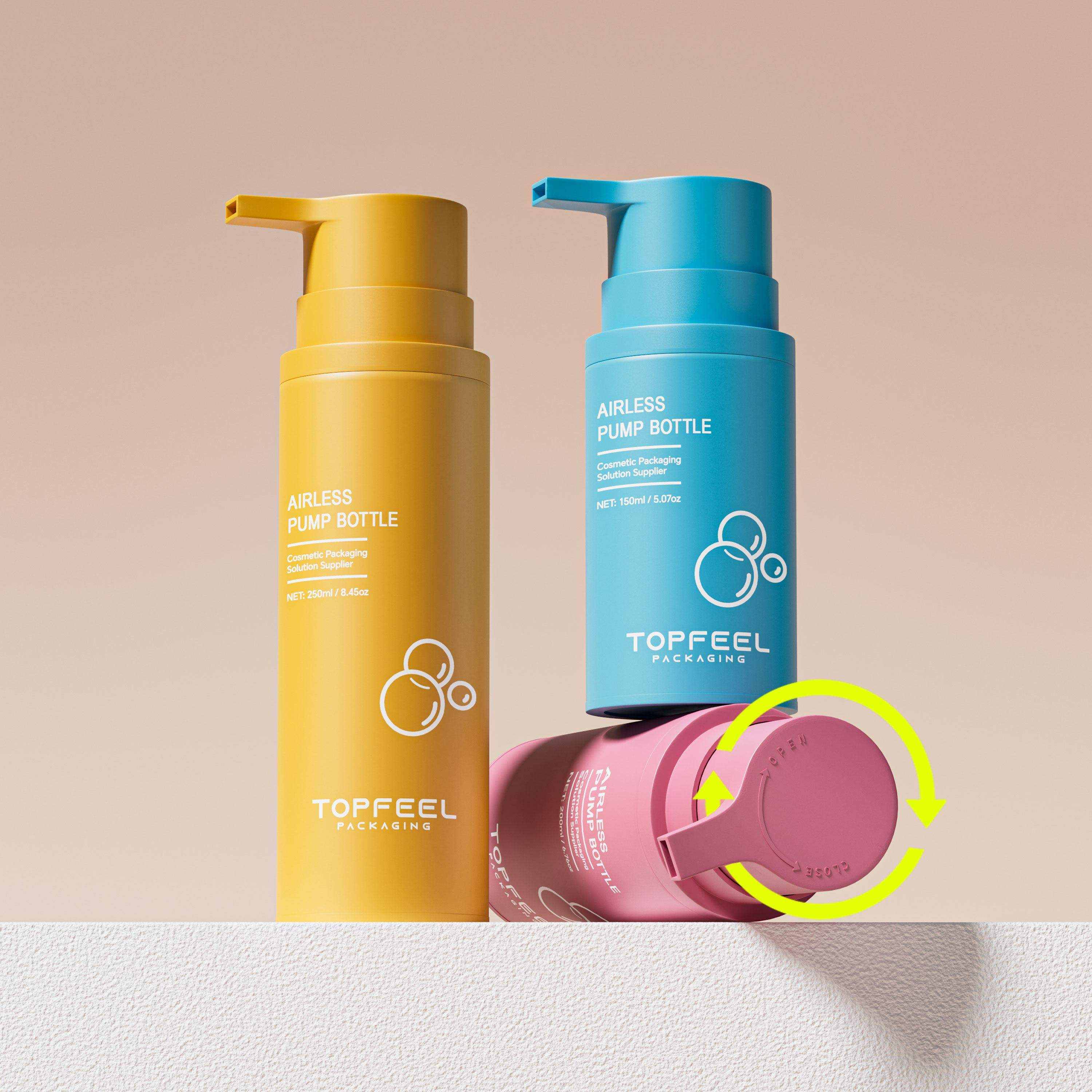
The required lock should suit the complete dispensing system and expected handling. Topfeelpack’s PA163 Large Capacity Airless Bottle with Lock-pump is listed in 150ml, 200ml, and 250ml versions with a rotating locking pump. Its page also describes direction markings on the pump head.
Compare the selected size in its intended carton or bag. Approval of one capacity should not automatically cover another bottle size, actuator shape, or packing arrangement.
Why a Locked Pump Can Still Leak
An actuation lock addresses one possible cause of product release. Leakage can also occur at the bottle-to-closure connection, through a damaged seal, or through another route within the dispensing assembly. Ask the supplier to identify the sealing interfaces and explain how the proposed lock relates to them.
Formula exposure adds another variable. Assess the finished formula with the relevant bottle, pump, gasket, and other contact components. Check for changes in function, component condition, product appearance, and leakage under the agreed storage conditions. An empty sample cannot establish filled-package compatibility.
Use failure observations to guide investigation. Product found around the neck calls for examination of the closure interface. Product at the nozzle may require checking unintended actuation, residual product, or internal sealing. Record the location and conditions rather than treating every wet exterior as a lock failure.
What Should Buyers Test Before Bulk Approval?
Agree on a written evaluation plan using production-representative components, the finished formula, and the intended shipping pack. Set conditions and acceptance criteria with the supplier and testing team. There is no single unlocking force, cycle count, or transit sequence suitable for every cosmetic package.
- Initial function: Confirm engagement, release, dispensing after unlocking, and relocking after use. Record unintended discharge during these actions.
- Resistance to unintended operation: Apply agreed contact loads and handling conditions to the locked assembly. Check whether it unlocks, moves, or dispenses.
- Repeated operation: Repeat the expected lock and unlock actions. Inspect for wear, loose engagement, broken features, and changes in operating effort.
- Filled-pack performance: Check leakage and function in relevant orientations and storage conditions. Include partially used packs if consumers are expected to relock them.
- Distribution performance: Evaluate the filled product in the actual secondary and shipping packaging, then inspect lock position, leakage, damage, and dispensing function.
Select distribution testing for the route and shipping configuration. The International Safe Transit Association’s test procedure guidance distinguishes screening tests from general simulation tests that represent transport motions, forces, conditions, and sequences. A basic screening result should not be presented as proof of performance across all distribution environments.
Retain results against the exact component and packing revisions tested. Reassess relevant changes, including a new actuator, resin, bottle connection, decoration process, or carton insert, according to their effect on function.
What to Include in a Supplier Brief
Give the supplier enough information to recommend a mechanism and prepare representative samples:
- Formula type and relevant compatibility information, shared under appropriate confidentiality arrangements.
- Target capacity, dispensing format, and expected output per actuation.
- Shipping configuration and expected consumer use, including repeated travel or relocking.
- Preferred lock action, operating marks, and cap or clip requirements.
- Decoration requirements, filling setup, order quantity, and target schedule.
- Required evaluation conditions, acceptance criteria, inspection records, and component change controls.
Ask which locking options are available for the exact model. Confirm MOQ, customization, lead time, and sample arrangements for that configuration. Avoid assuming that a mechanism shown on one product can be transferred to another bottle without development work.
Frequently Asked Questions
Can a twist-lock replace a separate overcap?
Potentially, if the complete design meets the project’s requirements. An overcap may also protect the nozzle from contact or provide a desired appearance. Compare those functions and test the proposed package before removing it from the specification.
Does adding a lock change the pump’s output?
A lock controls access to actuation, but its presence does not establish output consistency. Confirm output with the intended formula after unlocking and after repeated lock cycles. Include priming and restart behavior where relevant to the product.
Can the same lock be used for a lotion pump and a fine mist sprayer?
Do not assume interchangeability. Actuator geometry, movement, outlet design, and assembly requirements can differ. Request a locking solution specified for the chosen dispenser and evaluate that combination.
Review Locking Pump Options for Your Project
Compare the PA185 twist-lock and PA163 rotating-lock product pages above, then contact Topfeelpack with your formula type, capacity, dispensing requirements, order quantity, and shipping configuration. Request samples of the proposed locking assembly and agree on the functional and filled-pack checks needed before bulk approval.
Post time: Oct-20-2026
