
An airless bottle supports Design for Recycling when its body, pump, piston, closure and other significant components are compatible with the intended recycling stream. A mono-material architecture can reduce material-separation barriers, but an “all-PP” description alone does not prove recyclability. Buyers must also evaluate seals, colorants, labels, decoration, product residue, sorting behavior and local recycling infrastructure.
What Does Design for Recycling Mean for an Airless Bottle?
Design for Recycling, commonly shortened to DfR, means making packaging decisions that improve the package’s compatibility with collection, sorting and recycling processes in its target market.
For an airless bottle, this requires evaluating the complete dispensing system rather than checking only the bottle wall. The assessment should include:
- Outer bottle or container
- Inner bottle, pouch or piston
- Pump housing and actuator
- Spring or alternative pump mechanism
- Valves, balls, seals and gaskets
- Overcap and base
- Labels, inks, coatings and metallization
- Formula residue remaining after normal use
RecyClass similarly evaluates plastic packaging as a complete system. Its current rigid PP guidance addresses material composition, closures, seals, labels, adhesives, decoration, additives, dimensions and product residue—not only the main container resin. Buyers should therefore ask suppliers for a component-level bill of materials instead of relying on a general “recyclable packaging” statement.
Why Are Conventional Airless Pumps Difficult to Recycle?
Airless packaging is designed to protect the formula and deliver controlled dispensing as the product is used. Achieving those functions may require several tightly integrated components.
A conventional design can combine a PP actuator, PE or PP bottle, engineering-plastic pump parts, a metal spring, elastomeric seals, pigments, coatings and a label. These materials may be practical for dispensing, but their combination can create three recycling challenges:
- Separation: Small internal components may not be removed by the consumer or separated during recycling.
- Material compatibility: A minor component can affect the quality of the recycled PP if it melts or behaves differently during reprocessing.
- Sorting recognition: Dark colors, metallic decoration, large labels or non-standard structures may interfere with identification and sorting.
The buyer’s objective is not simply to eliminate the highest possible number of components. It is to retain the required protection and dispensing performance while making those components compatible with the intended recycling pathway.
How Does a Mono-Material Airless System Work?
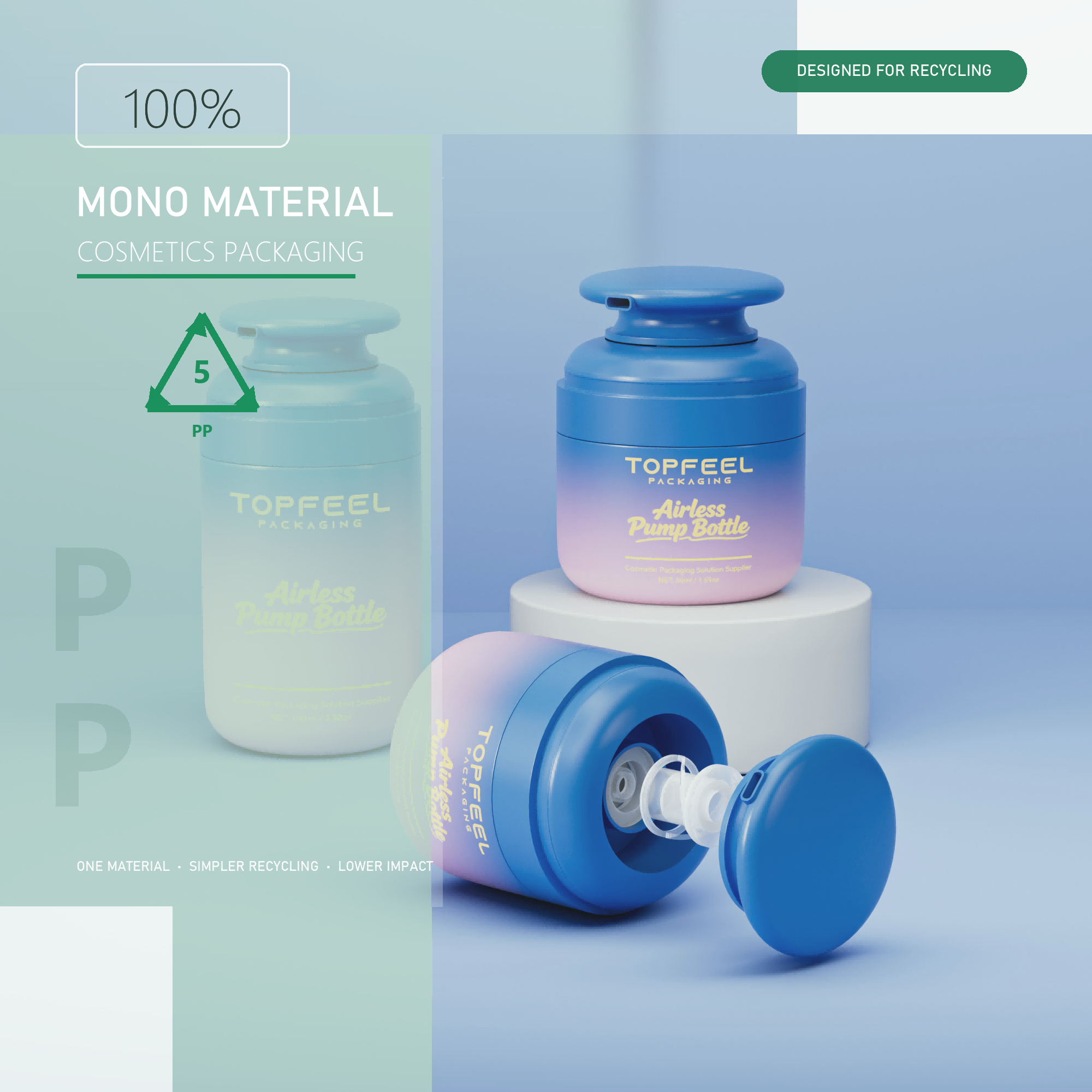
A mono-material airless bottle normally uses one predominant polymer family across its main components. For rigid cosmetic packaging, PP is one possible architecture because it can be used in bottles, closures and multiple molded pump components.
The practical goal is recycling-stream compatibility, not a marketing claim that every molecule in the package is identical.
1. Bottle, Piston and Closure
The bottle body, piston, base, actuator and overcap should be identified by polymer and weight. Using compatible PP components can reduce the need to separate incompatible rigid plastics.
2. Metal-Free Pump Mechanism
Replacing a conventional metal spring with a plastic mechanism can remove a component that is incompatible with PP reprocessing under current RecyClass guidance. However, “metal-free” must be verified at component level. Buyers should ask whether metal is present in the spring, valve, ball, decorative collar or hidden assembly.
3. Compatible Seals and Valves
Valves and seals are necessary for priming, leakage control and formula protection. They should not be deleted only to improve a sustainability claim. Instead, request their material identity, weight percentage and recycling-guideline status. A technically successful mono-material design must remain functional throughout filling, storage, transport and consumer use.
4. Recycling-Compatible Decoration
Metallization, metallic labels, heavy coatings and certain inks can undermine an otherwise compatible PP structure. Decoration should therefore be selected as part of the DfR review rather than added after the package architecture is approved.
Seven DfR Checks for Airless Packaging
| Design area | Preferred direction | Common risk | Evidence to request |
|---|---|---|---|
| Main structure | Predominantly one compatible polymer stream | Mixed rigid polymers with different recycling behavior | Component BOM and resin identification |
| Pump mechanism | Metal-free or proven compatible construction | Hidden metal spring, ball or collar | Exploded drawing and signed material declaration |
| Seals and valves | Minimal, functional and compatible materials | Unidentified elastomers or incompatible small parts | Material name, weight share and test evidence |
| Color and additives | Sorting-compatible colorants and necessary additive levels | Carbon-black or unidentified pigments; excessive fillers | Colorant and additive declaration |
| Labels and adhesives | Limited coverage with compatible face stock and adhesive | Large labels, metallic layers or non-releasable adhesive | Label construction and coverage percentage |
| Decoration | Minimal compatible printing or coating | Full metallization, foil or heavy coating | Decoration specification and ink/coating data |
| Product residue | High evacuation under normal consumer use | Viscous formula remains trapped in the package | Evacuation test method and result |
This table is a supplier-screening framework, not a recyclability certification. Applicable criteria can differ by packaging format, color, target country and recycling system.
Mono-Material Does Not Automatically Mean Recyclable
“Mono-material,” “recyclable” and “recycled at scale” describe different things.
- Mono-material describes the package’s material architecture.
- Designed for recycling describes compatibility with defined recycling criteria.
- Recyclable in a market also depends on collection, sorting and reprocessing infrastructure.
- Recycled at scale requires evidence that the packaging is actually recycled through established systems.
For example, RecyClass maintains separate guidance for natural or white PP containers and colored PP containers. Under its natural and white rigid PP guidance last updated in March 2026, polymer composition, color, labels, adhesives, metal parts, fillers and residual content can all affect classification. The same guidance treats less than 70% total PP and PE by weight as non-compatible with that stream.
Consequently, a brand should avoid an unconditional statement such as “this mono-material airless bottle is fully recyclable everywhere.” A more defensible claim identifies the material architecture, the assessment method, the target geography and any limitations.
What Should Buyers Request Before Sampling?
Use the following questions during supplier qualification:
- Can you provide a component-level bill of materials with weight percentages?
- Are the bottle, piston, pump, actuator, base and cap made from the same polymer family?
- Does the assembly contain any metal spring, ball, pin, collar or decorative layer?
- What materials are used for the valves, seals and gaskets?
- Which recycling guideline and version was used to evaluate the design?
- Was the complete decorated package assessed, or only the undecorated container?
- What label face stock, adhesive, ink, coating and coverage are proposed?
- Has the package been evaluated for sorting and recycling in the intended sales market?
- What percentage of the formula remains after normal consumer use?
- Which formula-compatibility and dispensing tests are recommended before production?
If a supplier cannot identify the materials in a concealed pump assembly, the buyer does not yet have enough evidence to approve a mono-material or DfR claim.
How Should Formula and Dispensing Performance Be Validated?
Recyclability evaluation does not replace package-performance testing. An airless bottle still needs to protect and dispense the specific formula throughout its intended life.
The validation plan should consider:
- Formula viscosity and rheology
- Oils, solvents, acids and active ingredients
- Filling process and fill temperature
- Priming performance
- Dose consistency
- Actuation force
- Leakage and transport resistance
- Piston movement
- Product evacuation
- Storage stability
- Decoration and label durability
A material change made to improve recycling compatibility can alter sealing, friction, dimensional stability or pump behavior. Testing should therefore use the final formula, final components and intended decoration wherever possible.
How Does the EU PPWR Affect DfR Planning?
Regulation (EU) 2025/40 on packaging and packaging waste applies from August 12, 2026. It establishes a recyclability framework based on Design for Recycling criteria and, later, recycling-at-scale assessment.
The European Commission must adopt delegated acts establishing detailed DfR criteria by January 1, 2028. The recyclability performance grades are scheduled to apply from January 1, 2030, or 24 months after those delegated acts enter into force, whichever is later. Recycling-at-scale requirements follow from 2035.
This means cosmetic brands should build traceable packaging data now, but they should not claim final PPWR conformity based only on a supplier’s “all-PP” description or a voluntary guideline score. Current tools can support design decisions; they do not replace the applicable legal assessment once the detailed EU criteria are adopted.
For an earlier example of this product direction, read 100% Recycled Material Airless Pump Bottle—Metal Free. Its recyclability wording should be interpreted together with the market-specific qualifications explained in this guide.
A Practical Decision Framework
Before approving a mono-material airless bottle, complete these four gates:
Gate 1: Material Transparency
Obtain the complete BOM, component weights, resin identification and decoration specification.
Gate 2: Recycling Compatibility
Compare the final package against a current, market-relevant DfR guideline. Record the guideline version and assessment date.
Gate 3: Formula and Functional Validation
Test the selected package with the final or representative formula for dispensing, leakage, compatibility and evacuation.
Gate 4: Claim Review
Confirm that environmental wording matches the evidence and target market. Avoid converting a material fact—such as “PP-based” or “metal-free pump”—into an unconditional recyclability claim.
Questions to Discuss with an Airless Bottle Supplier
When requesting samples, provide the supplier with:
- Formula type and viscosity
- Target fill volume
- Intended sales countries
- Desired dosage and user experience
- Decoration requirements
- Mono-material or recycling target
- Planned compatibility and transport tests
- Launch schedule
You can review Topfeelpack’s product catalog or examine the currently listed PA125 all-plastic, metal-free PP airless bottle. Product materials and configurations should be reconfirmed for the specific project before claims or testing plans are finalized.
Frequently Asked Questions
Is an all-PP airless bottle automatically recyclable?
No. An all-PP architecture can improve compatibility with a PP recycling stream, but recyclability also depends on seals, additives, color, labels, adhesives, decoration, residue, sorting and local infrastructure.
Does Design for Recycling require removing the metal spring?
A metal-free mechanism can remove an incompatible component from a PP package, but the complete pump must still be reviewed. Metal may also be present in balls, pins, collars or decorative parts.
Can a mono-material airless bottle use labels?
Potentially, yes. Label material, density, coverage, adhesive and decoration affect compatibility. Evaluate the final labeled package under the relevant guideline rather than assuming any label is acceptable.
Is a RecyClass assessment proof of PPWR compliance?
No. RecyClass provides a voluntary recyclability evaluation methodology. Final PPWR assessment will depend on the applicable EU criteria and legal requirements.
What is the first document a buyer should request?
Start with a component-level BOM that identifies the material and weight of every bottle, pump, closure, seal and decorative component. Without material transparency, a meaningful DfR review is not possible.
Conclusion
The strongest mono-material airless bottle project combines three outcomes: recycling-stream compatibility, reliable formula dispensing and supportable environmental claims.
Start by defining the target market and recycling objective. Then compare the complete package—not only the bottle body—against a current DfR guideline. Finally, validate the selected system with the formula and decoration that will be used in production.
Planning a mono-material airless packaging project? Share your formula type, viscosity, fill volume, target markets, decoration requirements and testing expectations with Topfeelpack. The project team can use these inputs to discuss an appropriate airless bottle direction and sampling plan.
External Sources
- European Union, Regulation (EU) 2025/40 on packaging and packaging waste, January 22, 2025: Official regulation
- European Commission, Packaging waste: Policy overview
- RecyClass, Design for Recycling Guidelines — Packaging: Guideline library
- RecyClass, Design for Recycling Guidelines for Natural and White PP Containers, last updated March 2026: Official guideline PDF
Post time: Aug-24-2026
