
In the beauty and personal care industry, plastic jars are one of the most mainstream packaging solutions, widely used for creams, lotions, masks, balms and other cosmetic products. Consumers and brand owners always focus on the safety of packaging materials, including chemical migration, material stability, and usage applicability. This blog comprehensively analyzes the safety performance of plastic jars, covers material classification, safety standards, usage taboos, selection guidelines and common FAQs, helping brands and users accurately judge and use cosmetic plastic packaging safely.
1. Basic Classification & Safety Attributes of Plastic Jars
The safety of plastic jars is fundamentally determined by the raw material resin. Different plastic materials have distinct chemical stability, temperature resistance and anti-corrosion properties, which directly affect their safety in cosmetic packaging scenarios. Mastering the classification of plastic jar materials is the premise of identifying packaging safety.
1.1 Common Plastic Jar Material Types
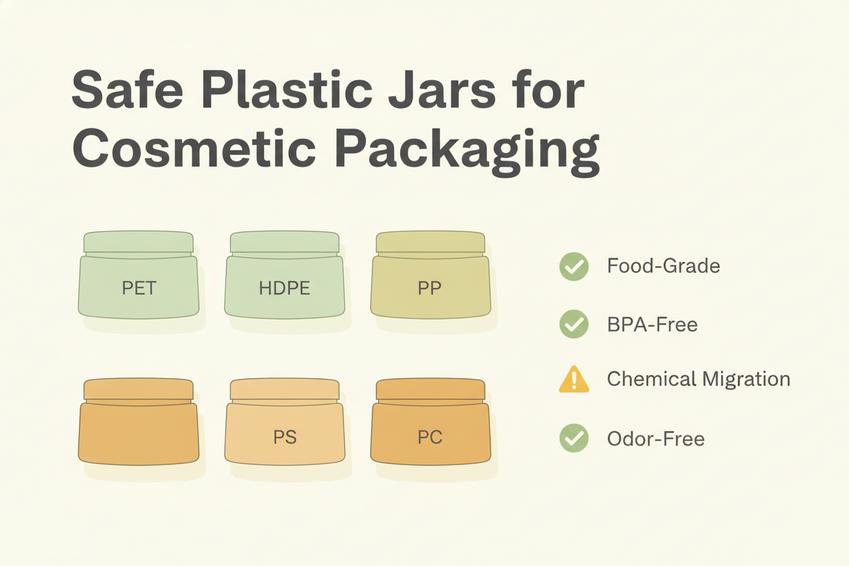
The mainstream materials for cosmetic plastic jars on the market include PET, HDPE, LDPE, PP, PS and PC. Each material has unique safety characteristics and applicable scenarios, which are summarized in the table below:
| Material Type | Safety Performance | Cosmetic Application Scenarios | Core Advantages |
|---|---|---|---|
| PET | Food-grade safe, stable chemical properties, no harmful substance precipitation under normal temperature; not resistant to high temperature | Ordinary cream, gel, moisturizer, exfoliating products | Lightweight, transparent, good texture, low cost |
| HDPE | High safety, strong chemical resistance, BPA-free, excellent stability | Sensitive skin care products, organic cosmetics, body care balms | Durable, drop-resistant, good air tightness |
| PP | High temperature resistant, safe and non-toxic, stable performance, reusable | Hot-processed cosmetics, facial mask paste, hand cream | High temperature resistance, corrosion resistance, recyclable |
| LDPE | Soft texture, safe and non-irritating, mild chemical properties | Mild skin care products, baby cosmetics | Soft, not easy to crack, good flexibility |
| PS | Brittle texture, poor high temperature resistance, easy to precipitate harmful substances under heat | Dry cosmetic powder, loose powder, cosmetic tool storage | High transparency, low price |
| PC | May contain BPA, not recommended for long-term storage of skin care products | Non-direct contact cosmetic outer packaging | High hardness, strong impact resistance |
1.2 Core Safety Judgment Standards
For cosmetic-grade plastic jars, safety judgment is not limited to material types, but also needs to comply with industry universal certification and detection standards, to ensure no hidden dangers in product packaging.
- Food-grade & Cosmetic-grade Certification: Qualified plastic jars must pass cosmetic packaging safety testing, meet food-grade contact standards, and prohibit the use of recycled inferior materials.
- BPA-Free Design: Formal cosmetic plastic jars are all BPA-free, avoiding endocrine-disrupting chemical precipitation that irritates the skin and body.
- Chemical Migration Compliance: Under normal storage and use conditions, the precipitation of heavy metals and harmful chemicals of plastic jars is within the standard allowable range, which will not react with cosmetic ingredients.
- Odor & Impurity Free: Safe plastic jars have no peculiar smell, no surface impurities, and no residual harmful substances in the production process.
2. Key Safety Risks of Plastic Jars
Although qualified plastic jars are safe for cosmetic packaging, improper material selection, irregular production and wrong use methods will lead to potential safety hazards. Understanding common risks helps avoid packaging safety problems for brands and consumers.
2.1 Material-Related Risks
Different plastic materials have inherent performance defects. Unreasonable matching between plastic jars materials and cosmetic products is the main cause of safety problems.
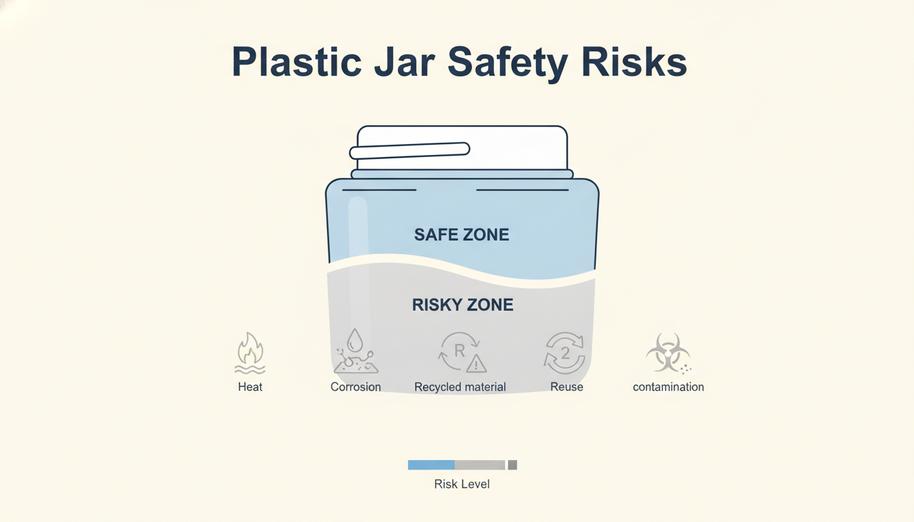
- High Temperature Precipitation Risk: Non-high-temperature resistant plastic jars will accelerate chemical molecular precipitation when exposed to high temperature, contaminating internal cosmetics.
- Corrosion Reaction Risk: Ordinary low-grade plastic jars are prone to chemical reaction with acidic, alkaline and alcoholic cosmetic ingredients, resulting in packaging deterioration and product deterioration.
- Recycle Material Risk: Inferior plastic jars made of recycled materials have unstable components and are easy to precipitate impurities and harmful substances.
2.2 Usage & Storage Risks
Even high-quality plastic jars will have safety hidden dangers if used and stored incorrectly. Standardized use is an important guarantee for giving full play to the safety of plastic packaging.
| Risk Type | Specific Performance | Safety Hazard |
|---|---|---|
| Long-term High-Temperature Storage | Plastic jars are placed in high-temperature environments such as car interiors and sun exposure for a long time | Accelerate chemical precipitation, cause cosmetic deterioration, and irritate the skin |
| Disordered Reuse | Reuse plastic jars that have expired, deformed or scratched seriously | Bacterial growth, increased impurity precipitation, reduced packaging stability |
| Mismatched Product Filling | Use ordinary plastic jars to fill high-concentration acidic and alkaline cosmetics | Packaging corrosion, ingredient deterioration, invalid product preservation |
| Unclean Production & Processing | Plastic jars have residual dust, bacteria and chemical residues before filling | Secondary pollution of cosmetics, affecting product safety |
3. How to Choose Safe Plastic Jars for Cosmetics
For beauty brands, selecting compliant and safe plastic jars is the key to ensuring product quality and consumer safety. Combined with industry standards and practical application experience, we summarize systematic selection criteria.
3.1 Priority Selection Principles
In cosmetic packaging scenarios, we need to select targeted plastic jars according to product attributes, and prioritize materials with high safety and strong stability.
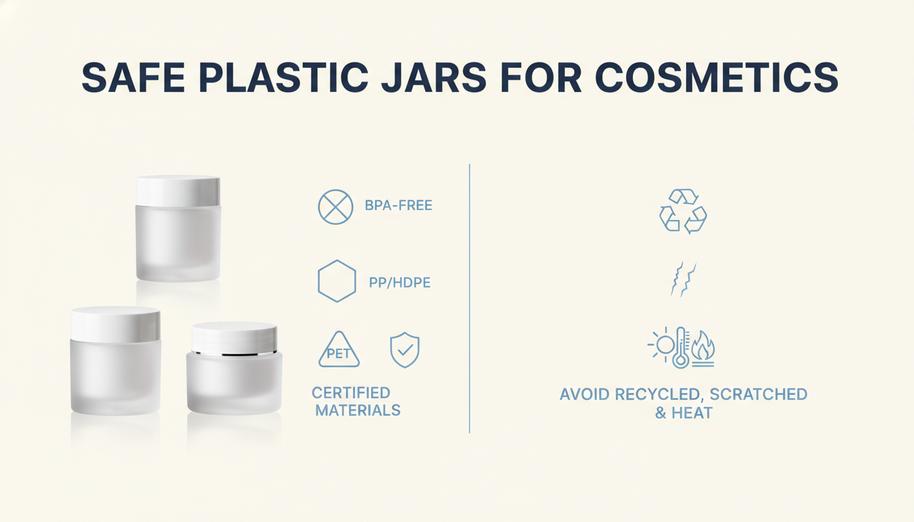
- Priority BPA-Free Materials: All cosmetic packaging plastic jars should choose BPA-free, BPS-free and BPF-free materials to avoid bisphenol series chemical hazards.
- Match Material with Product Attributes: PP and HDPE plastic jars are preferred for sensitive skin and organic cosmetics; PET plastic jars are suitable for conventional neutral cream products.
- Check Qualification Certificates: Before bulk procurement, verify the safety test report, cosmetic packaging qualification and food contact certification of plastic jars.
- Check Product Appearance: Qualified plastic jars have smooth surface, no bubbles, no peculiar smell, uniform thickness and no deformation.
3.2 Avoidance Guidelines
In the procurement and use of plastic jars, we need to avoid inferior materials and wrong matching methods to eliminate potential safety hazards from the source.
- Avoid low-cost inferior plastic jars made of recycled materials, which have unstable quality and untested safety performance.
- Avoid using non-high-temperature resistant plastic jars for hot filling and high-temperature storage of cosmetics.
- Avoid using PC, PVC and other unsafe plastic materials for long-term storage of skin care products in direct contact with the skin.
- Avoid repeatedly using expired, scratched and aged plastic jars to hold cosmetic products.
4. FAQs About Plastic Jars Safety
Q1: Are cosmetic plastic jars safe?
A1: Qualified cosmetic-grade plastic jars are completely safe. They are made of food-grade raw materials, pass professional safety tests, and have no chemical precipitation under normal use, which is suitable for cosmetic packaging. Only inferior unqualified plastic jars have safety risks.
Q2: Can plastic jars be reused?
A2: High-quality PP, HDPE plastic jars can be reused for many times after cleaning and disinfection. PET plastic jars are recommended for one-time or short-term repeated use. Deformed and damaged plastic jars are prohibited from reuse.
Q3: Do all plastic jars contain BPA?
A3: No. Regular cosmetic plastic jars all adopt BPA-free formula. Only individual low-grade PC plastic containers may contain BPA, which are not used in formal cosmetic packaging.
5. Conclusion
Plastic jars are safe, lightweight, cost-effective and highly versatile cosmetic packaging materials. Their safety does not depend on the plastic material itself, but on raw material quality, production standards and usage norms. By selecting qualified BPA-free food-grade plastic jars, matching materials reasonably, and standardizing storage and use methods, brands can completely avoid packaging safety risks and provide consumers with safe and reliable cosmetic products.
Post time: Jun-30-2026
