
Syringe bottle dosing depends on four variables: the orifice diameter, the piston stroke volume, the formula viscosity, and the seal at the tip. The stated dose is only reliable when all four are specified and tested together. A pack that delivers 0.10 ml on day one and 0.06 ml on day thirty has not solved the problem.
Precision sounds like a single property. In practice it is the output of a system, and most dosing failures come from a variable nobody wrote down.
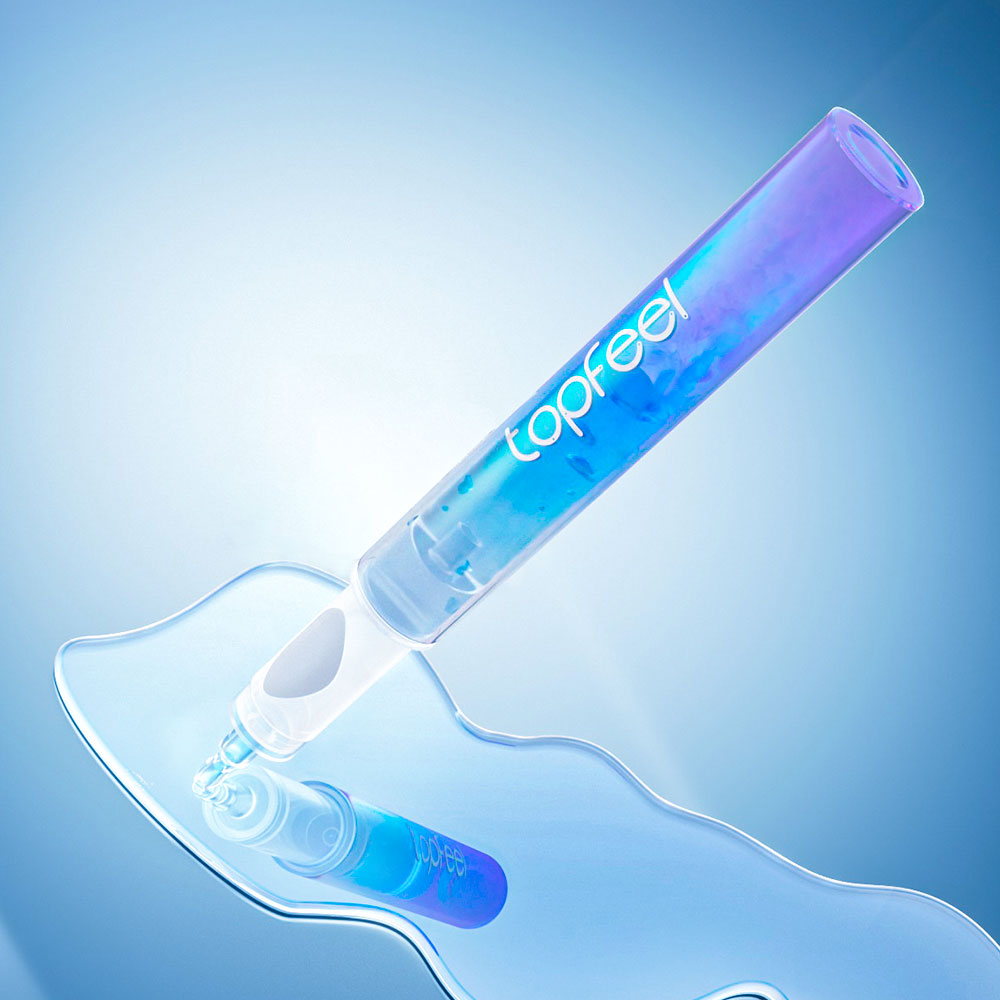
The four variables that set the dose
| Variable | What it controls | Typical specification | Failure mode if wrong |
|---|---|---|---|
| Orifice diameter | Flow rate and targeting | 0.5–3.0 mm | Clogging (too small) or imprecision (too large) |
| Piston stroke volume | Nominal dose per actuation | 0.05–0.50 ml | Consistent but wrong dose |
| Formula viscosity | Fill and flow behaviour | 5,000–30,000 cPs | Sputtering, incomplete delivery |
| Tip seal | Retention between uses | Internal plug seal | Drying, clogging, priming loss |
The important insight is that only two of these — orifice and stroke volume — are under the pack designer’s direct control. Viscosity belongs to the formulator, and the seal belongs to the cap designer. A dosing problem is therefore usually a coordination problem between three teams.
Start from the dose, not the pack
The correct specification sequence runs backwards from the application.
- Define the dose per application in millilitres. Not “a small amount” — a number. For an eye treatment this is typically 0.05–0.10 ml per eye; for a spot treatment 0.05 ml; for a scalp serum 0.5–1.0 ml per zone.
- Multiply by applications per treatment to get the required fill volume per use session.
- Divide the pack capacity by the session volume to check the pack supports a sensible number of uses.
- Only then select the mechanism whose stroke volume matches the dose, or whose stroke count × stroke volume matches it.
A worked example: a 15 ml eye serum, 0.08 ml per application, two applications daily to both eyes. That is 0.32 ml per day, roughly 47 days of use. If the available pump offers 0.10 ml per stroke, the user must actuate once and the dose is 25% over. Over a 47-day cycle that is 3.8 ml of excess product — 25% of the pack wasted, and a possible irritation risk around the eye.
That is the kind of error that is invisible on a specification sheet and obvious to the consumer in week three.
Orifice selection
| Orifice diameter | Flow behaviour | Suitable dose range | Application |
|---|---|---|---|
| 0.5–0.8 mm | Very slow; requires pressure | 0.02–0.08 ml | Micro spot, precise eye line |
| 0.8–1.5 mm | Controlled | 0.05–0.20 ml | Eye care, spot treatment |
| 1.5–3.0 mm | Free-flowing | 0.15–0.50 ml | Serum, essence, scalp |
| Above 3 mm | No meaningful restriction | 0.5 ml+ | Not a syringe format |

Two practical constraints sit outside this table.
Clogging risk rises steeply below 0.8 mm, especially with formulas containing suspended particles, pigments, or film-formers. A 0.6 mm orifice on a formula with 20 µm particles will clog intermittently.
Pressure requirements rise as the orifice narrows. A user with limited hand strength — relevant for eye products aimed at older consumers — may not generate enough force for a 0.5 mm orifice. This is a usability issue that dose testing on a bench will not reveal.
Testing dose consistency properly
A single dose measurement proves nothing. Consistency requires a distribution.
The test: weigh twenty consecutive actuations on a balance accurate to 0.001 g, at controlled temperature, using the actual formula in the actual production configuration.
What to look for:
- Coefficient of variation (CV) below roughly 5% for a claim of precision. Above 10% the dose is not meaningfully controlled.
- Mean versus nominal. A tight distribution around the wrong mean is worse than a wide distribution around the right one, because it is harder to detect.
- Drift across the actuation series. If the first five strokes average 0.12 ml and the last five average 0.07 ml, the pack is delivering a declining dose as the piston travels. This is common in syringe formats with short stroke lengths and is a design flaw, not a fill issue.
- First-stroke behaviour. The first actuation after filling and after a week of storage should be measured separately. A first stroke that delivers 0.02 ml means the user must prime the pack, and that lost volume comes out of the pack’s usable capacity.
The residue test: dispense to exhaustion and weigh the remainder. Airless syringe formats should leave under 5%. A plain plunger syringe typically leaves 8–15% because the plunger cannot reach into the shoulder. On a 15 ml pack at a high price point, that residue is real money.
Viscosity: the variable that breaks specifications
Viscosity affects the dose and is not fixed by the pack. Three consequences follow.
- Temperature changes viscosity. A formula at 8,000 cPs at 20 °C may be 20,000 cPs at 10 °C. A pack tuned to the warmer figure will under-dose in winter or in an unheated warehouse. Dose claims should specify the test temperature.
- Formula changes invalidate pack validation. If the formulator adjusts thickener levels after the pack is approved, the dose validation is void. Change control between formulation and packaging teams matters more in this format than in most.
- Shear-thinning formulas behave differently at the orifice. A formula that thins under shear may flow faster through a narrow orifice than its static viscosity suggests, or may not recover quickly enough and drip after actuation.
The practical control is to test the dose with the specific formula batch that will be filled, not with water or a surrogate. Water-based testing is common because it is cheap and it produces numbers that mean nothing for a 15,000 cPs emulsion.
The cap seal problem
The single most common field complaint in this format is the tip drying and blocking between uses. It is a cap design issue.
A cap that merely covers the orifice allows a small air space at the tip where product dries. Over a few days the dried film blocks the cannula, and the user’s next actuation delivers nothing or a sputter.
A cap with an internal plug that enters the orifice displaces the air at the tip and seals the product column directly. This is a small moulded feature with a large effect on the user experience.
Test procedure: cap the filled pack, store seven days at ambient and at 30 °C, then actuate. If priming is required, the cap does not seal adequately. Repeat after twenty open-close cycles, because the plug degrades with use.

Reliability across the use cycle
Precision is not a constant. It degrades.
| Cycle stage | What changes | What to test |
|---|---|---|
| First actuation | Piston seating, priming | First-stroke volume |
| Early use (strokes 1–20) | Steady state | CV across 20 strokes |
| Mid use (strokes 20–100) | Piston wear, seal compression | Dose drift |
| Late use (residual) | Short stroke, product starvation | Residue and final dose |
| After storage gaps | Tip drying, product settling | Re-priming requirement |
A pack that tests well at strokes 1–20 and drifts at stroke 80 has not met the brief, and the standard bench test will not catch it.
Specification checklist
- ☐Dose per application defined in millilitres, with the application area and frequency
- ☐Stroke volume specified, with the resulting stroke count per application
- ☐Orifice diameter specified against the formula’s particle size and viscosity
- ☐Viscosity range specified at the actual storage and use temperatures
- ☐Cap seal type specified — internal plug, not merely a cover
- ☐Dose consistency tested with the actual formula, CV target stated
- ☐First-stroke and post-storage behaviour measured separately
- ☐Residue measured to exhaustion
- ☐Change control agreed between formulation and packaging teams
Frequently asked questions
What dose accuracy should a cosmetic syringe bottle achieve?
A coefficient of variation below 5% across twenty consecutive actuations is a reasonable target for a pack marketed on precision. Below 10% the dose is repeatable enough for most cosmetics but not for a claim of exact dosing.
Does a smaller orifice give better precision?
Not automatically. A smaller orifice improves targeting but increases clogging risk and the force required. Precision comes from stroke volume consistency, and a very small orifice can reduce it if the flow becomes intermittent.
Can dose be adjusted after the pack is ordered?
Only by changing the mechanism or the formula. Stroke volume is fixed by the piston and chamber geometry, so adjusting dose usually means a new mechanism, not a new setting. This is worth resolving before tooling.
Why does the last 10% of the pack dispense unpredictably?
The piston travels a shorter distance in the final strokes and product tends to starve at the orifice. Airless designs with a collapsible chamber handle this better than a rigid plunger. Residual volume of 8–15% is normal for a plain plunger syringe.
Is dose precision affected by the fill line?
Yes, significantly. An under-filled airless pack contains an air pocket that must be compressed before product flows, which changes the first-stroke volume and can shift the dose for the whole pack.
Sourcing precision-dosing packaging
Topfeelpack manufactures airless syringe bottles and narrow-orifice applicators from 5 ml to 30 ml, with dose validation available against your actual formula. See the syringe bottle range for capacities and orifice options, or review airless bottles for adjacent dosing formats.
Send the target dose, formula viscosity, and application area, and we will specify a mechanism whose stroke volume matches before tooling begins.
Post time: Nov-12-2026
