
Dual-chamber packaging is worth evaluating when two skincare formulas belong to one treatment concept but should not share the same reservoir before use. The format can keep them physically separate and dispense them independently or together. However, a dual-chamber bottle does not by itself prove formula compatibility, stability, shelf life, or dosing accuracy. Brands must validate each formula, contact material, chamber, pump, and intended mixing ratio as one finished package system.
That distinction matters during packaging selection. A dual-format concept may look compelling in a presentation, but it must also work during filling, storage, transport, dispensing, and normal consumer use. This guide explains when separation is justified, which dispensing structure to consider, and what evidence a skincare brand should obtain before approving samples.
What Is Dual-Chamber Packaging for Separate Formulas?
Dual-chamber packaging places two formulas in physically separate compartments within one retail unit. Depending on the design, users may dispense one side at a time, activate both sides simultaneously, or apply the products in sequence. Each formula has its own product-contact path, so the package must be assessed as two dispensing systems that also function together.
The concept is different from a single bottle containing a premixed formula. It is also different from ordinary secondary packaging that simply holds two separate bottles in a carton. A dual-chamber system integrates both formulas into one coordinated package and user experience.
Brands considering this format can review Topfeelpack's Dual Chamber Bottle category to understand the range of structural concepts available. Product-page specifications are starting points for screening, not substitutes for tests with the intended formulas.
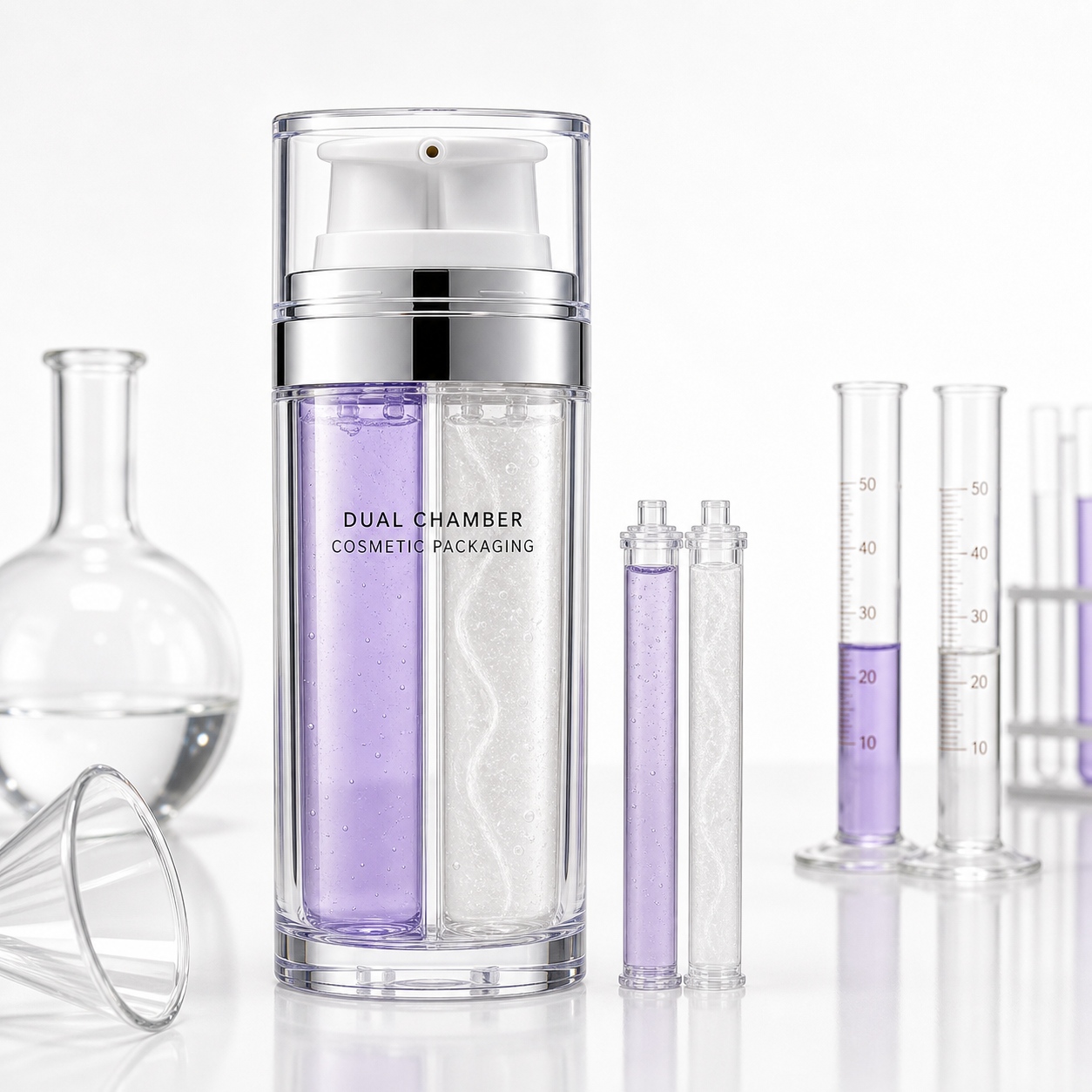
When Do Two Skincare Formulas Need to Remain Separate?
Two formulas should remain separate only when separation solves a defined formulation, dispensing, positioning, or usage problem. Complexity alone is not a benefit. The project team should be able to document why a single reservoir or two conventional packages would not serve the concept as well.
1. The combined formula has not demonstrated acceptable stability
A formulation team may determine through development work that two components should not be stored as one mixture. Potential warning signs include changes in color, odor, viscosity, pH, appearance, or other agreed quality attributes after the components are combined. Separation can prevent contact during storage, but it does not prove that either formula is stable inside the selected package.
Avoid assuming that familiar active ingredients automatically require separate chambers. Compatibility depends on the complete formulas, concentrations, processing conditions, contact materials, storage environment, and intended period of use. The formulation and safety teams should define the evidence required for the actual product.
2. The formulas need different dispensing conditions
A lightweight liquid and a higher-viscosity cream may require different pumps or dosage targets. A dual system can potentially pair two lotion pumps or combine formats such as a spray and a lotion pump, subject to the selected model's verified configuration. The benefit is not simply storing two textures; it is giving each texture a suitable dispensing path.
Viscosity data alone is not enough. Rheology, particulates, air entrapment, priming behavior, temperature sensitivity, and the formula's interaction with the pump can all affect performance. Test filled samples rather than approving a package from an empty-component demonstration.
3. The products form a deliberate two-step routine
Some concepts are intended for sequential use—for example, one formula followed by another—rather than mixing in the hand. Independent dispensing can keep the routine together while allowing users to control the order and quantity. This may suit paired day-and-night products or complementary treatment steps, provided the directions are clear and the two sides have appropriate usage lives.
The design team should verify that consumers can identify each chamber, understand the sequence, and avoid confusing one actuator with the other. Clear labeling and differentiated visual cues are functional requirements, not merely decoration.
4. The intended ratio must be created at the point of use
Simultaneous dispensing may be considered when the product concept calls for two formulas to meet immediately before or during application. In this case, the required output ratio becomes a critical performance specification. It must remain acceptable from the first usable dose through the expected end of pack life—not just during one bench demonstration.
If the formulas empty at different rates, the consumer may be left with product in one chamber. Before sampling, calculate the fill volumes, target dose from each side, expected number of actuations, priming loss, and allowable output-ratio range.
Separate Dispensing or Simultaneous Dispensing?
Choose the dispensing mode from the intended routine and measurable formula requirements. Do not select it only for novelty.
| Dispensing structure | Best suited to | Main points to validate |
|---|---|---|
| Independent dispensing | Two formulas used separately or in sequence | Instructions, actuator identification, dose per side, and usage-rate mismatch |
| Simultaneous dispensing | Two formulas intended to meet at the point of use | Output ratio, synchronization, mixing behavior, and whether both sides empty together |
| Different pump types | Formulas requiring different application formats | Pump–formula fit, dose or spray quality, operation sequence, and user comprehension |
For example, Topfeelpack's DA17 dual-chamber package lists dual-lotion, dual-spray, and spray-plus-lotion configurations. Its page also lists 10 ml + 10 ml and 15 ml + 15 ml options. Those are verified specifications for that model only; brands should confirm current specifications and test the selected configuration with their own formulas.
What Must Be Tested Before Sample Approval?
A useful test plan links every test to a defined failure risk and acceptance criterion. “No visible problem” is not a complete specification. The brand, formulator, filler, test laboratory, and packaging supplier should agree on responsibilities before production approval.
Formula–package compatibility
Evaluate each formula against every material in its product-contact path, including chamber, piston or pouch where applicable, gasket, valve, dip tube, pump components, and outlet. Observe agreed attributes under appropriate storage conditions and orientations. Also inspect the package for swelling, cracking, stress, discoloration, corrosion, loss of seal, or changes in dispensing behavior.
For products placed on the EU market, Annex I of Regulation (EC) No 1223/2009 addresses the cosmetic product's physical and chemical characteristics and stability under reasonably foreseeable storage conditions. It also calls for relevant information about packaging-material characteristics, particularly purity and stability. The responsible regulatory and safety professionals should determine how those requirements apply to the finished product.
Pump performance and dose consistency
Test priming, dose per actuation, output consistency, re-priming after storage, residual product, and performance at relevant orientations and temperatures. For simultaneous systems, record the output of each side separately as well as the combined dose. Establish an acceptable ratio range based on the product concept rather than assuming both pumps will remain perfectly synchronized.
Leakage, sealing, and transport resistance
Assess the filled package under the distribution conditions relevant to the project. The protocol may include orientation, vibration, drop, pressure or altitude simulation, and temperature cycling where justified. Check both external leakage and internal migration between chambers or product paths.
Stability and finished-package assessment
Run the stability program on the formulas in the intended final package, not only in laboratory reference containers. Examine each side independently and, if the formulas are intended to mix during use, assess the combined product under the conditions defined by the formulator. Packaging cannot replace a suitable preservation, safety, compatibility, and stability program.
Filling and assembly feasibility
Confirm how each chamber will be filled, assembled, coded, inspected, and rejected if it is out of specification. The two formulas may have different filling temperatures, handling needs, or bulk hold times. Determine whether the selected filler can control fill weight and prevent cross-contamination while assembling the finished unit efficiently.
User comprehension
Ask representative users to identify each side and complete the intended routine using realistic instructions. Observe missed actuations, accidental dispensing, incorrect order, difficulty pressing both pumps, and confusion about mixing. A technically functional package can still fail if its operation is unclear.
When Is Dual-Chamber Packaging the Wrong Choice?
Dual-chamber packaging is probably not justified when a stable single formula already meets the product brief, when the two products do not need to travel or operate together, or when a conventional set provides a clearer user experience. It may also be unsuitable when filling complexity, component cost, line capability, or testing requirements exceed the project's commercial limits.
Reconsider the format if the two formulas are consumed at substantially different rates, if the required dose ratio cannot be maintained, or if one side is likely to empty long before the other. Sustainability claims also require care. A compact two-in-one unit may reduce some secondary components, but a multi-component dispensing system is not automatically recyclable. Material composition, disassembly, local collection, sorting, and recycling infrastructure all influence the outcome.
Questions to Ask a Dual-Chamber Packaging Supplier
Before requesting samples, provide enough information for meaningful screening and ask specific questions:
- Which components and materials contact each formula?
- Can the two chambers use different pump types?
- What is the nominal dose from each side, and what tolerance applies?
- What formula properties and viscosity information does the supplier need?
- Can each chamber be operated independently, simultaneously, or both?
- How should the two chambers be filled and assembled?
- What drawings, decoration areas, samples, and component documentation are available?
- Which performance checks can the supplier support, and which tests remain the brand's responsibility?
- Are the proposed capacities aligned with the expected dose and usage period of both formulas?
- Have any specifications, materials, or production conditions changed since the sample was made?
Use a consistent supplier-qualification process alongside the technical review. Topfeelpack's Cosmetic Packaging Supplier Checklist provides additional questions to ask before sampling.
A Practical Go/No-Go Decision Framework
A dual-chamber project is ready to proceed to structured sampling only when the team can answer “yes” to all five questions below:
| Decision gate | Evidence needed |
|---|---|
| Separation need | A documented formulation, dispensing, routine, or positioning reason for keeping two products apart |
| Dispensing feasibility | A plausible pump and dose configuration for both formulas, including the intended ratio or sequence |
| Compatibility plan | Identified contact materials, risks, test methods, conditions, acceptance criteria, and owners |
| Filling feasibility | A filler and assembly process capable of handling both products and the selected component |
| Commercial justification | User value and brand differentiation sufficient to support added package, testing, and production complexity |
If one gate is unresolved, treat the concept as an investigation rather than a production-ready solution. Early evidence is cheaper than correcting a filling-line or field-performance problem later.
Frequently Asked Questions
Can two skincare formulas use different pumps in one package?
Some dual-chamber models support different dispensing formats, such as a spray paired with a lotion pump. Availability is model-specific. The brand must verify that each pump suits its formula and that consumers understand how and when to operate each side.
Does dual-chamber packaging guarantee formula stability?
No. It can keep two formulas physically separate before use, but stability depends on the complete formula, manufacturing process, package-contact system, storage conditions, and intended life. Finished-package stability and compatibility testing are still required.
Can the formulas mix automatically during dispensing?
Certain structures can discharge both sides together so the outputs meet at or after the outlet. The mixing result and dose ratio must be tested with the actual formulas. Other structures are intended for independent, sequential dispensing.
What should a brand provide before requesting samples?
Provide the formula type, relevant physical properties, viscosity or rheology information, target dose, intended mixing ratio or usage sequence, required capacity, target market, decoration needs, filling plan, and launch timing. Share confidential formula information through an appropriate controlled process.
Is dual-chamber packaging suitable for formulas with different viscosities?
It may be, particularly when each side has an appropriate pump, but suitability cannot be decided from viscosity numbers alone. Filled-sample testing should assess priming, output consistency, ratio, residual product, temperature effects, and consumer operation.
Plan the Package as a Complete System
Dual-chamber packaging is most valuable when separation solves a verified product problem and the two sides create a coherent consumer routine. The best procurement decision is based on evidence: a defined reason for separation, suitable dispensing paths, a realistic filling process, and an approved compatibility and stability program.
Evaluating dual-chamber packaging for two skincare formulas? Send Topfeelpack the intended formula types, viscosity ranges, required dispensing sequence, target dose, and capacity. The team can help identify relevant packaging options for sampling. Final compatibility, stability, safety, and filling validation should be completed with your formulation, regulatory, filling, and testing partners before production.
External sources
- European Union — Regulation (EC) No 1223/2009 on cosmetic products, consolidated text accessed August 13, 2026. Annex I addresses physical/chemical characteristics and stability under reasonably foreseeable storage conditions and relevant packaging-material characteristics.
- U.S. Food and Drug Administration — Product Testing of Cosmetics, page dated November 21, 2022 in Google results and accessed August 13, 2026. Use as a general safety-substantiation reference; the FDA page was temporarily unavailable during final source checking, so the CMS editor should reopen and verify it before publishing.
Post time: Aug-13-2026
