
A dual-chamber bottle keeps two formulas separate by giving each its own reservoir and its own product path through the pump to the outlet. The formulas meet only if the design discharges both sides together, and then only at or after the outlet. Separation depends on seals, valves, and components that must be tested with the actual formulas.
The Core Principle: Two Reservoirs, Two Product Paths
A dual-chamber package is built as two dispensing systems inside one retail unit. Each formula has its own product-contact path, from the chamber through the pump to the outlet. This differs from a bottle holding one premixed formula, and from a carton holding two separate bottles.
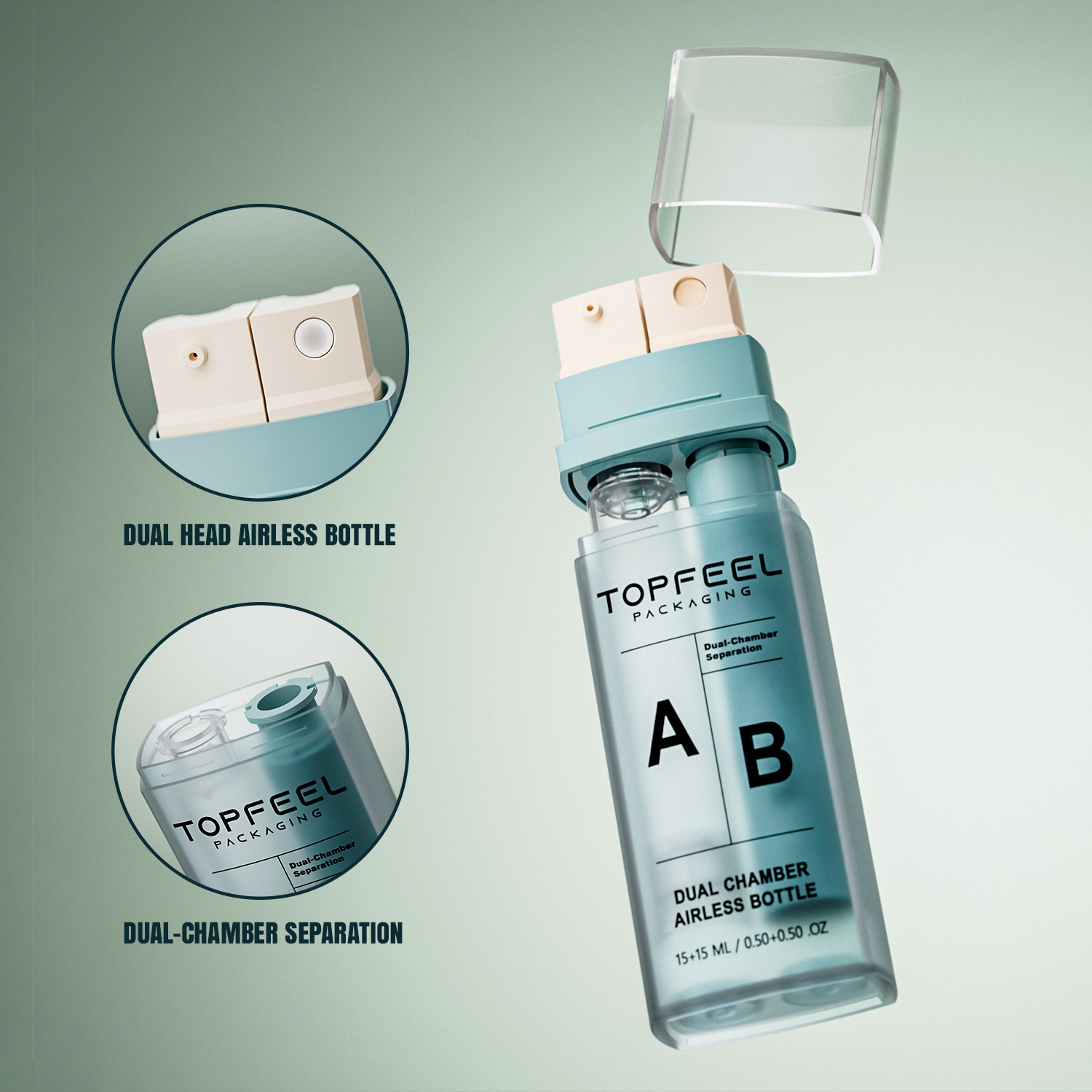
Components That Create the Separation
| Component | Role | What to verify |
|---|---|---|
| Chamber wall | Holds each formula apart | No swelling, cracking, stress, or discoloration with the formula |
| Piston or pouch (where used) | Moves product toward the pump as it is used | Smooth movement; residual product at end of use |
| Gasket and valve | Seal each product path | External leakage and internal migration between chambers |
| Pump or actuator | Dispenses each side | Priming, dose per actuation, output consistency |
| Outlet | Where product leaves the pack | Cross-contact, build-up, output ratio |
Which parts exist depends on the model. Ask the supplier for the component list of each formula’s contact path.
Independent or Simultaneous Dispensing
With independent dispensing, each side has its own actuator and the user chooses the order and quantity. With simultaneous dispensing, both sides discharge together and the outputs meet at or after the outlet. Simultaneous systems make the output ratio a critical specification: it must stay acceptable from the first dose to the end of pack life, not only during one bench demonstration.
Where Separation Can Fail
Separation is a design intent, not a certainty. Check four risks:
- Leakage at a seal or gasket.
- Internal migration between chambers or product paths.
- Cross-contact at a shared or adjacent outlet.
- Unequal emptying, which leaves one side full when the other is finished.
A demonstration with an empty package or with water does not show how the pack behaves with real formulas.
What to Test Before Approving Samples
- Formula-package compatibility for every contact material in each product path.
- Pump performance: priming, dose per actuation, re-priming after storage, and residual product. For simultaneous systems, record each side’s output and the combined dose.
- Leakage and transport resistance on the filled pack, checking both external leakage and internal migration.
- Stability in the final package for each formula, and for the combined product if the formulas are meant to mix.
Packaging cannot replace a suitable preservation, safety, compatibility, and stability program.
Topfeelpack Examples
-

DA17 Dual Chamber Airless Bottle: listed with dual-lotion, dual-spray, and spray-plus-lotion configurations, plus 10 ml + 10 ml and 15 ml + 15 ml options. -

DA13 Airless Dual Chamber Plastic Cosmetic Bottle: listed as an airless dual-chamber plastic bottle.
Product-page specifications are screening points. Confirm current details with Topfeelpack and test with your own formulas.
A Worked Example of the Pre-Sampling Calculation
This is an illustrative calculation, not a Topfeelpack specification. Suppose each chamber holds 15 ml, and the brief calls for a target dose of 0.5 ml per actuation from side A and 0.4 ml from side B.
- Side A: 15 ml / 0.5 ml = 30 actuations before priming loss.
- Side B: 15 ml / 0.4 ml = 37.5 actuations before priming loss.
- If the user always presses both sides together, side A is empty after 30 uses while side B still holds about 3 ml, roughly 20 percent of its fill.
The example shows why fill volumes should be set from the dose and the intended ratio, not matched by default. If both sides must empty together, the fills or the pump outputs need to be matched to the ratio. Priming loss and dose tolerance shift the numbers further, so measure filled samples rather than relying on arithmetic alone.
What to Send a Supplier
Provide the formula type and viscosity range for each side, the target dose and ratio, the required capacity of each chamber, the intended dispensing mode, decoration needs, and the destination markets. Ask which components contact each formula and what tolerance applies to the dose from each side.
FAQ
Does separation guarantee that each formula stays stable?
No. Separation keeps the formulas apart before use, but stability still depends on each formula, the contact materials, and storage conditions.
Can the two chambers use different pumps?
Some models support different formats, such as a spray paired with a lotion pump. Availability is model-specific.
How can a brand check that both sides empty together?
Before sampling, calculate fill volumes, target dose per side, expected number of actuations, priming loss, and the allowable ratio range. Then measure the output of filled samples.
Request samples · Request a quote: contact Topfeelpack
Post time: Nov-18-2026
