
Pharmaceutical-inspired skincare products should be packaged according to the formula's stability, texture, dispensing, and user-experience requirements—not simply to make the product look like medicine. Packaging can communicate clinical credibility through clarity, precision, and functional design, but it cannot replace formula testing, substantiated claims, or regulatory review.
For most active skincare products, the main packaging options include airless bottles, dropper bottles, cosmetic tubes, cream jars, and, in specific cases, dual-chamber bottles. The right choice depends on the product format and the risks that need to be controlled during storage and use.
What Is Pharmaceutical-Inspired Skincare?
"Pharmaceutical-inspired skincare" generally describes cosmetic products influenced by pharmaceutical research, clinical aesthetics, active ingredients, or dermatologist-led product development.
It may include:
- High-performance serums
- Barrier-repair creams
- Acne-prone skin products
- Brightening treatments
- Retinoid-inspired products
- Professional or clinic-positioned skincare
- Products marketed around clinical testing or active ingredients
The term does not automatically mean that a product is a pharmaceutical drug. In the United States, product classification depends heavily on intended use and the claims made on labels, websites, advertising, and other promotional materials. The FDA does not recognize "cosmeceutical" as a separate legal product category.
Therefore, packaging decisions should support the product's actual cosmetic positioning rather than imply drug approval or therapeutic performance.
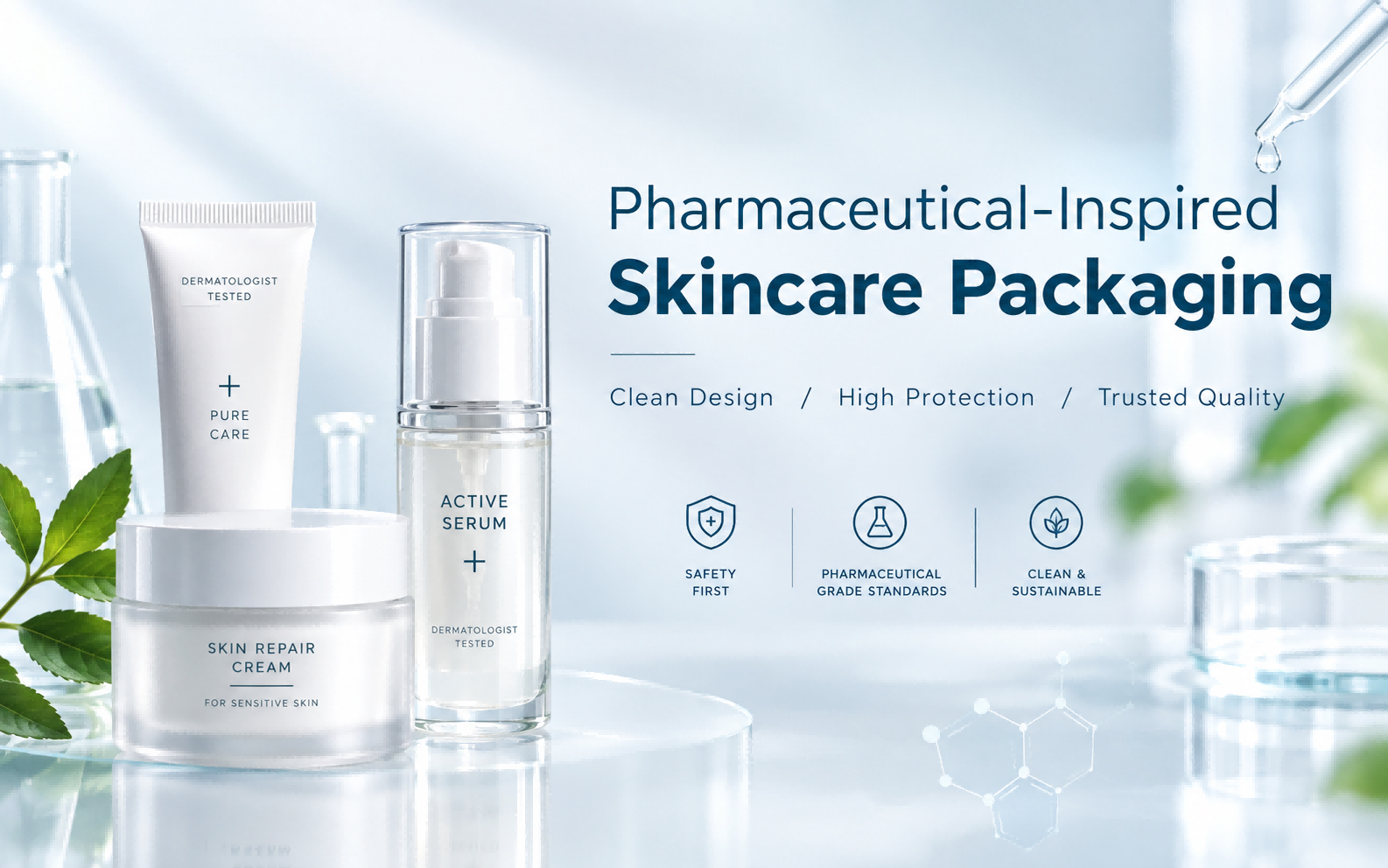
Start With the Formula, Not the Pharmaceutical Look
A clinical or pharmaceutical-style appearance should be considered only after the formula requirements are understood.
Before selecting a package, evaluate:
- Formula viscosity
- Dispensing quantity
- Sensitivity to air, light, or contamination
- Compatibility with the package components
- Expected frequency of use
- Consumer application method
- Filling and assembly requirements
- Whether two ingredients need to remain separate
The package should solve a formula or usage problem before it communicates a brand position.
For example, an airless bottle may be suitable for a cream or lotion that requires controlled dispensing, while a dropper bottle may be more appropriate for a fluid serum where the user expects visible dosage control. These are packaging decisions, not automatic consequences of calling a product "clinical" or "medical-grade."
Which Packaging Format Is Best?
Airless Bottles for Controlled Skincare Dispensing
An airless bottle can be considered for serums, lotions, creams, and other products that require measured dispensing or a clean, controlled user experience.
It may be a suitable direction when a brand wants to emphasize:
- Controlled dose delivery
- Minimal direct contact with the formula
- A clean and precise application experience
- A modern clinical appearance
- A premium skincare format
However, airless packaging should not be described as universally protective or automatically suitable for every active formula. Brands should confirm compatibility, pump performance, dosage consistency, residual product, and stability under expected storage conditions.
Dropper Bottles for Fluid Serums
Dropper bottles are often associated with concentrated serums, facial oils, and lightweight treatment products. Their visual transparency can help communicate precision and active-ingredient positioning.
Important evaluation points include:
- Drop size and dosage consistency
- Formula viscosity
- Leakage during transport
- Interaction between the formula and dropper components
- Exposure to air during repeated use
- Ease of use for the target consumer
A dropper bottle may create a strong clinical impression, but the visual association alone is not evidence that the product has pharmaceutical-level performance.
Cosmetic Tubes for Targeted Treatments
Cosmetic tubes are practical candidates for gels, creams, spot treatments, eye products, and other formulas that require targeted application.
They can support a pharmaceutical-inspired design direction through:
- Compact proportions
- Clear dosage instructions
- Narrow or controlled dispensing openings
- Easy portability
- Simple, high-contrast labeling
Tubes may be especially useful when the product is intended for a specific area of application. The closure, nozzle, or opening should be evaluated together with the formula to reduce leakage, over-dispensing, and unnecessary product exposure.
Cream Jars for Rich Textures
Cream jars may be considered for rich creams, masks, balms, and other high-viscosity products that are difficult to dispense through a pump.
The main questions are:
- How will consumers remove the product?
- Is the formula intended for repeated opening?
- Is a spatula or other accessory needed?
- Does the jar format match the product's hygiene expectations?
- Does the jar help or weaken the brand's clinical positioning?
A jar can look premium and substantial, but it may communicate a different usage experience from a precise pump or tube. The format should match the product's texture and consumer routine.
Dual-Chamber Bottles for Separate Formulas
A dual-chamber bottle should be considered only when two formulas need to remain separated until dispensing or application.
Potential use cases may include:
- Two-part skincare systems
- Separate active ingredients
- Fresh-mix concepts
- Products requiring different storage conditions before use
- Formula combinations that are not intended to be premixed during storage
The key validation points include:
- Separation between chambers
- Independent dispensing performance
- Mixing ratio
- Simultaneous or sequential dispensing
- Consumer understanding of the instructions
- Compatibility of both formulas with the package
A dual-chamber format should solve a genuine formula or application requirement. It should not be selected only because it looks technologically advanced.
Packaging Format Comparison
| Packaging format | Potential product formats | Main evaluation points |
|---|---|---|
| Airless Bottle | Serum, lotion, cream | Compatibility, pump performance, dose consistency, residual product |
| Dropper Bottle | Fluid serum, facial oil | Drop size, viscosity, leakage, repeated-use exposure |
| Cosmetic Tube | Gel, cream, eye or spot product | Opening design, targeted application, leakage, over-dispensing |
| Cream Jar | Rich cream, balm, mask | Product access, repeated opening, application routine |
| Dual Chamber Bottle | Two-part or fresh-mix system | Formula separation, dispensing ratio, mixing instructions |
How Can Packaging Communicate Clinical Credibility?
Pharmaceutical-inspired packaging does not need to imitate a medicine bottle. A more effective approach is to use design elements that communicate precision and transparency.
Use Clear Information Hierarchy
The front panel should make the product easy to understand. Important information may include:
- Product type
- Main cosmetic benefit
- Key ingredient category
- Skin concern or usage area
- Net content
- Directions or frequency of use
The information hierarchy should be consistent across the primary container and secondary packaging.
Use Restrained Visual Design
Clinical skincare brands often use:
- Limited color palettes
- White space
- Clear typography
- Structured layouts
- Minimal decorative elements
- Technical but readable information
These elements can create a professional impression without making unsupported medical suggestions.
Make Dosage and Instructions Easy to Follow
Precision is communicated not only through appearance but also through usability.
Consider whether the package makes it clear:
- How much product to use
- How often to apply it
- Whether the product should be shaken
- Whether two components must be mixed
- Which area of the skin is appropriate
- How the package should be closed or stored
A visually clinical package with confusing instructions can weaken trust.
Which Pharmaceutical-Inspired Design Elements Require Caution?
Some visual and verbal elements may create unintended regulatory or consumer-perception risks.
Use caution with:
- Prescription-style symbols
- Medical crosses or hospital-like graphics
- Dosage language that implies treatment
- "Clinically proven" without appropriate evidence
- "Medical-grade" without a clear substantiation basis
- "Pharmaceutical-grade" ingredient language
- Disease-treatment claims
- Before-and-after imagery implying guaranteed medical results
- Statements suggesting FDA approval where none exists
In the United States, claims that a product will diagnose, cure, mitigate, treat, or prevent disease—or affect the structure or function of the body—can cause a product to be regulated as a drug. A cosmetic may also be both a cosmetic and a drug when it has both cosmetic and drug intended uses.
The packaging itself should therefore be reviewed together with:
- Product name
- Label copy
- Website content
- Advertising
- Social media claims
- Ingredient descriptions
- Consumer instructions
Cosmetic Claims Versus Drug Claims
A product may remain within cosmetic positioning when its claims focus on appearance or cosmetic benefits, such as:
- Hydrates dry-feeling skin
- Improves the appearance of uneven tone
- Helps skin feel smoother
- Supports a healthy-looking skin barrier
- Reduces the appearance of fine lines
- Leaves skin looking brighter
Claims relating to disease treatment, prevention, or physiological change require much greater care. The FDA states that intended use can be established through labeling, advertising, websites, promotional materials, consumer perception, and certain ingredient associations.
For international brands, claim review should also consider the target market. In the European Union, cosmetic claims are subject to common criteria for justification, including legal compliance, truthfulness, evidential support, honesty, fairness, and informed decision-making.
This article is a packaging-planning guide, not a substitute for market-specific regulatory or legal review.
A Practical Packaging Selection Framework
| Question | Packaging implication |
|---|---|
| Is the formula fluid or viscous? | Consider a dropper, pump, tube, or jar according to dispensing performance |
| Does the product require measured dosing? | Evaluate pumps, droppers, or controlled openings |
| Is the formula sensitive during repeated use? | Review exposure, closure, compatibility, and storage conditions |
| Is targeted application important? | Consider a cosmetic tube or controlled nozzle |
| Must two formulas stay separate? | Investigate a dual-chamber system |
| Does the product need a clinical appearance? | Use restrained typography, clear information, and functional design |
| Are there drug-like claims? | Conduct regulatory and claim review before finalizing packaging copy |
| Does the package match the consumer routine? | Test opening, dispensing, application, and closure in realistic use |
Packaging Selection Checklist
Before finalizing a pharmaceutical-inspired skincare package, confirm:
- The package format matches the formula viscosity.
- Formula and packaging compatibility will be evaluated.
- The dispensing method produces an appropriate amount.
- The package can be filled, assembled, transported, and used as intended.
- Any light, air, storage, or repeated-use requirements have been identified.
- The clinical design remains readable and easy to use.
- Instructions explain dosage, mixing, storage, and application where relevant.
- Cosmetic claims do not imply unsupported treatment or drug approval.
- Market-specific label and claim requirements will be reviewed.
- Final package testing reflects realistic storage and consumer-use conditions.
Final Takeaway
The best packaging for pharmaceutical-inspired skincare is not necessarily the package that looks most like a medicine. It is the format that aligns the formula, dispensing method, stability needs, consumer routine, visual identity, and market claims.
For many active skincare concepts, airless bottles, dropper bottles, cosmetic tubes, and cream jars may all be possible starting points. Dual-chamber packaging is more specialized and should be reserved for formulas or application systems that genuinely require separation.
A credible clinical skincare package should communicate:
- Precision
- Clarity
- Functional suitability
- Responsible claims
- Consistent user experience
Packaging can reinforce trust, but it should never be used to imply medical approval, pharmaceutical status, or therapeutic performance that the product cannot substantiate.
Frequently Asked Questions
Is pharmaceutical-inspired skincare the same as cosmeceutical skincare?
Not necessarily. "Pharmaceutical-inspired" usually describes a product's development philosophy, visual identity, or active-ingredient positioning. "Cosmeceutical" is an industry marketing term rather than a separate legal category under U.S. federal law.
Is airless packaging always best for active skincare?
No. Airless packaging may be a candidate for certain formulas, but suitability depends on viscosity, component compatibility, dispensing performance, stability requirements, and the intended user experience.
Can cosmetic packaging look like pharmaceutical packaging?
It can use clean, precise, and clinical design cues, but brands should avoid misleading symbols, drug-like claims, or visual language that suggests regulatory approval or therapeutic treatment.
When should a brand use dual-chamber packaging?
A dual-chamber package is most appropriate when two formulas need to remain separate before dispensing or application. The concept should be validated through formula and package testing.
What is the safest alternative to "medical-grade skincare"?
Depending on the product evidence and market, brands may consider more specific language such as "clinical skincare," "professional skincare," "dermatologist-developed," or a direct cosmetic benefit. Each claim still requires appropriate substantiation and market review.
Post time: Aug-31-2026
