
Cosmetic packaging design companies can make or break your brand, and that’s the truth no one sugarcoats. One bad batch, one off-color label, and suddenly your shelf appeal tanks while costs creep up and timelines slip. This isn’t just about pretty jars; it’s about keeping your reputation intact when production scales fast.
The right partner thinks beyond looks, balancing creativity, compliance, and consistency so your product shows up sharp, every time.
Melodic Key Points: Cosmetic Packaging Design Companies
➔ Expertise Validation: Review case studies and measurable results to ensure proven industry know-how and shelf-impact success.
➔ Trust & Transparency: Verify authentic portfolios, ISO 9001 quality certifications, and clear communication flows for seamless collaboration.
➔ Material & Finish Innovation: Opt for sustainable substrates, gloss or soft-touch coatings, and metallic foils that elevate brand distinction.
➔ Cost & Compliance Clarity: Choose partners offering transparent pricing, end-to-end services, and full regulatory adherence for reliable scaling.
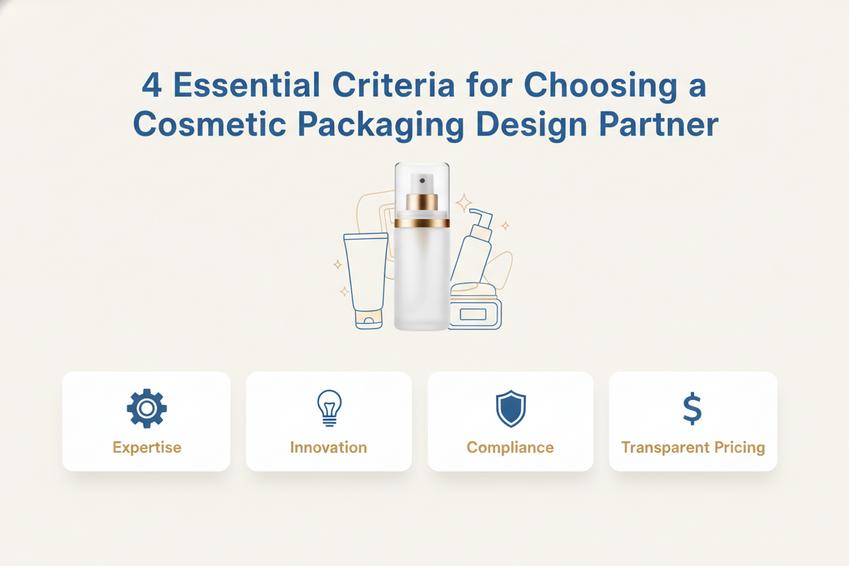
4 Essential Criteria For Design Partner Selection
Picking among cosmetic packaging design companies can feel messy, but a clear lens helps. This quick guide breaks down what actually matters when comparing cosmetic packaging design companies and selecting a specialized packaging design company for cosmetics.
Proven Industry Expertise: Cosmetic Packaging Case Studies
- Portfolio depth
- • Review experience across skincare, color cosmetics, and fragrance
- • Check case studies tied to real retail launches
- • Look for measurable lift: sell-through, shelf pickup, repeat buys
- Execution signals
-
- Consistent design language across SKUs
-
- Smart packaging structures that protect formulas
-
- Clear brand-story alignment backed by industry insight
-
- Reality check
- ◦ A strong expertise trail beats flashy mockups every time
Short take: the best cosmetic packaging design companies show proof, not promises. Topfeelpack, with over 14 years of specialized experience and 200+ successful airless product launches, highlights before/after outcomes to ground decisions in data, not vibes.
Innovative Material Solutions for Brand Differentiation
- Material thinking
- • Innovation in mono-materials, refill systems, and PCR content to meet modern eco-friendly demands.
- • Sustainability claims backed by reputable third-party certifications.
- User impact
-
- Tactile feel → premium perception
-
- Barrier performance → product stability
-
- Design edge
- ◦ Unique finishes and technology that stand out on shelf
A cosmetic packaging design company that treats materials as storytelling tools wins attention fast, especially when balancing structural integrity with environmental responsibility.
End-to-End Service Capabilities and Regulatory Compliance
- Full chain control
- • Services spanning concept → prototyping → manufacturing
- • Integrated supply chain visibility
- Compliance guardrails
-
- Global regulatory checks (such as EU standards, FDA guidelines, and ASEAN compliance)
-
- Accurate packaging and labeling alignment to satisfy global consumer safety laws
-
- Quality loop
- ◦ Ongoing audits to maintain quality at scale
Cosmetic packaging design companies that own the entire supply chain dramatically reduce lead times, production delays, and compliance risks.
Transparent Pricing Models Aligned with Your Budget
- Cost clarity
- • Line-by-line cost structure for tooling, materials, MOQs
- • No hidden fees; clear transparency
- Fit to plan
-
- Tiered models for startups vs. scale brands
-
- ROI view on investment vs. shelf impact
-
- Smart alignment
- ◦ Balance value and performance within your budget
Topfeelpack keeps pricing readable and maintains an in-house design and mold development facility, helping beauty brands choose a cosmetic packaging design company without financial guesswork.
Can You Trust Your Packaging Design Company?
Picking among cosmetic packaging design companies can feel a bit like scrolling reviews at 2 a.m.—lots of shiny claims, not always much proof. This guide keeps it grounded. You’ll see how to verify real work, test quality assurance, and read a team’s communication flow so your cosmetic packaging design project doesn’t drift or stall.
Evaluating Portfolio Authenticity and Client Testimonials
- Start with portfolio authenticity
- Check if items are real production photos vs. concept renders
- Look for batch numbers, labels, and retail placement clues
- Ask for before/after dielines and print proofs
- Map projects to client industries
- Whether your brand relies on a cosmetic tube or a premium cream jar, ensure their experience matches your exact cosmetic formulation.
- Check if items are real production photos vs. concept renders
- Validate client testimonials
- Cross-check names on LinkedIn or brand sites
- Confirm timelines and delivery consistency
- Request 1–2 references
- Ask about revision cycles, cost control, and on-time delivery
- Cross-check names on LinkedIn or brand sites
- Quick sanity loop
- Shortlist → verify → sample check → final pick
- With Topfeelpack, brands often note traceable case studies tied to real SKUs, not just glossy mockups—use that as a benchmark when comparing other cosmetic packaging companies.
Assessing Quality Assurance Processes and Certifications
- Break down quality assurance (QA)
- Incoming material inspection
- Resin grade, ink adhesion, color tolerance (ΔE)
- In-process checks
- Mold accuracy, print registration, leak tests
- Final audits
- Drop tests, sealing integrity, barcode readability
- Incoming material inspection
- Verify certifications
- Ensure compliance with globally recognized ISO 22716 (GMP for cosmetics) standards.
- Verify REACH and RoHS directives for chemical safety.
- Multi-step validation
- Request QA SOPs
- Review test reports
- Order pilot run samples
- Approve golden sample
- Compare vendors
- A solid cosmetic packaging design company shows test data without hesitation. Topfeelpack typically provides clear material testing protocols, which sets a practical bar for other cosmetic packaging design companies.
Understanding Communication Flow and Project Transparency
- Map the communication flow
- Dedicated project manager
- Single thread for briefs, changes, approvals
- Defined reporting frequency
- Weekly updates or milestone-based check-ins
- Dedicated project manager
- Track project transparency
- Shared timelines with buffers
- Design → sampling → tooling → mass production
- Visible issue logs
- Risks, fixes, and revised ETAs
- Shared timelines with buffers
- Nested workflow view
- Kickoff
- Align brand goals and packaging constraints
- Design phase
- Concepts → revisions → 3D/physical samples
- Production phase
- Tooling → pilot → scale-up
- Delivery
- QC pass → shipping → post-launch review
- Kickoff
- Red flags vs. green lights
- Vague replies, shifting dates = caution
- Clear files, quick answers, shared dashboards = go
- Among cosmetic packaging design companies, the teams that win long-term trust—like Topfeelpack—keep every step visible so your cosmetic packaging design stays on track and on budget.
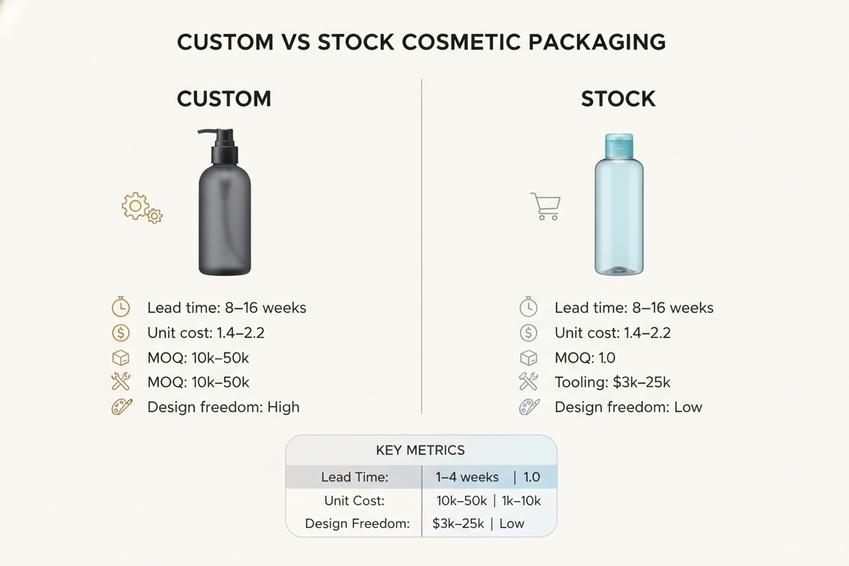
Custom Vs. Stock: Packaging Options Compared
A quick reality check: picking between custom and stock isn’t just taste—it’s timing, cost, and how loudly your brand needs to speak on shelf. In the world of cosmetic packaging design companies, small tweaks can change buying behavior. So let’s map how cosmetic packaging, packaging design companies, and cosmetic design teams approach both paths.
Custom
- • Unique design meets brand identity fast when briefs are tight and vision is clear.
- • Tailored solutions unlock design flexibility, from closures to specialized materials.
- • Product differentiation shows up in bespoke aesthetics customers actually notice.
- Define intent
- Prototype with molding options, and analyze PET and PETG physical properties for chemical compatibility.
- Test usability and shelf impact
- Scale with suppliers aligned to cosmetic packaging design companies
Deep dive flow:
- Strategy
- Audience cues → color, touch, refill habits
- Brand codes → logo, tone, finish
- Creation
- CAD + tooling → molding options
- Material pick → glass, PCR, mono-materials (specialized materials)
- Validation
- Drop tests, leak tests
- Retail simulation
- Launch
- MOQ planning
- Supplier lock-in (Topfeelpack fits here when speed + finish both matter)
Short beats: bold look. higher cost. longer lead. strong recall. cosmetic packaging design companies often push this route when shelf wars are intense.
Stock
- • Standardized forms keep budgets calm.
- • Off-the-shelf parts mean quick turnaround.
- • Common sizes reduce risk, but limited customization caps expression.
Data snapshot for cosmetic packaging design companies:
| Metric | Custom | Stock |
|---|---|---|
| Lead time (weeks) | 8–16 | 1–4 |
| Unit cost index | 1.4–2.2 | 1.0 |
| MOQ (units) | 10k–50k | 1k–10k |
| Tooling cost ($) | 3k–25k | 0–1k |
| Design freedom | High | Low |
Multi-level view:
- Availability
- Readily available SKUs like a standard lotion bottle, an innovative dual chamber bottle, a classic dropper bottle, or a deodorant stick.
- Pre-designed finishes
- Constraints
- Generic shapes limit storytelling
- Label-only branding
- Use cases
- Trial runs
- Seasonal drops
- Fast retail tests via packaging design companies
Quick combo path many cosmetic packaging design companies use:
- Start stock → validate demand
- Add sleeves, coatings
- Migrate to custom once velocity proves out (Topfeelpack can bridge this shift)
Short beats: fast launch. lower spend. safe bets. harder to stand out.
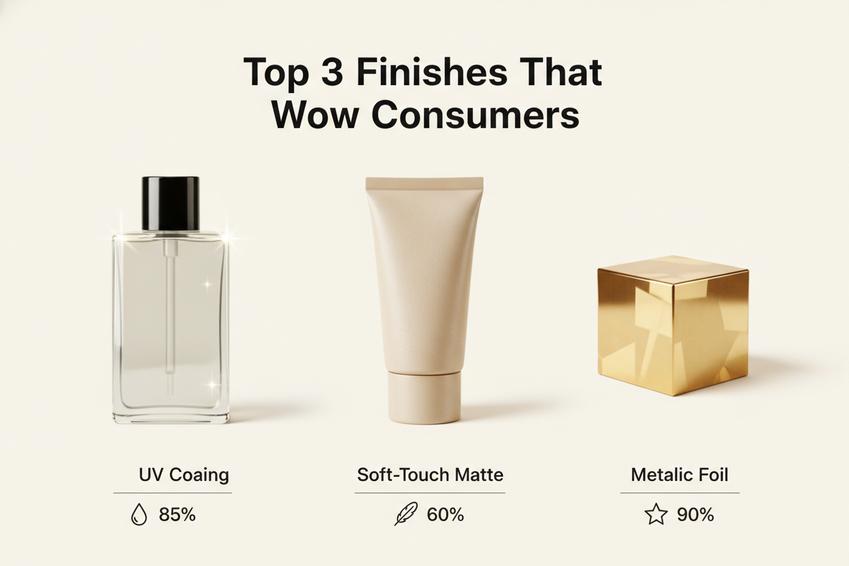
Bullets: Top 3 Finishes That Wow Consumers
Cosmetic packaging design companies keep chasing that “pick-me-up” moment on the shelf. When cosmetic packaging design companies, packaging design companies for cosmetics, and cosmetic package design firms tune finishes right, shoppers notice fast. Topfeelpack brings these effects together so cosmetic packaging design companies can balance look, touch, and brand story without overcomplicating production.
Gloss Coatings for Maximum Shelf Impact
- Gloss finish boosts visual appeal under store lighting
- UV coating and varnish create a reflective surface that screams freshness
- Strong shelf presence helps cosmetic packaging design companies stand out
- Apply base ink → 2) seal with high shine layer → 3) cure for durability
| Finish Type | Reflectivity (%) | Smudge Resistance | Best Use Case |
|---|---|---|---|
| UV Gloss | 85 | High | Logos, hero panels |
| Aqueous Varnish | 60 | Medium | Full coverage |
| Spot Gloss | 90 | High | Accents |
For cosmetic packaging design companies and cosmetic package design firms, gloss works when color needs to pop hard without extra materials. Topfeelpack often pairs spot gloss with matte backgrounds for contrast that feels intentional, not loud.
Soft-Touch Lamination to Convey Luxury
- Soft-touch finish adds sensory appeal instantly
- Matte lamination cuts glare while keeping a premium feel
- The velvet texture nudges perception toward high-end
Short notes:
- Feels warm, not cold
- Reduces fingerprints
- Signals sophisticated packaging
Steps that cosmetic packaging design companies follow:
- Print base artwork
- Laminate with soft-touch finish
- Edge-seal for longevity
“Tactile finishes are now a top driver of perceived value in beauty packaging,” notes a 2025 McKinsey retail insight update.
Topfeelpack uses this finish when cosmetic packaging design companies want a calm, upscale vibe that doesn’t rely on shine.
Metallic Foils for Striking Brand Highlights
- Metallic accents sharpen brand emphasis
- Foil stamping or hot stamping creates a crisp shimmer effect
- Adds visual distinction with premium detailing
Nested flow cosmetic packaging design companies rely on:
- Choose foil tone
- Gold → warmth, heritage
- Silver → clean, modern
- Select application
- Full logo
- Micro-details
- lines
- icons
- Balance with base finish
- Pair with matte for contrast
- Or gloss for high drama
Cosmetic packaging design companies and packaging design companies for cosmetics use foils sparingly; small hits often outperform full coverage. According to global design guidelines from the World Packaging Organisation, minimalist and precise metallic detailing can elevate a product's luxury standing much more effectively than over-saturated foil placement. Topfeelpack aligns foil placement with brand marks so the shine feels earned, not pasted on.
References
- ISO 9001 Quality Management Systems - iso.org
- McKinsey & Company Retail and Beauty Insights - mckinsey.com
- World Packaging Organisation (WPO) Resources - worldpackaging.org
- EU Regulation on Cosmetic Products (EC No 1223/2009) - ec.europa.eu
- European Chemicals Agency (ECHA) REACH Regulations - echa.europa.eu
- Ellen MacArthur Foundation Plastics and Circular Economy Overview - ellenmacarthurfoundation.org
- Cosmetics Europe - The Personal Care Association - cosmeticseurope.eu
- Sustainable Packaging Coalition - sustainablepackaging.org
Post time: Jul-17-2026
