
Efficient cosmetic filling and packaging dictates whether brands scale profitably or bleed revenue through defects. Topfeelpack engineers emphasize that precision machinery and rigorous compliance are non-negotiable for dependable production. Executed correctly, costs drop, launches accelerate, and product presentation remains impeccably consistent.
Quick Notes on Cosmetic Filling and Packaging Success
- Select sustainable materials like glass, PCR, or bioplastics to balance eco-impact and product protection.
- Calibrate filling machines for precise dosing, minimizing waste across high-viscosity creams and volatile serums.
- Integrate capping, pumps, and dropper bottles to secure seals and maintain dispenser performance.
- Enhance branding with labeling, embossing, or UV coating while validating material compatibility.
- Conduct leak and stability testing under stringent GMP compliance and ISO standards to guarantee integrity.
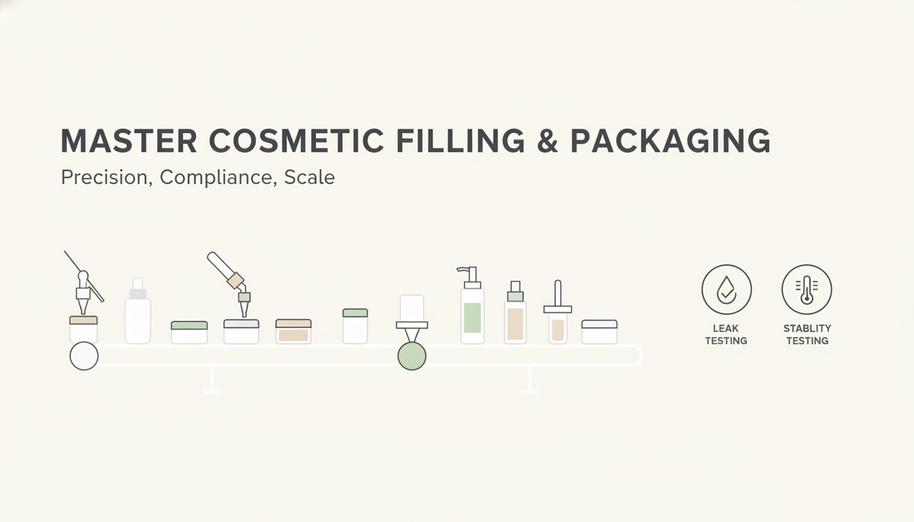
5 Proven Steps To Cosmetic Filling And Packaging Mastery
Mastering cosmetic packaging industry workflows requires breaking production into manageable, highly controlled stages to minimize waste and ensure strict quality control.
Step 1 – Selecting Sustainable Materials: Glass, PCR & Bioplastics
- Core picks for durable, sustainable packaging:
- Glass: Inert with a premium feel; ideal for sensitive serums.
- PCR: Boosts recycled content, balancing cost with eco-friendly mandates.
- Bioplastics: Offers a lighter carbon footprint, highly useful for flexible cosmetic tubes.
Step 2 – Calibrating Filling Machines for Precision Dosing
Dialing in machine mechanics eliminates dosing guesswork and prevents costly product loss:
- Adjust machine settings to match viscosity (e.g., dense creams vs. fluid gels).
- Deploy piston fillers for thick blends and gear pumps for continuous, smooth flow.
- Verify dispensing accuracy via small batch checks before initiating full-scale runs.
Step 3 – Integrating Capping Machines, Pumps & Droppers
- Closure systems must operate in perfect synchronization:
- Capping machines: Require strict torque control to avoid micro-cracks.
- Pumps: Must deliver consistent output per press.
- Droppers: Calibrated for clean dosing without dripping.
Step 4 – Decorating with Labeling, Embossing & UV Coating
- Labeling must adhere flawlessly without edge-peeling.
- Embossing adds tactile texture for premium positioning.
- UV coating boosts surface finish and scratch resistance.
“Packaging durability and sustainability now directly influence purchase decisions,” notes a 2025 McKinsey packaging insights update.
Step 5 – Verifying GMP Compliance and Leak Testing
- Quality assurance workflow:
- GMP compliance: Enforcing documented safety protocols.
- Leak testing: Utilizing pressure and vacuum decay methods.
- Defect detection: Combining visual inspection with automated scanning.
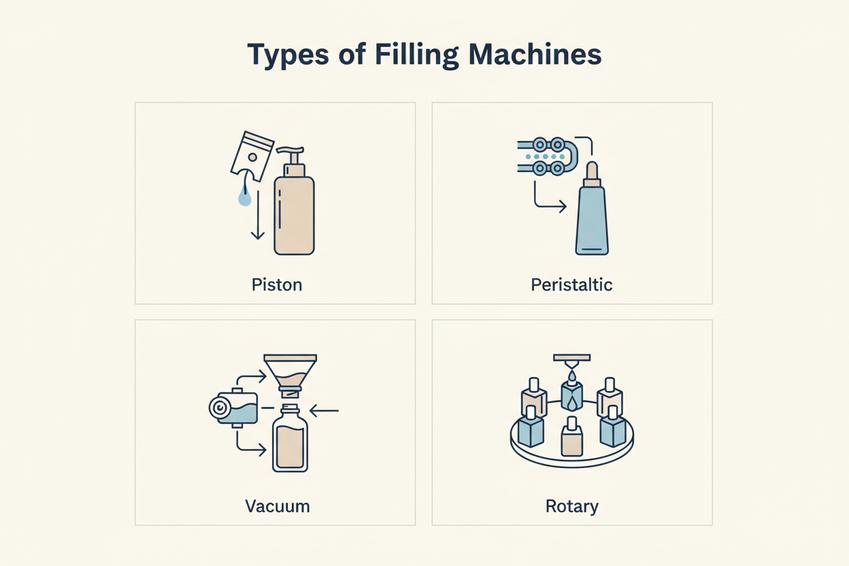
Types Of Filling Machines
Modern lines blend precision hardware with smart workflows. From small-batch deodorant sticks to full-scale lotion bottle production, the right system defines your output quality.
Piston Fillers
- Volumetric control built around cylinders and pistons, engineered for viscous formulas.
-
- Product is drawn into the chamber through nozzles.
-
- A fixed dosage is pushed forward with high accuracy.
-
- Output remains consistent despite density swings.
-
- Topfeelpack favors this for stable automation, easily handling gels and heavy creams with rapid cleaning cycles.
Peristaltic Dosing Systems
- Flow path relies entirely on sealed tubing and a rotating pump.
- Product never touches machine mechanics, ensuring strict sterility.
- Low shear action keeps delicate formulations intact.
Ideal for precision dosing in ampoules and pharmaceutical-grade packaging where contamination risks must be zero.
Vacuum Filling Machines
- Operates via vacuum pull and overflow return, ensuring a visually uniform fill level.
- Product enters via gravity.
- Air is extracted to prevent bubbling.
- Yields a drip-free, highly consistent finish.
Rotary Bottle Filling
- Engineered for high-output motion:
- Multiple heads rotate synchronously.
- Bottles process through indexed stations (Alignment → Continuous Fill → Capping/Labeling).
- Delivers maximum automation and production scale without sacrificing tolerance limits.
5 Quality Checks For Cosmetic Filling Lines
Rigorous inspection prevents product recalls and preserves shelf life. Topfeelpack integrates these checkpoints directly into automated loops.
Leak Testing on Bottles, Jars & Tubes
- Core validations utilizing leak testing standards:
- Pressure testing for bottle durability.
- Vacuum testing across cream jar closures.
- Seal quality validation on tube seams.
Compatibility Testing with Plastic, Aluminum & Glass
- Validate material compatibility between formulas and packaging (e.g., plastics, aluminum, glass).
- Track long-term chemical interaction.
- Confirm product stability to prevent degradation or discoloration.
Stability Testing after Filling and Sealing
- Monitored conditions: Temperature cycling, light exposure, and accelerated aging.
| Test Type | Duration | Focus | Outcome |
|---|---|---|---|
| Heat Cycle | 7 days | package integrity | Seal holds |
| UV Exposure | 72 hrs | cosmetic product | No fading |
| Aging | 30 days | shelf life | Stable |
Calibration of Inspection Systems and Sealing Lines
- Continuous cycle: Inspect → Adjust → Validate.
- Strict measurement accuracy prevents drift, ensuring global cosmetic packaging standards are met consistently.
ISO Certification & GMP Compliance Audit
- Review quality management systems.
- Audit manufacturing processes.
- Verify GMP and ISO alignment to facilitate global market entry.
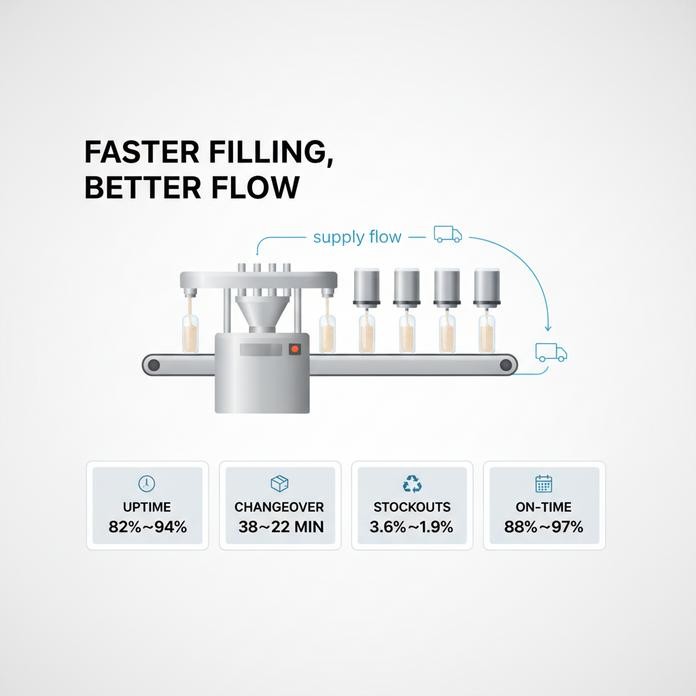
Slow Line Speeds? High-Speed Fillers To The Rescue
When demand spikes for components like dual chamber bottles or complex sunscreen packaging, upgrading to synchronized, high-speed automated systems is required to maintain throughput.
Servo-Driven Filling Machines for Rapid Throughput
- Filling heads powered by servo motors deliver rapid throughput without splashing or overdosing.
- Configure motion: Calibrate automation loops and acceleration curves.
- Validate output: Check weight variance and nozzle timing.
- Scale lanes: Add parallel heads to maximize line efficiency.
Automated Assembly with Synchronized Capping Equipment
- Automated assembly physically links with capping equipment to maintain continuous synchronization.
- Infeed: Robotic bottle spacing and handling.
- Fill zone: Optimized nozzle dive profiles and drip control.
- Cap zone: Torque mapping and real-time seal verification.
- Outfeed: Vision checks and case-ready transfer.
Topfeelpack utilizes integrated cap torque feedback to immediately flag errors, preventing rework accumulation across cosmetic packaging production lines.
Supply Chain Optimization to Match Production Pace
If materials lag, the fastest airless bottles line will still stall.
- Plan: Demand signals dictate demand forecasting.
- Source: Vendor slots align with logistics.
- Stage: Safety stock drives inventory management.
- Move: Line-side kits optimize material flow.
- Store: Smart racks streamline warehouse operations.
Data snapshot:
| Metric | Before | After | Impact |
|---|---|---|---|
| Line uptime (%) | 82 | 94 | +12 |
| Avg. changeover (min) | 38 | 22 | -16 |
| Stockouts/month | 9 | 2 | -7 |
| Scrap rate (%) | 3.6 | 1.9 | -1.7 |
| Orders on-time (%) | 88 | 97 | +9 |
By maintaining optimized logistics, Topfeelpack ensures filling and packaging runs steadily, hitting peak pace without starving for parts.
References
- filling machines - https://www.pmmi.org/
- ISO standards - https://www.iso.org/standard/36437.html
- cosmetic packaging industry - https://www.gminsights.com/industry-analysis/cosmetic-packaging-market
- purchase decisions - https://www.mckinsey.com/industries/paper-forest-products-and-packaging/our-insights/sustainability-in-packaging-inside-the-minds-of-us-consumers
- leak testing - https://www.astm.org/d3078-02r13.html
- material compatibility - https://www.plasticsindustry.org/
- global cosmetic packaging standards - https://www.worldpackaging.org/
- cosmetic packaging production - https://www.packagingdigest.com/
Post time: Jul-16-2026
