
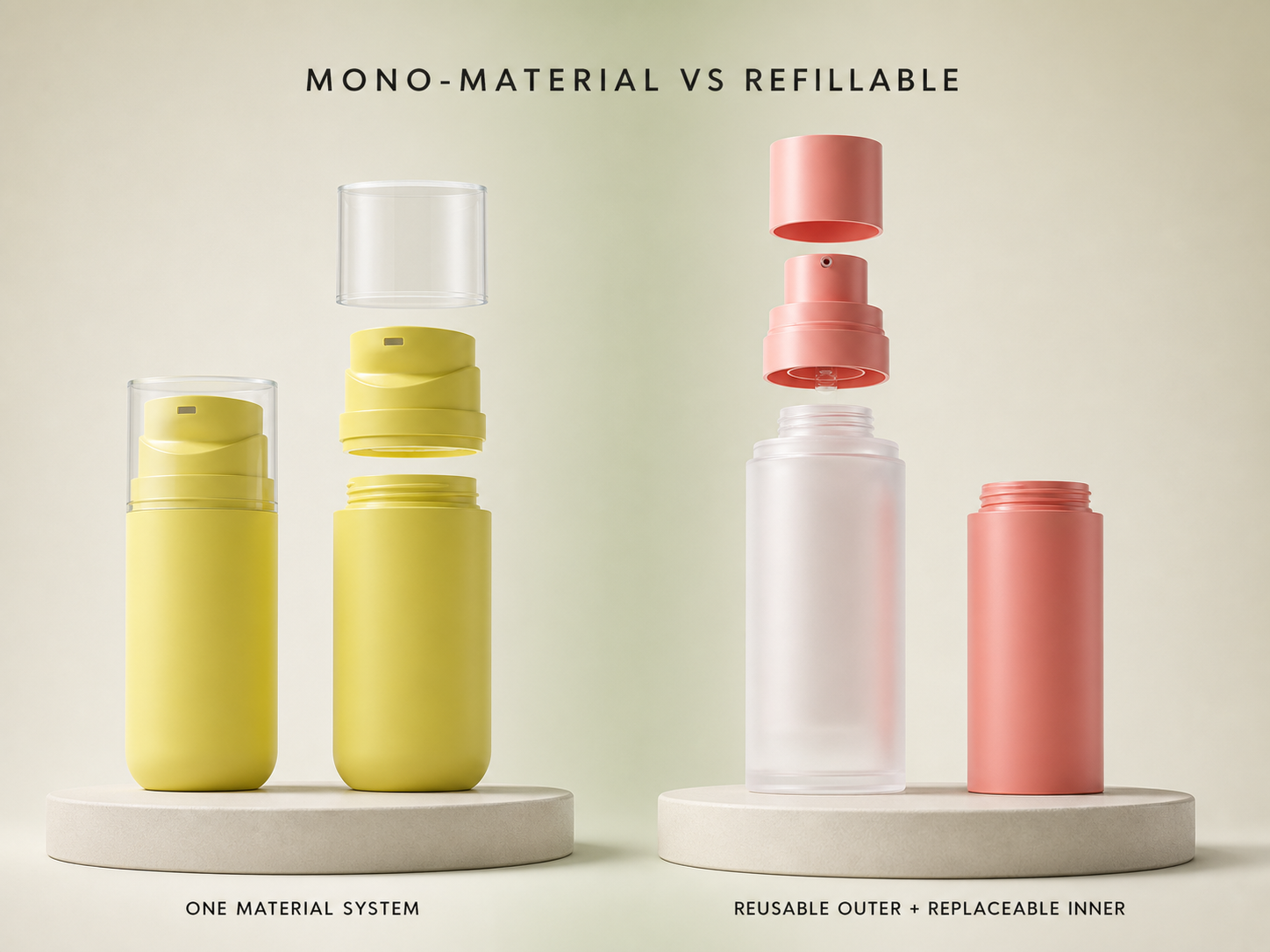
Mono-material cosmetic packaging and refillable cosmetic packaging solve different sustainability problems. Mono-material design aims to simplify material recovery. Refillable design aims to keep a durable component in use while replacing only the product-containing part. The better option depends on the formula, packaging weight, decoration, sales channel, repeat-purchase behavior, and destination-market recycling system.
The Short Answer
Mono-material cosmetic packaging is usually the clearer choice when a brand needs a simple end-of-life story, broad SKU flexibility, and no dependence on consumers buying refills. Refillable packaging can create a stronger premium ritual and reduce repeated use of a durable outer component, but only when the refill is easy to obtain, easy to install, and used enough times to justify the extra outer pack. Neither system is automatically more sustainable. The correct decision depends on the full packaging unit, formula protection, local collection and recycling, logistics, decoration, and actual user behavior.
For many fast-moving skincare launches, a mono-PP airless bottle is a practical starting point because the body, piston, and cap can be designed around one polymer family. For a hero moisturizer with loyal repeat purchase, a replaceable inner cup inside a durable jar may create more value. Some projects can combine both strategies: a refillable system whose principal structural components and refill pod are designed around compatible materials. The comparison should therefore be made at product-system level, not by applying a single sustainability label.
What Mono-Material and Refillable Really Mean
Mono-material packaging is designed so the principal components use one material or one compatible polymer family. In a mono-PP airless bottle, for example, the container, piston, and cap may be polypropylene. This can reduce the need to separate incompatible materials and simplify documentation. It does not guarantee collection or recycling, and small springs, seals, labels, colorants, inks, or barrier layers still need to be considered. RecyClass evaluates packaging features against specific recycling streams, including closures, labels, adhesives, inks, and other components [6].
Refillable packaging is designed so the user retains one component and replaces the product-containing component. In cosmetics, that may be an inner cream cup, airless cartridge, compact pan, or dropper reservoir. Refill-at-home differs from a return system: the user usually keeps the outer pack, installs a new sealed refill, and disposes of the empty refill component. Environmental performance therefore depends on the material and weight of both starter and refill packs, the number of repeat purchases, secondary packaging, transport, and whether consumers actually reuse the durable part.
Side-by-Side Decision Criteria
The table below is a decision framework rather than a universal ranking. Mono-material packaging tends to reduce structural complexity, while refillable packaging shifts the challenge toward behavior and system design. A high-value outer jar that is reused six times may be preferable to six complete premium jars, but a heavy outer pack that is abandoned after one purchase can perform poorly. Likewise, a light mono-material bottle may be easier to sort in theory, but decoration or an incompatible pump component can undermine the intended recycling route.
Start with the packaging function and destination market. If the formula needs airless protection, compare complete airless systems rather than comparing a simple bottle with a complex refill jar. If the brand sells through subscription or direct-to-consumer channels, refill access may be easier to maintain. If distribution is fragmented across many countries and retailers, a recyclable single-pack format may create a clearer operating model. The most credible sustainability claim is the one supported by a bill of materials, test evidence, a realistic consumer pathway, and market-specific waste infrastructure.
| Criterion | Mono-material | Refillable |
| Core objective | Simplify material composition and recycling pathway | Keep durable outer component in repeated use |
| Consumer action | Dispose through the correct local stream | Buy and install refill; retain outer pack |
| Best channel fit | Broad retail and multi-market distribution | Loyalty, DTC, subscription or controlled retail |
| Main risk | Hidden mixed components or incompatible decoration | Low refill adoption or unavailable refills |
| Quality focus | Complete-pack material and performance validation | Starter pack, refill protection and replacement reliability |
| Claim discipline | Describe verified composition and assessed recyclability | Describe replaceable parts and measured reuse outcomes |
When Mono-Material Cosmetic Packaging Is the Better Fit
Choose mono-material cosmetic packaging when the brand needs a relatively straightforward packaging specification across many SKUs or markets. It can suit products with uncertain repurchase behavior, launch quantities that do not support a separate refill supply chain, or channels where consumers cannot reliably find replacement pods. It is also useful when packaging weight and component count can be reduced without compromising formula protection or dispensing performance.
For airless skincare, verify that 'mono-material' applies to the complete relevant packaging unit, not only the visible bottle wall. Ask about the pump engine, piston, actuator, cap, seals, valves, decoration, label, and any metal component. Topfeelpack's PA186 product information, for example, identifies a mono-PP body, piston, and cap, 30 ml, 50 ml, and 100 ml capacities, and a 0.6 cc output [7]. These are specific design parameters, not proof that every decorated configuration will achieve a particular recyclability grade. The brand still needs compatibility testing, finished-pack assessment, and confirmation of the local recycling route.
When Refillable Cosmetic Packaging Is the Better Fit
Refillable packaging is strongest when the outer component delivers lasting value and the product has a realistic repeat-purchase pattern. Premium face cream, cleansing balm, compact makeup, and treatment products can fit this model because consumers may want to retain a substantial jar or case. The refill must be cheaper or more convenient than buying another complete pack, remain available in the same channels, and be simple to replace without contaminating the product or damaging the mechanism.
Design the refill experience as carefully as the starter pack. Use clear orientation, tamper evidence, a hygienic seal, and minimal steps. The inner component should protect the formula during filling, shipping, storage, and installation. Topfeelpack's PJ47 product page describes a 50 g PP refillable jar with a replaceable inner cup and separate cap [8]. That demonstrates one implementation, but the sustainability case still depends on repeat use and the weight of the complete system. Track refill attachment rate, repeat intervals, customer complaints, and the number of outer packs actually retained.
Why Airless Systems Make the Comparison More Technical
Airless packaging adds performance requirements that cannot be reduced to material choice. A piston-based system must prime, deliver a controlled dose, maintain seal integrity, evacuate the product, and operate after aging and transport. A refillable airless pack must also reconnect the cartridge and actuator reliably. If the consumer installs the refill incorrectly, the pack may lose prime or leak. If the refill cannot be separated cleanly at end of life, the sustainability story becomes difficult to explain.
Build a test matrix around the actual formula. Record pump output across the first, middle, and final doses; number of priming strokes; total evacuation; leakage in multiple orientations; actuation force; compatibility after elevated-temperature aging; and performance after drop and vibration tests. Test decorated samples because coatings, assembly heat, and dimensional changes can affect function. The cosmetic GMP framework in ISO 22716 covers production, control, storage, and shipment [5], while the EU cosmetic safety report framework considers packaging characteristics and potential interactions [4]. Packaging approval should connect both product safety and packaging quality systems.
How the EU PPWR Changes the Decision
The EU PPWR now generally applies from August 12, 2026 [2]. Its recyclability framework rates packaging A, B, or C. Under Article 6 and Annex II, packaging below 70% recyclability performance is technically non-recyclable under the future assessment method; from 2030, compliant packaging must fall within A, B, or C according to the applicable timeline, and from January 1, 2038, packaging must reach A or B [3]. The regulation also introduces recycled-content, minimization, labeling, and other obligations with different dates and conditions.
This does not mean every mono-material pack will receive grade A or every refillable pack will comply automatically. A refillable pack may still need recyclability assessment, and its refill component must be evaluated as packaging. A mono-material structure may still be affected by color, labels, inks, closures, dimensions, or a recycling stream that is not available at scale. The Commission must establish detailed design-for-recycling criteria and assessment rules through further acts. Brands should avoid guaranteed-grade marketing claims until the relevant methodology and evidence are available. Design now for simpler composition, separability, documented materials, and minimal packaging, then update the assessment as implementation develops.
Use a Life-Cycle and Business-System Check
A packaging decision can move impacts rather than remove them. A durable refillable outer pack may use more material at the first purchase. It delivers value only if consumers reuse it enough times and the refill format reduces repeated material, decoration, and transport burdens. UNEP's life-cycle work emphasizes assessing alternatives across the full value chain rather than assuming a different material or reuse label is automatically better [9]. For returnable systems, the Ellen MacArthur Foundation identifies scale, shared infrastructure, standardization, and high return rates as key performance drivers [10]. A cosmetic refill-at-home system has different logistics, but the same lesson applies: behavior and operating design determine whether reuse works.
Create a simple scenario model before launch. Compare the starter pack plus one, three, and six refills against the same number of complete mono-material packs. Include primary and secondary packaging weight, expected decoration, manufacturing loss, transport volume, and realistic refill adoption. Do not publish a carbon or waste-reduction percentage unless it comes from a defined, reviewable methodology. If data are incomplete, use factual claims such as 'replaceable inner cup' or 'principal components made from PP' rather than an unsupported environmental superiority claim.
A Practical Selection Matrix
For a new serum line with uncertain repeat purchase and broad international distribution, start by evaluating a mono-material airless bottle. For an established hero cream with high loyalty and direct access to customers, evaluate a refillable jar with a durable outer shell and a light, sealed refill. For a prestige treatment sold through counters, consider whether the outer pack creates enough tactile and visual value to motivate reuse. For travel, sampling, or rapid seasonal launches, prioritize light weight, protection, and operational simplicity over a complicated refill proposition.
The final brief should state the target packaging function, material strategy, consumer end-of-life action, test plan, claim language, and evidence owner. Require a golden sample and full bill of materials for every decoration variant. If the brand changes a coating, label, pump, color, or refill seal, reopen the relevant checks instead of assuming the previous result still applies. Sustainable packaging is not a one-time material selection. It is a controlled specification that connects design, purchasing, quality, regulatory, marketing, and consumer behavior.
New or seasonal SKU: favor a proven, lightweight, easily documented structure.
Hero product with high repeat purchase: test a refill system and measure attachment rate.
Sensitive formula: make protection and dispensing performance non-negotiable.
EU distribution: document every component and track PPWR implementation updates.
Any environmental claim: connect it to a defined unit, market, methodology, and evidence.
Frequently Asked Questions
Is mono-material packaging always recyclable?
No. Mono-material design may improve compatibility with a recycling stream, but collection, sorting, size, color, labels, inks, closures, and local infrastructure also matter. Assess the complete finished package.
Is refillable packaging always more sustainable?
No. It depends on the weight and durability of the starter pack, the refill design, repeat-use rate, logistics, and end-of-life pathways. Model realistic numbers of refills and avoid unsupported reduction claims.
Can an airless bottle be both mono-material and refillable?
Yes, some structures combine the strategies. The brand must still validate cartridge replacement, priming, dose consistency, leakage, evacuation, material composition, and the disposal pathway for each component.
Which option is faster to launch?
A stock mono-material bottle is often operationally simpler because it needs one packaging flow. A stock refill system can also launch quickly, but the brand must prepare refill inventory, instructions, merchandising, forecasting, and customer support.
Post time: Aug-20-2026
