
Direct answer: Beauty brands developing packaging for the EU should use 2026–2030 as a controlled transition period. Build a component-level packaging baseline now, screen designs for material recycling and minimisation, plan for the applicable post-consumer recycled-content rules, validate formula compatibility, and maintain technical evidence that can be updated as detailed EU methodologies take effect.
The EU Packaging and Packaging Waste Regulation, Regulation (EU) 2025/40, entered into force on February 11, 2025 and generally began to apply on August 12, 2026. It covers packaging of every material and origin placed on the EU market. Cosmetic packaging is therefore within scope, and packaging intended for cosmetics is included in the regulation's definition of contact-sensitive packaging.
For a beauty brand, PPWR preparation is not a one-time material substitution. It is a development program involving the pack structure, formula, decoration, supplier data, testing, documentation and intended EU markets.
This article provides a practical project framework rather than legal advice. Requirements and deadlines should be checked against the current regulation, Commission guidance, implementing acts, delegated acts and national enforcement arrangements before a commercial decision is made.
PPWR Cosmetic Packaging Requirements at a Glance
| Question | Working answer for packaging teams |
|---|---|
| When did PPWR generally begin to apply? | August 12, 2026 |
| Is cosmetic packaging in scope? | Yes. PPWR covers packaging generally, and packaging intended for cosmetics is defined as contact-sensitive packaging |
| What is the 2030 PCR planning level? | 30% for PET contact-sensitive plastic packaging and 10% for non-PET contact-sensitive plastic packaging, subject to timing, calculation and exemption rules |
| What is the technical recyclability threshold? | Packaging below 70% under the Annex II framework is technically non-recyclable |
| Is mono-material packaging mandatory? | No. The applicable design-for-recycling assessment concerns the complete packaging unit |
| Is refillable packaging automatically compliant? | No. Refillability does not replace recyclability, minimisation, performance or documentation work |
What PPWR Changes for Cosmetic Packaging Development
PPWR changes the development question from “Does this package use a sustainable material?” to “Can the complete packaging unit meet the applicable requirements, perform its function and be supported by evidence?”
Five workstreams matter most for a new cosmetic packaging project:
- Recyclability: Assess the complete packaging unit and its components against the applicable design-for-recycling criteria.
- Recycled content: Determine the correct plastic packaging category, target and calculation method instead of applying one PCR percentage to every component.
- Minimisation: Reduce weight and volume to the minimum needed for packaging functionality.
- Product protection: Maintain formula compatibility, dispensing performance, safety, hygiene and shelf-life protection.
- Documentation: Build technical information and supplier traceability that can support the required conformity assessment.
A bottle described as mono-material, PCR, lightweight or refillable may support one workstream. None of those labels, by itself, proves that the complete pack meets all applicable PPWR requirements.
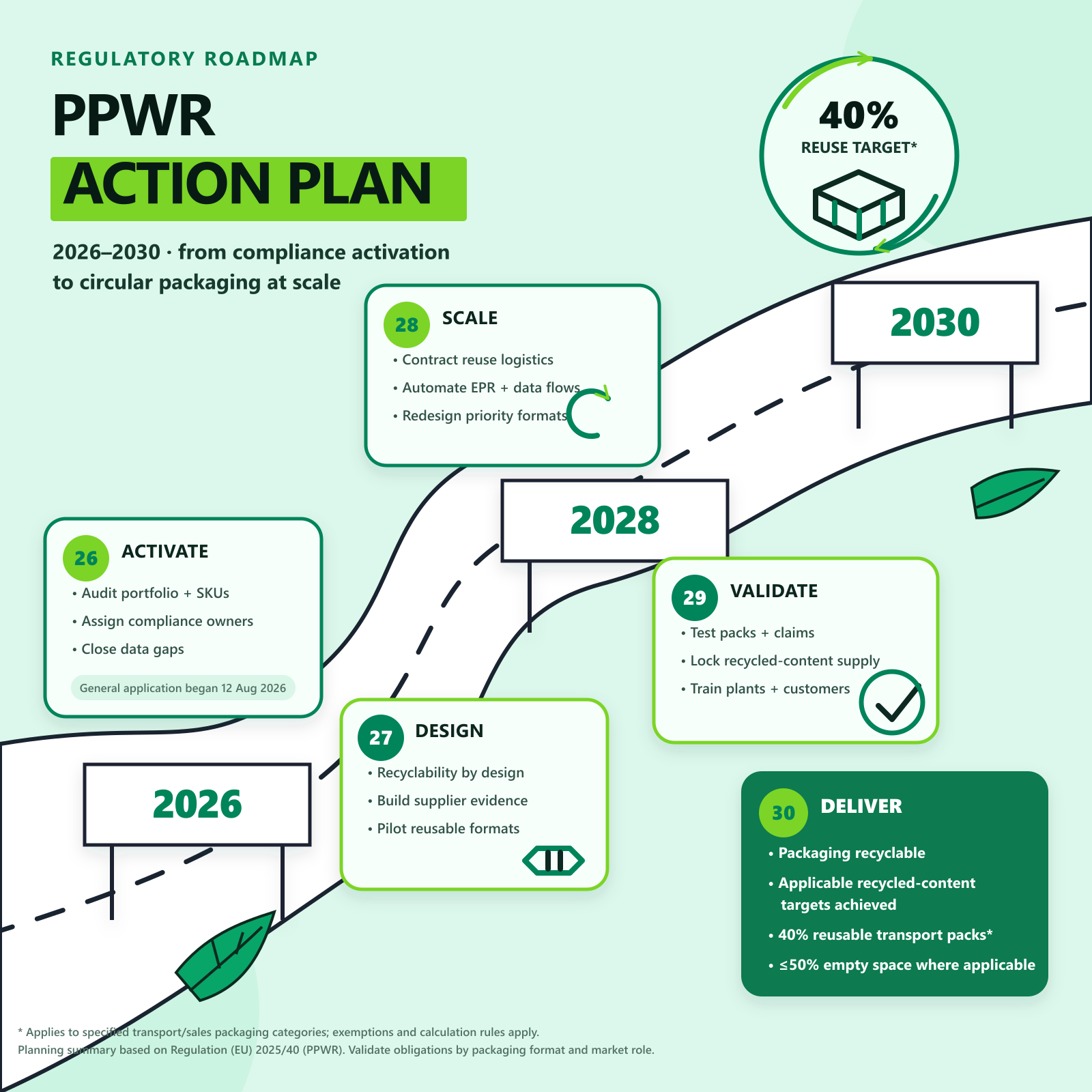
The 2026–2030 PPWR Action Plan
| Period | Main objective | Packaging-development actions | Approval gate |
|---|---|---|---|
| 2026 | Establish control | Assign regulatory roles; create a component-level bill of materials; identify EU markets, packaging category and contact-sensitive status; open the technical evidence file | Do not approve a concept without material and component visibility |
| 2027 | Reduce avoidable risk | Compare structures, decorations and dispensing systems; request PCR and traceability options; challenge unnecessary mass, volume and layers; monitor adopted calculation and documentation methods | Select a preferred platform plus a technically realistic backup |
| 2028 | Reassess against detailed criteria | Review published design-for-recycling acts and harmonised standards; score every component; update drawings, specifications and supplier questionnaires | Do not freeze tooling until the design has been reassessed |
| 2029 | Validate and industrialise | Complete compatibility, functional and transport validation; confirm material supply; prepare artwork and labelling changes when final requirements are available; close evidence gaps | Release production only with an approved validation and documentation package |
| 2030 | Maintain market-ready evidence | Confirm the legal trigger dates that apply; verify minimisation, recyclability and recycled-content evidence; update declarations and change-control records | Treat compliance as a maintained system, not a one-time certificate |
Some 2030 obligations use “whichever is later” timing linked to secondary legislation. Project teams should therefore maintain a live regulatory calendar rather than relying on a single simplified deadline.
2026: Build a Packaging Baseline Before Redesigning
The first step is not choosing a new resin. It is documenting the package that the brand is actually developing.
Create one controlled record for the complete packaging unit:
- primary container material and weight;
- shoulder, base, inner wall or insert materials;
- pump, actuator, dip tube, spring, valve, gasket and closure materials;
- label, sleeve, ink, coating, metallisation, adhesive and decoration;
- components that remain attached during disposal;
- components a user is expected to separate;
- secondary packaging and inserts;
- supplier, manufacturing plant and specification revision;
- target formula, fill volume, market and launch date.
This baseline exposes hidden complexity. A nominally polypropylene bottle, for example, may still contain a pump, metal component, elastomer, label and decoration that affect sorting, separation or recycling. PPWR recyclability assessment considers integrated and separate components, not only the material named in the product title.
Assign Economic-Operator Responsibilities
Clarify who is the manufacturer, importer, supplier, filler and producer for each route to market. Under PPWR, manufacturers must perform the applicable conformity assessment, prepare technical documentation and draw up an EU declaration of conformity when compliance has been demonstrated. Suppliers must provide information and documentation needed by the manufacturer.
A supplier declaration is useful evidence, but it does not replace the responsible economic operator's own assessment. Contract documents should define who supplies:
- material composition and component weights;
- recycled-content evidence;
- manufacturing-plant identification;
- specifications and controlled drawings;
- test reports;
- change notifications;
- information needed for technical documentation.
2027: Screen Designs Before Tooling Becomes a Constraint
In 2027, compare packaging concepts while geometry, decoration and component selection are still changeable.
Use a Component-Level Recyclability Review
Ask these questions for every component:
- What material stream is expected to receive the component?
- Can collection and sorting systems identify the package?
- Does its size, colour or shape create a sorting risk?
- Can attached components be separated during normal recycling processes?
- Could a label, sleeve, coating, adhesive, metallised finish or pigment interfere with sorting or material quality?
- Does the component prevent the main body from producing useful secondary material?
- What evidence supports the answer in the intended market?
The regulation establishes recyclability grades A, B and C. Under the framework in Annex II, performance below 70% is treated as technically non-recyclable. The design-for-recycling placement restriction applies from January 1, 2030 or 24 months after the relevant delegated acts enter into force, whichever is later. The detailed criteria are therefore essential inputs to the final assessment.
Buyer decision: Prefer architectures that leave room for adjustment. A simplified component structure, removable decoration or alternative actuator can be easier to update than a highly integrated pack after tooling is complete.
Do Not Treat “Mono-Material” as a Legal Shortcut
PPWR does not create a universal rule saying every cosmetic package must be mono-material. A mono-material direction may improve compatibility with a recycling stream, but only if the complete pack can be collected, sorted and recycled under the applicable criteria.
Conversely, a multi-component package is not automatically disqualified. The practical issue is whether its components and materials meet the applicable assessment rules and do not hinder the recyclability of the main body.
2027–2028: Build the Correct PCR Strategy
Cosmetic packaging is included in the definition of contact-sensitive packaging because the definition refers to products within the scope of the EU Cosmetics Regulation.
For planning purposes, Article 7 establishes these 2030 minimum recycled-content levels for plastic packaging:
| Plastic packaging category | 2030 planning target |
|---|---|
| Contact-sensitive packaging with PET as the major component, excluding single-use beverage bottles | 30% |
| Contact-sensitive packaging made from plastics other than PET, excluding single-use beverage bottles | 10% |
| Other plastic packaging outside the listed contact-sensitive and beverage categories | 35% |
The legal trigger is January 1, 2030 or three years after the relevant calculation-method implementing act enters into force, whichever is later. The percentages are calculated by packaging type and format as an average per manufacturing plant and year. They should not be presented as a universal per-unit percentage for every cosmetic pack.
Questions to Ask Before Specifying PCR
- Is the plastic part classified as PET contact-sensitive, non-PET contact-sensitive or another category?
- Which manufacturing plant will produce the packaging?
- How will the annual average be calculated and verified?
- Is the input post-consumer recycled material under the PPWR definition?
- What traceability evidence will accompany each production route?
- Can the supplier maintain colour, odour, mechanical and dimensional requirements?
- Does the PCR option remain compatible with the formula and decoration process?
- How will changes in recycled feedstock or plant location be controlled?
Any plastic part representing less than 5% of the total weight of the complete packaging unit is outside the Article 7(1) and 7(2) requirements. Do not apply that rule from an estimated weight: record the component mass and retain the calculation.
PCR Content Does Not Replace Compatibility Testing
The recycled-content target does not override cosmetic product safety, formula stability or packaging performance requirements. A PCR resin can differ in colour, odour, processing behaviour or mechanical consistency from a virgin grade.
Before approval, define tests appropriate to the formula and pack, which may include:
- material and formula compatibility;
- leakage and seal integrity;
- pump output or dosage consistency;
- torque and closure performance;
- accelerated and real-time ageing;
- temperature cycling;
- drop and transport testing;
- colour, appearance and odour monitoring;
- decoration and adhesion performance.
The exact protocol should be set by the brand's packaging, quality and regulatory teams for the product and distribution route.
2028: Reassess the Design Against Published Criteria
PPWR requires the Commission to establish detailed design-for-recycling criteria and the related assessment methodology through delegated acts. When those criteria are available, reopen every active project rather than assuming an earlier supplier score remains valid.
The reassessment should cover:
- the correct Annex II packaging category;
- every integrated and separate component;
- component separability;
- sorting compatibility;
- expected recycling yield;
- the quality of the resulting secondary material;
- decorative and functional elements;
- the evidence required for the technical file.
Create a formal decision record for each gap:
| Gap | Possible response |
|---|---|
| Decoration interferes with sorting | Reduce coverage, change process or qualify an alternative |
| Mixed-material component limits recycling | Redesign, make separable or select another mechanism |
| PCR supply lacks traceability | Qualify another source or delay the claim |
| Lightweighting affects performance | Rebalance geometry and retest |
| Refill concept lacks a return/refill system | Reframe it as a replaceable-component format or develop the operational system |
| Evidence depends on an unpublished method | Keep the specification provisional and schedule reassessment |
2028–2029: Prove Packaging Minimisation
By January 1, 2030, manufacturers or importers must ensure packaging weight and volume are reduced to the minimum necessary for functionality. PPWR also targets characteristics intended only to increase perceived product volume, including unnecessary layers, false bottoms and double walls, subject to the regulation's conditions and limited exceptions.
For cosmetic packaging, minimisation should be an engineering exercise rather than a simple weight-reduction target.
Document why each element is needed for:
- product protection;
- hygiene and safety;
- dispensing and complete evacuation;
- mechanical resistance;
- manufacturing and filling;
- transport and storage;
- information and legal labelling;
- accessibility and consumer use;
- reuse or refill cycles, where applicable.
Then test whether the same function can be achieved with:
- lower component weight;
- fewer decorative layers;
- less empty or hidden volume;
- a simpler insert;
- a smaller closure;
- reduced secondary packaging;
- standardised parts across a product family.
The technical documentation should preserve the calculations, test results, market research or studies used to justify the final design. “Luxury appearance” alone should not be used as the only justification for avoidable mass or volume.
Should a Beauty Brand Choose Refillable Packaging?
Refillable packaging can reduce repeated use of some durable components, but it is not automatically the lowest-risk PPWR route.
A refillable concept must be evaluated as a system:
- Which component is retained and which becomes waste?
- How many cycles can the retained component perform?
- Can it be refilled safely and without damage?
- Is the refill component itself recyclable?
- Is a refill or return system available in the target market?
- Does the consumer understand how to separate or return the parts?
- Does the complete system reduce material use under realistic behaviour?
- Can the brand support cleaning, hygiene and traceability requirements where relevant?
Where a refill direction fits the brand's model, review a replaceable-inner packaging format as a development reference, not as proof of PPWR compliance. The complete structure, formula, decoration, market and evidence still require project-specific assessment.
2029: Complete Validation and Documentation
By 2029, the objective should be to convert a preferred design into a controlled production specification.
Technical Validation File
Include, as applicable:
- approved drawings and bill of materials;
- component weights and material specifications;
- packaging category rationale;
- design-for-recycling assessment;
- PCR calculation and traceability evidence;
- minimisation assessment;
- compatibility and functional test reports;
- transport validation;
- refill or reuse evidence, where relevant;
- artwork and labelling specifications;
- supplier declarations;
- manufacturing-plant details;
- deviation and change-control history.
PPWR requires the EU declaration of conformity to follow the model in Annex VIII and remain updated. The regulation requires technical documentation and declarations for single-use packaging to be retained for five years after placement on the market and for reusable packaging for ten years.
Supplier Change Control
Require advance notification before changes to:
- polymer or recycled feedstock;
- material formulation or colourant;
- adhesive, coating or decoration;
- component geometry;
- tooling;
- manufacturing plant;
- sub-supplier;
- PCR percentage or calculation route;
- test method or specification.
A package assessed with one resin, decoration or factory should not automatically inherit the same conclusion after an uncontrolled change.
A Supplier Evidence Checklist for New Cosmetic Packaging
Use the following checklist before approving samples or tooling:
| Evidence request | Why the buyer needs it |
|---|---|
| Complete component list | Prevents decisions based only on the main container |
| Material identity for each component | Supports categorisation and recycling assessment |
| Component and total pack weights | Supports minimisation and the 5% plastic-part calculation |
| Manufacturing-plant identity | Required for plant-based recycled-content averaging |
| PCR source and traceability method | Supports recycled-content verification |
| Controlled drawings and specifications | Establishes the assessed design |
| Decoration and adhesive details | Identifies sorting and recycling interference risks |
| Design-for-recycling evidence | Supports the recyclability file |
| Compatibility and functional data | Protects product performance |
| Change-notification agreement | Keeps evidence valid after approval |
| Technical-documentation support | Enables the responsible economic operator to complete its file |
For chemical-scope questions that sit beside the PPWR workstream, use the PFAS cosmetic packaging supplier checklist as a separate supplier-screening reference. PPWR's specific PFAS restriction concerns food-contact packaging; cosmetic-packaging chemical compliance requires its own applicable-law review.
A Practical Packaging Concept Scorecard
The following is a project-screening tool, not an official PPWR scoring method:
| Decision area | Weight | Pass question |
|---|---|---|
| Design-for-recycling evidence | 25 | Can the full pack be assessed using current applicable criteria? |
| Component and material simplification | 15 | Have avoidable materials, attachments and finishes been removed? |
| PCR strategy | 15 | Is the correct category, target, plant and evidence route defined? |
| Packaging minimisation | 15 | Is every gram and layer justified by functionality? |
| Formula and functional performance | 20 | Has the final material and structure passed the approved test plan? |
| Documentation and change control | 10 | Can the technical file remain accurate through production? |
Suggested internal gate:
- 80–100: proceed to detailed validation, subject to unresolved legal criteria;
- 60–79: redesign or close evidence gaps before tooling;
- Below 60: stop and compare another packaging platform.
Do not describe the resulting score as a PPWR grade. Official recyclability grades must follow the regulation and applicable secondary legislation.
Common PPWR Planning Mistakes
1. Asking Only Whether the Bottle Is Recyclable
The assessment must address the complete packaging unit, including closures, pumps, labels, decorations and other components.
2. Treating 10% PCR as the Rule for Every Cosmetic Pack
The target depends on classification. PET contact-sensitive packaging has a different target from non-PET contact-sensitive packaging, and compliance uses plant-and-year averaging by type and format.
3. Adding PCR Without Repeating Validation
PCR content can change processing and performance characteristics. Test the actual production-intent material.
4. Waiting for Every Technical Rule Before Starting
Brands can already simplify structures, collect component data, establish change control and identify reversible design choices.
5. Freezing Artwork Around Draft Labels
Harmonised labelling details depend on implementing measures. Maintain artwork space and revision flexibility instead of treating an unconfirmed symbol as final.
6. Assuming Refillable Means Compliant
Refillability must work operationally and does not automatically satisfy recyclability, minimisation, documentation or product-protection requirements.
7. Accepting an Unsupported “PPWR-Compliant” Certificate
Ask which article, packaging category, method, manufacturing plant, specification revision and test evidence support the statement.
Frequently Asked Questions
Does PPWR apply to cosmetic packaging?
Yes. PPWR covers all packaging placed on the EU market regardless of material or origin. Its definition of contact-sensitive packaging includes packaging intended for products governed by Regulation (EC) No 1223/2009 on cosmetic products.
Must all cosmetic packaging contain 10% PCR by 2030?
No. Article 7 sets a 30% planning target for contact-sensitive packaging with PET as the major component and 10% for contact-sensitive packaging made from other plastics, subject to the regulation's timing formula, calculation rules and exemptions. The calculation is an average per manufacturing plant and year for each packaging type and format.
Must cosmetic packaging be mono-material?
PPWR does not impose a universal mono-material rule for cosmetics. The complete pack must meet the applicable design-for-recycling criteria. Mono-material construction may help, but component compatibility, sorting, separation and recycled-material quality still matter.
Is PCR cosmetic packaging automatically recyclable?
No. Recycled content and recyclability are separate requirements. A package can contain PCR while still having components, decoration or geometry that reduce its recyclability.
Is refillable packaging automatically PPWR-compliant?
No. A refillable system must satisfy the applicable design, performance, documentation and market requirements. The retained and disposable components must be assessed separately, and the refill model must work in practice.
Can a packaging supplier certify the brand's PPWR compliance?
A supplier can provide essential specifications, declarations and test evidence. However, a supplier statement alone does not replace the conformity-assessment and documentation obligations of the responsible manufacturer or importer.
When should a beauty brand freeze a new packaging design?
Freeze the design only after the project has reviewed the latest applicable delegated and implementing acts, closed major recyclability and PCR evidence gaps, completed formula and functional validation, and established supplier change control. Before then, choose a platform that can still be adjusted.
Turn PPWR Requirements Into a Packaging Development Brief
PPWR preparation is strongest when it begins before tooling and artwork approval. A brand should give prospective suppliers a structured brief covering:
- target EU markets;
- formula type and compatibility risks;
- fill volume and dosage;
- complete component structure;
- preferred materials;
- PCR objective;
- refill or reuse objective, if any;
- decoration requirements;
- testing standards;
- target launch date;
- technical-documentation expectations.
Planning a new EU cosmetic packaging project? Send Topfeelpack your target markets, formula, pack format, component requirements, PCR or refill objective, decoration needs and launch schedule. The team can use that brief to discuss suitable packaging-development options and the evidence that should be requested before sampling and approval. Final regulatory responsibility and market compliance should remain subject to the brand's own legal, regulatory and technical review.
External Sources
All external links below must retain rel="nofollow" when entered in the CMS.
- Regulation (EU) 2025/40 on packaging and packaging waste, Official Journal of the European Union, January 22, 2025.
- Packaging waste overview and PPWR timeline, European Commission, accessed August 24, 2026.
- Commission Notice—Guidance document for Regulation (EU) 2025/40, Official Journal of the European Union, 2026.
- FAQ on Packaging and Packaging Waste Regulation, European Commission, August 3, 2026.
Post time: Aug-24-2026
