
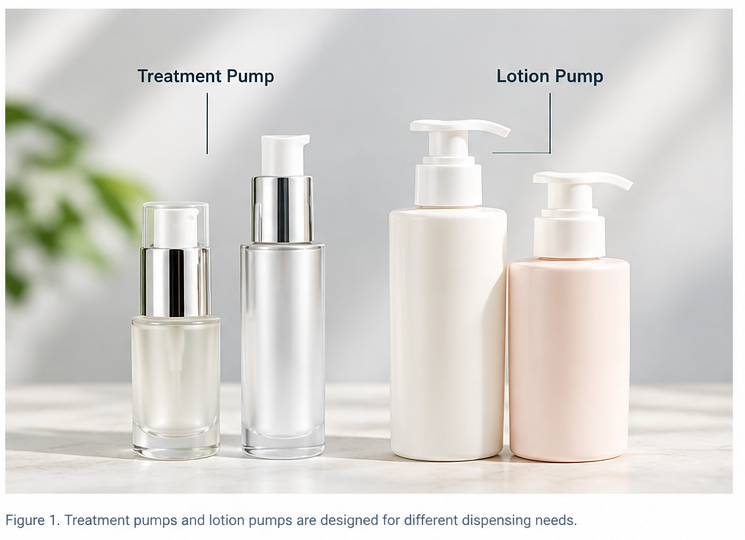
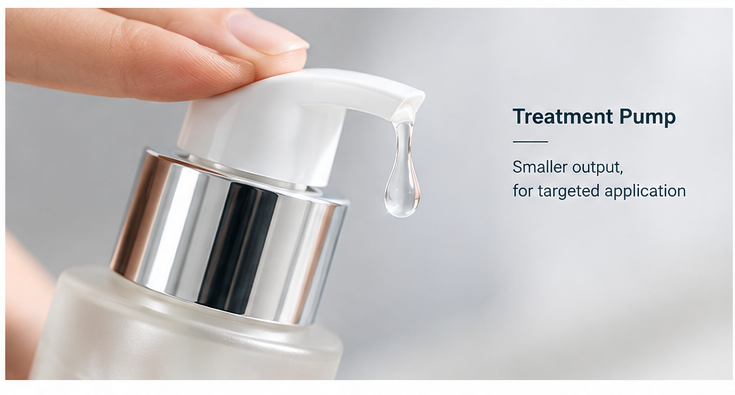
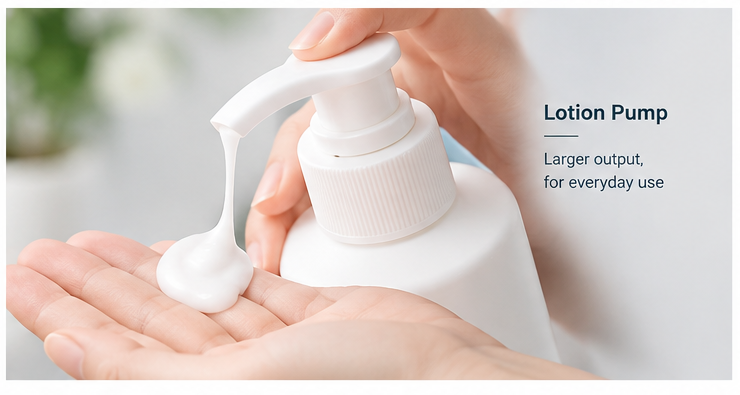
A treatment pump is generally designed for controlled, targeted dispensing of smaller amounts of skincare products, while a lotion pump is commonly used to dispense larger amounts of lotions and other everyday personal care formulas. However, their exact dispensing volumes and suitable applications vary by pump model and manufacturer.
For beauty brands, the difference between a treatment pump and a lotion pump goes beyond appearance. The pump affects how much product consumers receive with each press, how easily the formula is dispensed, and whether the packaging delivers a consistent user experience.
A treatment pump may be suitable for facial serums, concentrated treatments, and products that require measured application. A lotion pump is often a practical choice for facial moisturizers, body lotions, and other products used in larger quantities.
The right choice depends on four key factors: formula properties, output per stroke, intended application, and packaging compatibility.
1. Treatment Pump vs. Lotion Pump: Key Differences at a Glance
Although product naming conventions vary between packaging suppliers, the following table summarizes their typical differences.
| Comparison Factor | Treatment Pump | Lotion Pump |
|---|---|---|
| Primary purpose | Controlled dispensing for targeted applications | Convenient dispensing for everyday use |
| Typical product applications | Facial serums, targeted skincare treatments, lightweight treatment formulas | Facial lotions, body lotions, moisturizers, and other suitable liquid or emulsion formulas |
| Dispensing volume | Often designed for smaller doses | Often designed for larger doses |
| User experience | Emphasizes measured, controlled application | Emphasizes convenient, smooth dispensing |
| Formula considerations | Must suit the pump’s flow path, output, and operating mechanism | Must suit the pump’s flow path, output, and operating mechanism |
| Common packaging formats | Treatment bottles, serum bottles, and other compatible containers | Lotion bottles and other compatible containers |
| Main selection priority | Dose control and application precision | Output volume and ease of everyday use |
2. What Is a Treatment Pump?
A treatment pump is a dispensing mechanism commonly used for skincare products that benefit from controlled application. It is often associated with facial treatments, serums, and other formulas for which consumers prefer a measured amount per application.
The defining feature is its intended dispensing function, rather than the product category printed on the bottle.
How Does a Treatment Pump Work?
When the user presses the actuator, the pump mechanism draws product through its internal flow path and dispenses it through the outlet. The amount delivered depends on the pump’s design and specifications.
For brands developing targeted skincare products, the pump should provide an appropriate dose without requiring excessive force or repeated pressing.
During product evaluation, buyers should assess:
- Output per stroke: Does each press dispense an appropriate amount for the intended application?
- Actuation force: Can consumers operate the pump comfortably?
- Dispensing consistency: Does the pump deliver a reasonably consistent dose over repeated use?
- Formula flow: Can the formula pass through the pump without excessive resistance or clogging?
- Priming performance: How many presses are needed before product is first dispensed?
These factors should be evaluated using the actual formula and selected pump, rather than relying on the pump’s name alone.
Which Products May Use a Treatment Pump?
Treatment pumps may be considered for:
- Facial serums: Products that require controlled application to the face.
- Targeted skincare treatments: Formulas intended for specific areas or application routines.
- Lightweight treatment lotions: Products that need measured dispensing but are compatible with the pump mechanism.
- Selected eye-care products: Formulas for which the pump output and application method suit the intended use.
Not every serum requires a treatment pump. A low-viscosity serum may also work with a suitable serum pump, dropper, or airless dispenser. The choice depends on the formula, desired dose, user experience, and packaging design.
3. What Is a Lotion Pump?
A lotion pump is a dispensing mechanism commonly used for everyday skincare and personal care products. It is designed to make repeated dispensing convenient, allowing consumers to obtain product without pouring it directly from the container.
Lotion pumps are frequently paired with lotion bottles for facial moisturizers, body lotions, and other formulas that can flow through the selected mechanism.
How Does a Lotion Pump Work?
Many conventional lotion pumps use a dip tube that extends into the product. When the actuator is pressed, the mechanism draws product through the tube and releases it through the nozzle.
The actual construction varies by model, and some lotion pumps use different dispensing architectures.
For brand owners, the important question is whether the pump can deliver the required volume and handle the formula throughout the product’s intended use.
Key evaluation points include:
- Output volume: Is the amount dispensed per press suitable for the product’s recommended use?
- Flow behavior: Does the formula dispense smoothly without excessive force?
- Repeated-use performance: Does the pump continue to operate consistently as the product is consumed?
- Closure and leakage performance: Does the assembled package meet the brand’s storage and transport requirements?
- Consumer handling: Is the actuator comfortable and easy to use?
Which Products May Use a Lotion Pump?
Lotion pumps are commonly considered for:
- Facial moisturizers and daily lotions
- Body lotions and moisturizing emulsions
- Hand lotions and selected hand-care products
- Other liquid or emulsion-based personal care products compatible with the pump
A lotion pump is not automatically the best choice for every lotion. Highly viscous, particulate-containing, or otherwise challenging formulas may require a different mechanism or a specifically engineered pump.
For this reason, brands should evaluate viscosity and flow behavior together with the pump’s technical specifications.
4. How to Choose Between a Treatment Pump and a Lotion Pump
For a brand developing a new skincare product, pump selection should start with the intended consumer experience and formula requirements—not simply with the name of the packaging component.
Step 1: Define the Intended Application
First, determine how consumers are expected to use the product.
If the product is intended for targeted facial application and requires a relatively small amount per use, a treatment pump may be a suitable starting point.
If the product is intended for routine moisturizing and consumers need a more generous amount per application, a lotion pump may be more appropriate.
However, the intended application is only an initial screening criterion. It does not replace technical evaluation.
Step 2: Determine the Required Output per Stroke
Output per stroke is one of the most important specifications when comparing cosmetic pumps.
It refers to the approximate volume of product dispensed during one complete actuation under defined test conditions. It is commonly expressed in milliliters per stroke (mL/stroke) or cubic centimeters per stroke (cc/stroke). Since 1 mL equals 1 cc, these units represent the same volume.
The required output should be determined by considering:
- The recommended amount per application
- The number of presses consumers are expected to use
- The formula’s intended method of application
- The bottle’s total capacity and expected usage pattern
For example, a brand developing a facial serum may want consumers to dispense a small, controlled amount. A body lotion brand may prefer a larger amount per press to make application more convenient.
These are usage scenarios, not fixed rules. The final output specification must be confirmed against actual pump performance.
Step 3: Match the Pump to the Formula
Formula compatibility is essential to reliable dispensing.
A pump that works well with a lightweight emulsion may not perform equally well with a thicker cream or a formula containing suspended particles.
Before selecting a pump, consider:
- Formula viscosity at relevant temperatures
- Flow behavior and tendency to clog
- Chemical compatibility with product-contact materials
- Sensitivity to air exposure, where relevant
- Potential changes in dispensing performance during storage
Compatibility should be validated with the actual formulation and final packaging configuration. A general statement that a pump is suitable for serums or lotions is not sufficient evidence that it will work with every formula in that category.
Step 4: Select the Appropriate Bottle and Pump Assembly
A pump should not be evaluated independently from its container.
The selected pump must be compatible with the bottle’s neck finish, closure dimensions, dip-tube length where applicable, and overall package design.
Brands should also assess:
- Bottle capacity and available headspace
- Pump height and overall proportions
- Actuator shape and ergonomics
- Decoration and branding requirements
- Leakage and transport performance
- Compatibility with filling and assembly processes
For example, a pump may meet the desired output specification but still be unsuitable if it does not fit the selected bottle or creates problems during filling and transport.
Topfeelpack’s lotion bottle and airless bottle categories provide starting points for exploring cosmetic packaging formats. The exact product model and pump specifications should be confirmed with the supplier before final selection.
Step 5: Test the Complete Package Before Mass Production
A successful pump selection requires more than checking a product drawing or testing an empty bottle.
A practical validation process should include:
- Initial dispensing tests: Check priming, output volume, and actuation force.
- Repeated-use tests: Evaluate dispensing consistency across multiple pump cycles.
- Formula compatibility tests: Observe changes in appearance, odor, package integrity, and dispensing behavior under an appropriate test plan.
- Leakage and transport tests: Evaluate the assembled package under conditions relevant to distribution and use.
- Consumer-use assessment: Confirm that the dispensing experience matches the brand’s expectations.
The exact test methods and acceptance criteria should be established according to the product, package design, and intended market.
5. Treatment Pump vs. Lotion Pump vs. Airless Pump
One common source of confusion is that treatment pumps, lotion pumps, and airless pumps are not necessarily three mutually exclusive categories.
Treatment pump and lotion pump generally describe intended dispensing applications. Airless pump describes a dispensing architecture designed to dispense product without relying on a conventional open-air replacement path into the product chamber.
An airless format may be suitable for certain serums, lotions, and treatment products, depending on the formula and system design.
| Feature | Treatment Pump | Lotion Pump | Airless Pump |
|---|---|---|---|
| Main distinction | Controlled, targeted dispensing | Convenient dispensing for routine use | Airless dispensing architecture |
| Typical application | Targeted skincare treatments | Daily lotions and moisturizers | Selected serums, lotions, and creams |
| Output | Depends on the model | Depends on the model | Depends on the model |
| Formula compatibility | Must be validated | Must be validated | Must be validated |
| Key decision factor | Dose and application precision | Output and ease of everyday use | Formula protection requirements and dispensing performance |
An airless pump is not automatically a treatment pump or a lotion pump in every supplier’s product classification. When comparing quotations, ask suppliers to identify the actual mechanism, output specification, and compatible container.
For additional background, see Topfeelpack’s article on cosmetic airless pump bottles.
6. Common Mistakes Brands Should Avoid When Selecting a Cosmetic Pump
Choosing by Product Name Alone
A pump described as a treatment pump may have different specifications from another supplier’s treatment pump. Product names are useful for initial screening, but they should not replace technical drawings and performance data.
Better approach: Request the pump’s output per stroke, dimensional specifications, material information, and relevant test results.
Assuming a Smaller Pump Head Means a Smaller Dose
The external appearance of an actuator does not reliably indicate the volume dispensed. Internal pump design and specifications determine the output.
Better approach: Confirm the nominal output and verify actual performance through testing.
Ignoring Formula Viscosity
A pump that dispenses a lightweight serum smoothly may struggle with a thicker formula. Conversely, choosing a pump with an unsuitable output or operating force can make the user experience inconvenient.
Better approach: Test the actual formula with the selected pump, including under relevant temperature and storage conditions.
Selecting the Pump Before Finalizing the Bottle
A pump and bottle may look compatible but have mismatched neck dimensions, tube lengths, or assembly requirements.
Better approach: Evaluate the complete packaging assembly and confirm compatibility before ordering production tooling or committing to bulk production.
Treating Packaging Samples as Proof of Production Readiness
A small number of successful sample tests cannot establish that every production batch will perform identically.
Better approach: Agree on specifications, acceptance criteria, and appropriate quality checks with the packaging supplier before mass production.
7. What Should Brands Ask a Cosmetic Packaging Supplier?
When requesting a quotation for a treatment pump or lotion pump, provide enough information for the supplier to recommend a suitable configuration.
Use this checklist during your next packaging discussion.
- Product type and intended application
- Formula viscosity and relevant formulation characteristics
- Required output per stroke
- Preferred bottle capacity and dimensions
- Bottle neck finish and pump compatibility requirements
- Preferred materials and product-contact components
- Airless or conventional dispensing requirements
- Decoration, color, and branding specifications
- Sample testing and performance acceptance criteria
- Estimated order quantity and target launch schedule
Providing these details early helps narrow the available options and reduces the risk of choosing a pump that looks suitable but does not meet the product’s functional requirements.
For brands comparing different packaging formats, Topfeelpack’s article on choosing an empty lotion bottle with a pump offers additional selection considerations.
Frequently Asked Questions
1. Is a treatment pump better than a lotion pump for serum?
Not necessarily. A treatment pump may be suitable when the serum requires controlled dispensing, but the best option depends on viscosity, desired output, formula compatibility, and user experience. Some serums may work better with other pump types or dispensing systems.
2. What is the main difference between a treatment pump and a lotion pump?
The main difference is their typical dispensing purpose. Treatment pumps are generally associated with controlled application of smaller amounts, while lotion pumps are commonly used for routine dispensing of lotions and moisturizers. Actual output varies by model.
3. Can a lotion pump dispense thick cream?
Some lotion pumps can handle relatively viscous formulas, but performance depends on the pump’s design, flow path, and specifications. Thick creams may require a suitable specialized pump or an alternative dispensing system. Testing with the actual formula is recommended.
4. Are treatment pumps and airless pumps the same?
No. Treatment pump generally refers to the intended dispensing application, whereas airless pump refers to a dispensing system architecture. Some treatment products may use airless packaging, but the terms are not interchangeable.
5. How do I choose the correct pump output for my skincare product?
Start with the recommended dose per application and the desired number of presses. Then compare available pump outputs and test the selected pump with the actual formula. Confirm dispensing consistency, actuation force, and compatibility before mass production.
Conclusion: Choose the Pump Around the Formula and User Experience
The difference between a treatment pump and a lotion pump is primarily about dispensing purpose and the user experience each is intended to deliver. Treatment pumps are commonly considered for controlled, targeted application, while lotion pumps are widely used for everyday moisturizing products.
For beauty brands, neither option is universally better. The right solution must balance output per stroke, formula properties, bottle compatibility, dispensing consistency, and the intended positioning of the finished product.
Topfeelpack helps beauty brands explore cosmetic packaging options based on their product and packaging requirements. If you are developing a new serum, facial treatment, or lotion, contact the Topfeelpack team to discuss the packaging format and pump specifications that should be evaluated for your project.
Post time: Oct-14-2026
