
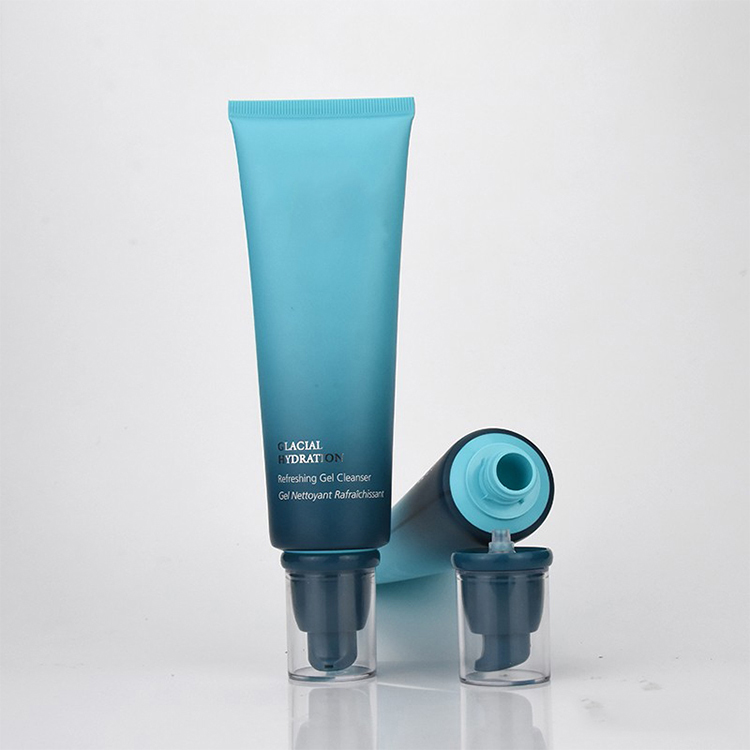
An airless tube is a cosmetic tube with a pump or airless dispensing system, so product is pushed out in controlled doses without air being drawn back into the pack. Compared with a plain squeeze tube, it can limit air exposure and improve dose control. It suits creams, BB creams, and sunscreens, but needs filling trials and a material check.

Squeeze Tube vs Airless Tube
| Point | Squeeze tube | Airless tube |
|---|---|---|
| Dispensing | User squeezes the body | Pump or airless mechanism delivers a dose |
| Dose control | Varies with how hard the user squeezes | More consistent, subject to pump testing |
| Air exposure | Air can be drawn back in as the tube recovers | Designed to limit air return |
| Components | Few | More; adds a pump or dispensing system |
| Cost and complexity | Simpler | Higher; needs line trials |
| Recycling check | Body, shoulder, cap | Body, shoulder, cap, plus pump parts |
Mechanisms differ by model, so confirm the construction with the supplier.
When an Airless Tube Fits
- Cream-type products where dose matters, such as BB cream or face cream.
- Sunscreens in larger sizes where a pump is easier to use than squeezing.
- Formulas sensitive to repeated air contact. Airless limits exposure but does not replace stability testing.
- Premium positioning where a pump gives a more controlled, cleaner application.
When a Plain Squeeze Tube Is Enough
- The formula is stable and the dose does not need to be tightly controlled.
- Cost, weight, or a simple material story is the priority.
- The product is sold as a single-use or short-use item.
What to Check Before Choosing
- Viscosity and dose: test the real formula for priming, dose per actuation, and residual product.
- Compatibility: check the formula against every contact material, including the pump parts.
- Filling: confirm the filler can fill an airless tube and avoid trapped air.
- Recycling: request a material breakdown that includes the pump.
- Barrier: a pump controls dispensing; wall barrier is a separate property. See Monolayer vs Multilayer Cosmetic Tubes.
Topfeelpack Airless Tube Models
- TU01 30 ml / 50 ml PE Airless Cream Tube: listed in 30 ml and 50 ml in PE.
- TU02 5-Layer Airless Cosmetic Tube: a five-layer plastic tube.
- TU03 Custom BB Cream Airless Pump Tube: listed for BB cream.
- TU56 Oval Airless Sunscreen Tube: listed in 50 ml to 80 ml.
Product-page specifications are screening points. Confirm current details with Topfeelpack and test with your own formula.

A Five-Step Selection Guide
- Define the product and the dose. Note the viscosity, the target dose, and how the product is used.
- Choose the dispensing system. Decide whether a pump is needed, or whether a squeeze tube meets the brief.
- Choose the size. Match the capacity to the use period of the product.
- Choose the wall. Decide whether the barrier of the body needs attention, then compare options. See Monolayer vs Multilayer Cosmetic Tubes.
- Trial and test. Run filling trials and stability testing on the filled tube.
What to Ask the Supplier
- What is the dispensing mechanism, and what dose does it deliver?
- What are the materials of the body, shoulder, cap, and pump parts?
- Which formulas has the design been used with, and at what viscosity?
- How is the tube filled, and is there a risk of trapped air?
- Is there a material breakdown that includes the pump?
Filling and Line Notes
An airless tube may need a different filling approach from a plain tube, because air must be managed during filling. Confirm with the filler how the tube is held, filled, and sealed, and whether the line needs adjustment. Test several filled units for dose, residual product, and leakage before approving a batch.
A Worked Dose Example
This is an illustrative calculation, not a Topfeelpack specification. Suppose a face cream is packed in a 30 ml airless tube and the brief targets about 0.5 ml per application.
- Nominal applications: 30 ml / 0.5 ml = 60.
- Priming and residual product reduce that number, so the real count is lower.
- If a customer uses the product twice a day, the nominal 60 applications last about a month.
Use the example to size the tube against the intended use period. Then measure filled samples for dose, priming loss, and residual product, because those figures decide whether the tube lasts as long as the pack claims.
FAQ
Is an airless tube the same as an airless bottle?
The principle is similar, but the format and body differ. A tube suits portable, soft-touch products; a bottle suits rigid, upright use.
Can an airless tube be refilled?
Only if the model is designed for it. Check the specific design.
Does an airless tube extend shelf life?
It can limit air exposure, but shelf life depends on the formula and must be confirmed by testing.
Keep Reading
- Category: Airless tube range
Request samples · Request a quote:
contact Topfeelpack
Post time: Nov-24-2026
