
Plastic cosmetic tubes are where brand dreams either shine or fall apart—leaks, cheap finishes, and supply hiccups can wreck a launch faster than bad reviews on a Monday morning.
Smart buyers know packaging pulls weight: it protects formulas, sells on sight, and keeps customers coming back. Every detail has to earn its spot without blowing the budget.
Key Insights on Plastic Cosmetic Tubes
➔ Eco-Friendly PCR Content: Incorporate post-consumer recycled PE/PP to cut virgin plastic use and enhance recyclability.
➔ Finish Options: Choose matte or glossy coatings with silk screen printing on bottles or hot stamping for standout shelf appeal.
➔ User-Friendly Closures: Flip-top caps and a reliable pump dispenser deliver precise dosage, superior hygiene, and minimal waste.
➔ Material & Barrier: Balance PE, PP, PETG or EVOH multi-layer designs for the ideal mix of flexibility, rigidity, and oxygen protection.
➔ Safety & Quality Control: Enforce migration, leak, and pressure testing plus consistent extrusion checks to ensure tube integrity.
Why Choose Specific Plastic Cosmetic Tubes?
Tubes may sound simple, yet the right choice shapes how a product feels, works, and sells. From eco-goals to daily usability, tailored plastic packaging influences brand value far better than generic alternatives.
Ensuring Eco-Friendly Packaging with PCR Content
Integrating sustainable packaging is no longer a side note. With post-consumer resin (PCR), modern tubes cut down virgin plastic use while maintaining robust strength.
- Reduced reliance on recycled plastic
- Support for green initiatives
- Alignment with eco-conscious design
Environmental Impact Comparison of Tube Materials
| Material Type | Virgin Plastic Use (%) | Carbon Reduction (%) | Recyclability Score (1–5) |
|---|---|---|---|
| Standard PE | 100 | 0 | 3 |
| 30% PCR PE | 70 | 18 | 4 |
| 50% PCR PP | 50 | 32 | 4 |
| 100% PCR Blend | 0–10 | 45 | 5 |
- Source certified PCR material.
- Blend with PE or pcr pp for structural balance.
- Test barrier performance and durability.
"Sustainable packaging remains a decisive factor for over 70% of global beauty consumers,” notes McKinsey’s 2025 global packaging outlook.
Manufacturers like Topfeelpack integrate these goals directly into production, making environmental responsibility practical.
Enhancing Brand Identity through Matte and Glossy Finishes
A matte finish gives a soft, premium vibe, while a glossy finish adds bold visual appeal.
- Elevated packaging aesthetics
- Stronger brand perception
- Memorable product presentation
Consider this layered approach:
- Surface Treatment
- Matte coating → subtle surface texture
- Gloss varnish → reflective effect
- Decoration
- Silk screen printing
- Hot stamping for metallic detail
- Market Positioning
- Skincare: calm, muted tones
- Youth cosmetics changes: vibrant gloss
Texture talks and shine sells; thoughtful surface treatments shape buying decisions in crowded aisles.
Optimizing User Experience with Flip-Top and Pump Dispensers
Convenience drives loyalty. A well-designed flip-top cap snaps shut with one hand, while a pump mechanism controls dosage with precision.
Key performance factors:
- Dispensing mechanism accuracy
- Leak resistance
- Clean application method
- Smooth product accessibility
Multi-layer thinking helps:
- User Convenience
- Easy squeeze force
- One-handed opening
- Functional Design
- Airless pump options
- Controlled output for creams and sunscreens
- Waste Reduction
- Measured dosing
- Less leftover residue
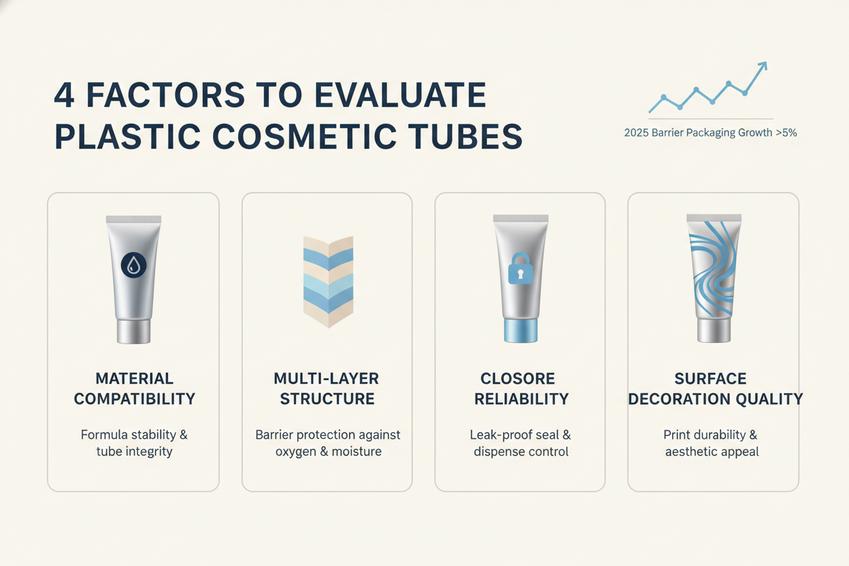
4 Factors To Evaluate Plastic Cosmetic Tubes
Choosing the right cosmetic tube requires evaluating every detail affecting product integrity and shelf life.
Material Compatibility: PETG vs. HDPE Barrier Performance
The wrong resin can compromise your formula fast.
- Core material comparison
- PETG
- High clarity
- Good rigidity
- Moderate chemical resistance
- HDPE
- Opaque finish
- Strong chemical resistance
- Better stress crack resistance
- PETG
- Barrier considerations
- Without barrier layer
- Basic protection
- Shorter shelf life for sensitive creams
- With EVOH layer
- Improved oxygen barrier
- Enhanced product integrity
- Without barrier layer
- Practical selection tips
- Match formula pH with resin stability
- Test essential oils against HDPE
- Check clarity needs before analyzing petg vs pet
“Barrier packaging demand in beauty applications is rising as brands prioritize extended shelf life and formula protection,” noted Smithers' 2025 flexible packaging outlook.
For modern formulations, barrier packaging featuring EVOH provides vital peace of mind.
Structural Design Insights on Monolayer and Multi-Layer Tubes
The tube structure dictates durability and user feel.
- Monolayer
- Single material layer
- Higher flexibility
- Lower production cost
- Multi-layer
- 2–5 material layers
- Integrated protection barrier
- Improved durability
Design breakdown for a high-quality squeeze tube:
- Outer layer: Print-friendly surface supporting decoration.
- Middle barrier layer: EVOH or similar to block oxygen migration.
- Inner contact layer: Formula-safe resin maintaining integrity.
Closure Mechanism Reliability of Screw, Disc Top, and Nozzle Caps
A premium tube means nothing if the closure leaks.
- Screw cap: Strong sealing, highly travel-friendly.
- Disc top cap: One-hand dispensing, controlled flow.
- Nozzle cap: Precision application, ideal for spot treatments.
Reliability checklist:
- Torque testing
- Drop testing
- Leakage simulation under Pressure testing
Surface Decoration Quality in Silk Screen, Hot Stamping, and Labeling
Decoration must survive friction and humidity to remain effective.
- Silk screen: Thick ink layer, strong color depth.
- Hot stamping: Metallic shine, premium appeal.
- Labeling: Flexible design updates, good for short runs.
Quality control focus:
- Adhesion testing
- Abrasion resistance
- Color consistency under UV exposure
High-end makeup packaging frequently mixes silk screen graphics with hot stamping to guarantee the tube keeps its edge through daily handling.
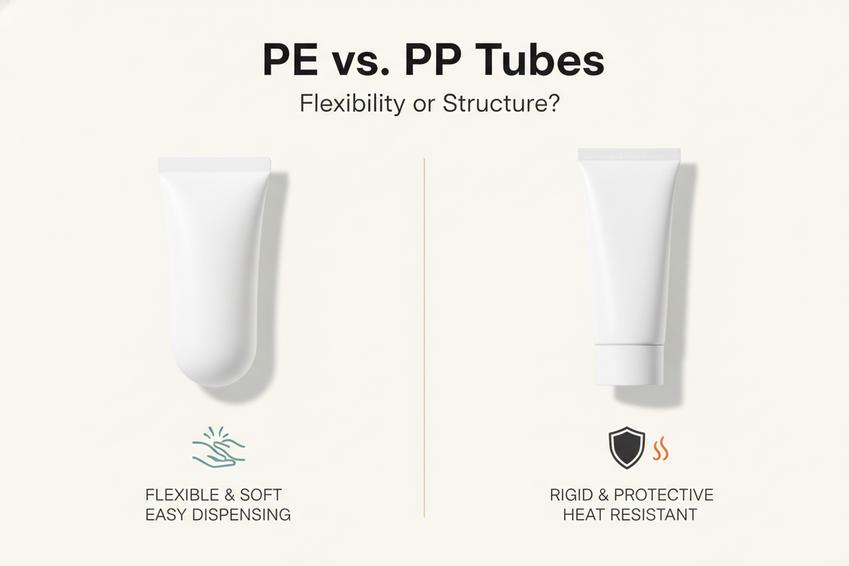
PE Vs. PP Tubes: Which Performs Best?
The choice between Polyethylene and Polypropylene dictates how cosmetic packaging behaves in real-world scenarios.
PE Tubes
Polyethylene stands out for intuitive comfort and ease.
- Key traits:
- Flexibility
- Squeezability
- Softness
- Common variants: LDPE, HDPE
- Why brands like it:
- ✓ Easy to squeeze during last drops
- ✓ Reliable chemical resistance
- ✓ Practical barrier properties
- Material Behavior
- Molecular Structure: Lower density (LDPE) for higher flexibility; Higher density (HDPE) for improved barrier properties.
- User Experience: Gentle compression and controlled flow.
- Sustainability Angle
- Reprocessing Potential: Recognized Recyclability in global markets.
- Lightweight Benefit: Reduced transport load.
Topfeelpack often recommends PE when tactile softness is essential to brand identity.
PP Tubes
Polypropylene delivers structure, requiring less squeeze while offering more strength.
- Core attributes:
- Rigidity
- Stiffness
- Durability
- Performance highlights: Elevated heat resistance, strong impact resistance.
- Structural Strength
- Mechanical Stability: High rigidity prevents panel dents; maintains clarity in certain grades.
- Thermal Behavior: Better heat fill resistance for hot-fill lines.
- Design Compatibility
- Decoration Options: Excels with injection molding and sharp shoulder detailing.
- Long-Term Use: High durability under frequent handling.
- Chemical Profile
- Stable chemical resistance for active formulas.
For premium tubes where silhouette precision matters, PP frequently wins. Topfeelpack customizes these solutions to perfectly balance performance and shelf appeal.
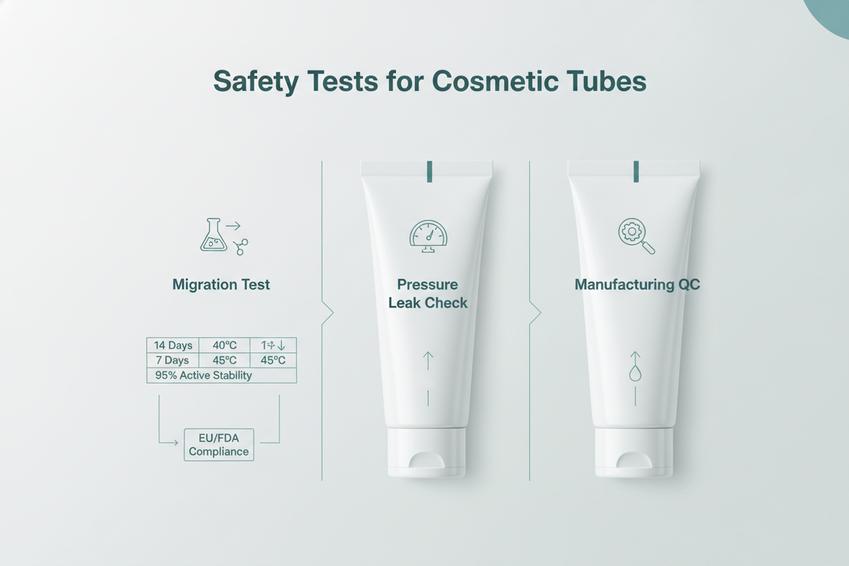
What Safety Tests Do Tubes Require?
From migration risks to pressure failures, every unit must pass rigorous lab checks before touching active ingredients.
Migration Testing for Face Cream and Sunscreen Formulations
When producing sunscreen packaging, Migration Testing is critical to verify chemical compatibility.
- Key risk areas:
- Migration of additives
- Reaction with UV filters
- Loss of preservative stability
- Identify formulation type.
- Match with tube resin structure (PE, EVOH).
- Conduct accelerated testing at 40°C–50°C.
- Analyze extractables.
| Test Condition | Duration (Days) | Temperature (°C) | Acceptance Criteria |
|---|---|---|---|
| Accelerated aging | 14 | 40 | No visible change |
| UV exposure | 7 | 45 | Active stability ≥95% |
| Solvent contact | 10 | 50 | Within Safety standards |
| Long-term storage | 90 | 25 | No measurable migration |
Modern packaging must strictly comply with EU and FDA frameworks to prevent costly recalls.
Pressure and Leak Assessments on Sealing Ends and Orifices
Squeeze a tube hard enough and weaknesses show fast.
- Core evaluations:
- Burst resistance
- Vacuum stability
- Drop impact
Testing flow:
- Seal the tube closures.
- Apply internal air pressure.
- Record deformation levels.
- Submerge in water for bubble-based leak detection.
Quality Control in Extrusion, Co-Extrusion, and Tube Forming
Safety begins during extrusion, well before the filling line.
- Material Stage
- Resin verification
- Melt flow index testing
- Barrier layer thickness validation
- Forming Stage
- Tube forming alignment
- Shoulder welding strength
- Cap threading precision
- Inspection Stage
- Dimensional accuracy measurement
- Wall thickness scan
- Inline Defect detection
When manufacturing lines are tightly controlled and inspections stay sharp, plastic cosmetic packaging performs exactly as expected—quietly,reliably, and safely.
References
- sustainable packaging - mckinsey.com/McKinsey & Company
- green initiatives - plasticsindustry.org/Plastics Industry Association
- visual appeal - cosmeticsdesign.com/Cosmetics Design
- pump dispenser - personalcaremagazine.com/Personal Care Magazine
- chemical resistance - echa.europa.eu/European Chemicals Agency
- Pressure testing - astm.org/ASTM International
- EU and FDA frameworks - ec.europa.eu/European Commission
- Recyclability - plasticsrecyclers.eu/Plastics Recyclers Europe
- Defect detection - iso.org/International Organization for Standardization
Post time: Jul-08-2026
