
Syringe bottle cosmetic packaging dispenses formula through a narrow needle, cannula or nozzle under controlled pressure, allowing precise and targeted application. It is used for eye creams, spot treatments, serums, scalp treatments and any formula applied to a specific point rather than a broad area.
The format is a small but growing niche. It exists because a growing number of products are defined by where they are applied, not just what they contain — and a pump bottle cannot deliver 0.05 ml to a 4 mm target.

The defining characteristic: a narrow orifice
What separates a syringe bottle from a pump bottle is not the mechanism but the outlet. The orifice diameter determines everything downstream.
| Orifice type | Typical diameter | Dose control | Best for |
|---|---|---|---|
| Needle / cannula | 0.5–1.5 mm | Very high precision | Spot treatments, eye area, scalp |
| Narrow nozzle | 1.5–3 mm | High precision | Serums, gels, essences |
| Standard pump spout | 3–6 mm | Moderate | Lotions, creams |
| Wide tube orifice | 8–15 mm | Low | Body creams, masks |
A syringe bottle’s value proposition is entirely captured in the first two rows. Once the orifice exceeds about 3 mm, the format loses its reason to exist and a standard pump or tube does the job at lower cost.
Where syringe formats are actually used
Five application categories account for most of the volume in this format.
- Eye care. The under-eye area is small, delicate, and needs small doses. A needle-tip applicator reaches the orbital contour without depositing product on the cheek. It also avoids the fingertip application that most consumers apply too heavily.
- Spot treatments. Acne treatments, pigmentation correctors, and targeted actives are applied to individual lesions or marks. Precision matters more than volume.
- High-cost actives. When the formula costs more per millilitre than the pack, precise dosing protects margin. A 15 ml serum at a high price point justifies a pack that delivers 0.1 ml reliably.
- Scalp and hair treatments. The hair is a barrier. A cannula reaches the scalp directly, which is why minoxidil-style formats and scalp serums use narrow applicators.
- Pharmaceutical-inspired skincare. Products positioned on clinical credibility often adopt syringe aesthetics deliberately. The form signals precision and dosage — which is a positioning decision as much as a functional one.
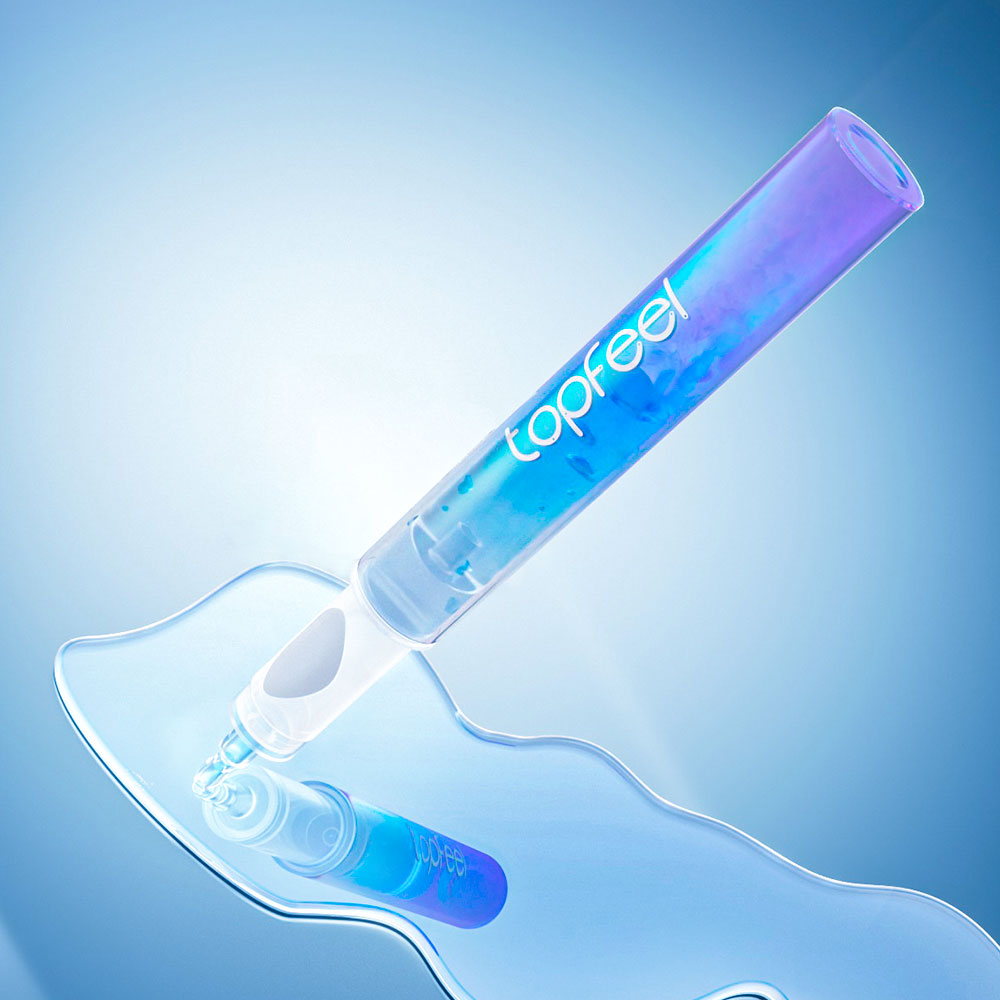
Topfeel’s TE21 syringe-style airless bottle for eye care and TE19 airless refillable syringe bottle cover the first and third categories directly. A needle-tip eye cream syringe example sits in the same family.
Airless and syringe: how the two combine
The most technically interesting variants combine a syringe outlet with an airless chamber.
In this construction, product sits above a piston inside a rigid or semi-rigid body. Actuating the mechanism advances the piston, which pushes product through the narrow orifice. Because the piston only moves forward, no air enters the chamber — the oxidation protection of an airless bottle with the targeting of a syringe.
The combination solves a problem that neither format solves alone:
- A plain syringe (plunger in a barrel) gives precision but exposes the formula to air as the plunger retracts or as the product is drawn back.
- A plain airless bottle gives oxidation protection but dispenses to a broad area.
- An airless syringe gives both, at higher cost and with stricter fill requirements.
The cost is the constraint. An airless syringe typically requires more precise fill control than a standard bottle because the piston travel is short and the headspace tolerance is tight. A short fill is not just a cosmetic defect — it changes the dose.
The refillable angle
A secondary reason brands adopt this format is refillability. Because the outer shell can be durable (metal-look, heavy-wall, or a premium plastic) while the inner chamber is a disposable cartridge, a syringe-style pack supports a refill model convincingly.
That matters under the EU Packaging and Packaging Waste Regulation, which addresses reuse and refill alongside recyclability. The regulation entered into force on 11 February 2025 and applies generally from 12 August 2026, with some requirements phasing in later. Refill systems can support a packaging-reduction story, but only where the design and the consumer’s actual behaviour both support reuse — and self-reported refill uptake is consistently more optimistic than observed behaviour.
The honest framing: refill has the highest theoretical material saving and the highest uncertainty. A refillable airless syringe bottle is a reasonable bet for a loyal, repeat-purchase customer base, and a weaker one for a first-time buyer.

Materials and construction
| Component | Common materials | Notes |
|---|---|---|
| Outer body | PP, PETG, AS, aluminium | Determines perceived quality and price point |
| Inner chamber | PP, PETG | Must be compatible with the formula |
| Piston | PP, PE | Fit tolerance determines bypass |
| Orifice / cannula | PP, LDPE, metal (rare) | Metal cannula raises recyclability issues |
| Cap | PP | Must seal the orifice, not just cover it |
Two specification traps are worth naming.
The cannula material. A metal cannula looks premium and is common in pharmaceutical formats. In a cosmetic pack it creates a separation problem at end of life and may react with acidic formulas. A moulded plastic cannula avoids both, at some cost to the perceived precision.
The cap seal. A cap that covers the orifice without sealing it allows the product to dry at the tip and block the cannula between uses. This is the most common field complaint for the entire format, and it is a cap design issue, not a formula issue.
When a syringe bottle is the wrong choice
Three cases where the format should be rejected outright.
When the formula is viscous. A thick cream will not pass a 1 mm cannula, and forcing it produces sputtering, inconsistent dose and clogging. If the formula is above roughly 30,000 cPs, the format is not viable without reformulation.
When the application area is broad. A full-face serum does not need a cannula. The precision is wasted, the pack costs more, and the user experience is worse — the user wants to spread product across the face, not deposit it in a line.
When the price point is low. The format’s cost only makes sense where the formula value or the positioning justifies it. A €12 serum in a syringe pack is spending money on a feature its buyer does not value.
The precision claim, tested
If the marketing claim is precision, it should be measurable. Three tests establish whether a syringe pack actually delivers:
- Dose consistency. Weigh twenty consecutive actuations. The coefficient of variation should be low and the mean should match the stated dose.
- Tip clogging. Leave the pack capped for seven days at ambient, then actuate. A pack that requires priming after a week has a cap seal problem.
- Residual volume. Dispense to exhaustion and weigh what remains. Airless syringe formats should leave under 5%; a plain plunger syringe typically leaves more because the plunger cannot reach the shoulder.
Ask for these results in the proposed production configuration. A sample tested undecorated and unfilled does not reproduce them.
Frequently asked questions
Is a syringe bottle the same as an airless bottle?
Not necessarily. Some syringe bottles use a simple plunger with no airless chamber, which means air enters as the plunger is drawn back. An airless syringe combines both: the piston advances only, so no air enters, and the narrow orifice provides precision.
What is the typical capacity of a cosmetic syringe bottle?
Most fall between 5 ml and 30 ml, with 10–15 ml the common range for eye and spot products. Above 30 ml the dose precision becomes less relevant and a standard pump is more economical.
Can a syringe bottle be refilled?
Yes, where the design uses a replaceable inner cartridge. Confirming the cartridge seating and the dose consistency across multiple cartridges is essential — a refill system that dispenses differently on the second cartridge will generate complaints.
Do syringe bottles need preservatives?
Usually yes, unless the formula and the production process are designed for a preservative-free claim. Airless construction reduces contamination exposure but does not sterilise the product, and preservation requirements depend on the formula and challenge testing.
Why does my syringe bottle clog between uses?
Product drying at the tip, most often caused by a cap that covers the orifice without sealing it. A cap with an internal plug that enters the orifice prevents this.
Sourcing syringe bottles
Topfeelpack manufactures airless syringe bottles, refillable syringe formats and needle-tip applicators from 5 ml to 30 ml, in PP and PETG with custom decoration. See the syringe bottle range for available capacities, or review airless bottles and dropper bottles for adjacent formats.
Send the formula viscosity, target dose, application area and launch volume, and we will confirm whether a syringe format is viable for your product.
Post time: Nov-11-2026
