
A monolayer cosmetic tube has one structural layer in its body wall, usually polyethylene. A multilayer tube combines layers, for example PE, tie layers, and an EVOH barrier. Multilayer is worth its added complexity only when measured barrier data addresses a specific formula risk. Layer count alone does not predict shelf life or recyclability.

Five Questions to Decide
| Question | If yes | If no |
|---|---|---|
| Does the formula have a documented oxygen, water-loss, or fragrance risk that a simple wall did not control in filled-pack tests? | Evaluate a multilayer wall with barrier data | A monolayer wall may be sufficient |
| Can the supplier give comparable OTR and WVTR data for the tube body, under stated conditions? | Compare structures on that data | Treat any high-barrier claim as unverified |
| Can recycling guidance be shown for the complete tube, including shoulder, cap, and any pump? | Proceed to like-for-like quotes | Resolve this before approving samples |
| Do matched quotes show the multilayer premium is acceptable? | Proceed to validation | Revisit the requirement or the structure |
| Is there time for stability testing on the finished tube? | Plan the program | Do not approve an unvalidated wall |
What the Two Structures Mean
A five-layer barrier body, read from outside to inside, can be PE / tie layer / EVOH / tie layer / PE. EVOH is a barrier material, and the tie layers bond the materials together. Not all multilayer tubes share one composition, so request the actual layer sequence, grades, and thicknesses. A monolayer wall can still contain a resin blend or additives; one layer does not mean one pure grade.
Cost Notes
Compare quotes on the same capacity, closure, decoration, and quantity. Do not attribute the whole price difference to wall construction when decoration or a pump also differs. Ask for tooling, samples, testing, and production costs to be listed separately. Paying for extra layers without a defined performance need is hard to justify, and choosing an unvalidated structure can cause retesting or launch delays.
Recycling Notes
Monolayer, mono-material, recycled content, and recyclable are different descriptions. A simple wall can help, but it is not enough alone. For EVOH-containing bodies, the APR HDPE design guidance considers barrier content and tie-layer characteristics, so the phrase contains EVOH does not settle the outcome. Ask for a material breakdown and confirm which guidance applies to your market.
For the Full Technical Walkthrough
This page is a short decision guide. For the in-depth comparison, including barrier-data conditions and a validation checklist, read Topfeelpack’s guide to comparing monolayer and multilayer cosmetic tubes.
Topfeelpack Tube Models to Discuss
- TU02 5-Layer Airless Cosmetic Tube: listed with a PE / tie layer / EVOH / tie layer / PE body construction.
- TU73 Cosmetic PE Squeeze Tube: listed as a PE squeeze tube. Confirm the wall construction.
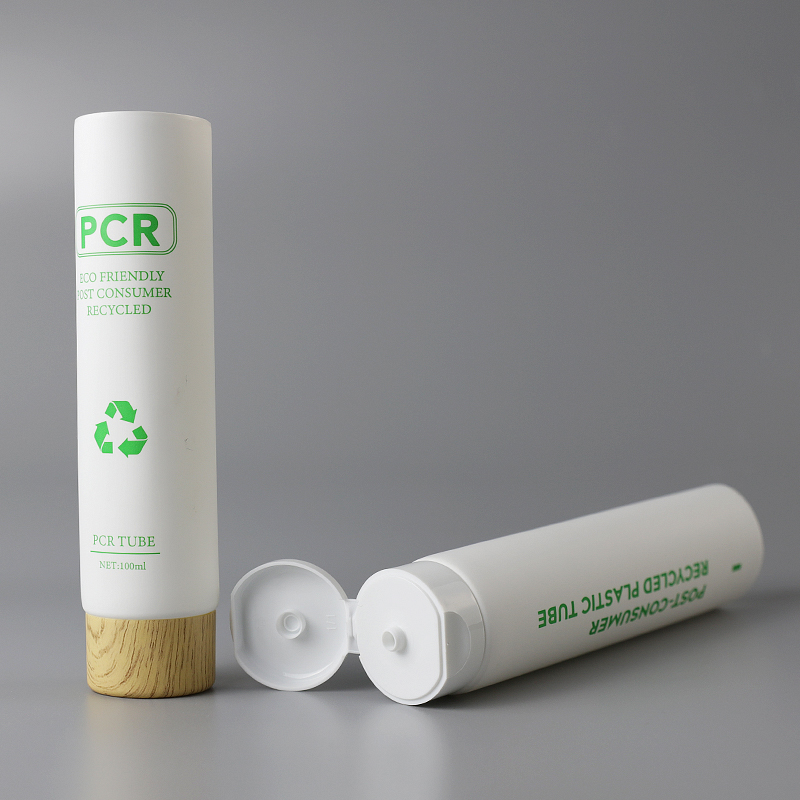
- TU06 PCR Cosmetic Tube: listed as a PCR tube. Confirm recycled-content level and calculation scope.
Product-page descriptions do not replace project-specific barrier and compatibility data.

How to Run the Comparison in Practice
- List the formula risks. Name oxidation, water loss, fragrance change, or light sensitivity, if they apply, and say what evidence would show whether a risk is real.
- Request the specifications. Ask for the layer sequence, grades, thicknesses, and tolerances of each candidate.
- Align the quotes. Match capacity, closure, decoration, and quantity before comparing prices.
- Test the finished tube. Run the filled-pack program with the formula, covering mass change, leakage, appearance, and dispensing.
- Decide on evidence. Choose the simpler wall if it meets the requirement, and the more complex wall only where the data supports it.
Red Flags in Supplier Claims
- A high-barrier claim with no stated test method or conditions.
- Barrier data for a film that is presented as proof for the tube.
- A recyclability claim for the whole tube with no material breakdown.
- A request to approve the structure before testing is possible.
Documents to Put in the Approval File
Whichever wall you choose, keep the evidence together so a later change can be judged against it.
- The layer sequence, grades, thicknesses, and tolerances of the approved tube.
- Barrier test reports, with the method, units, and conditions stated.
- The filled-pack stability results for your formula.
- A material breakdown of the body, shoulder, cap, and any liner, pump, or decoration.
- The matched quotation, with tooling, samples, testing, and production costs listed separately.
- A written agreement that the supplier will notify you of changes to resin, layers, or closures.
When a change is proposed, compare it with this file before approving it.
FAQ
Is a multilayer tube always better?
No. It is better only where its measured performance meets a specific formula need.
Can a multilayer tube be recycled?
It depends on the layer composition and the local system. Ask for a package-specific assessment.
What triggers revalidation?
Changes to resin, layer thickness, recycled content, closure, decoration, or formula.
Keep Reading
- Category: Cosmetic Tube range
Request samples · Request a quote:
contact Topfeelpack
Post time: Nov-24-2026
